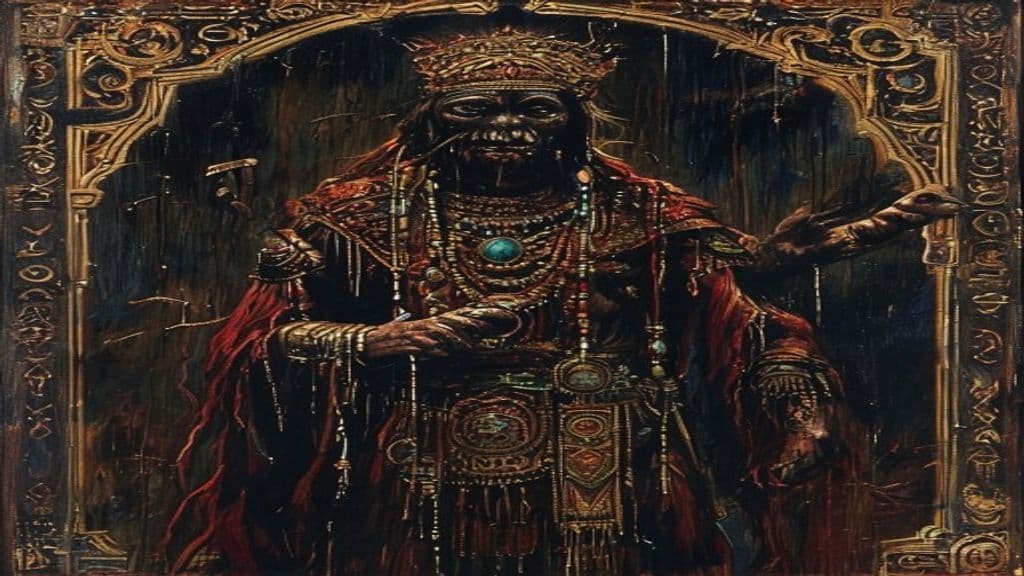
Yanantin is a fundamental concept in Andean thought, emphasizing balance and harmony between opposing forces. It reflects the indigenous worldview's emphasis on equilibrium between yin and yang-like dualisms.
There is no physical description of Yanantin as it is a philosophical concept rather than an entity with a tangible form.
Yanantin does not possess abilities in the classical sense, but serves as a guiding principle for understanding interconnectedness and bringing seemingly conflicting opposites into harmony.
Huacas (Mountain Deities)
In the Quechua mythology, Huacas are mountain deities revered as protectors of regional ethnicities and central figures in myths. (Note: 1. Power tier: Primordial seems too high given that Huacas are mountain deities and not cosmic entities. 2. Appearance: Should be added that there is no physical description provided for the Huacas, b)
Inkarri
Supernatural vengeful entity that resurrects and avenges Atahualpa's death, restoring balance between Pacha Mama and humanity. (Note: 1. Power tier: Inkarri's abilities don't suggest Primordial level; it seems more like Greater or Ancient. 2. Appearance: Add a description of what Inkarri looks like after resurrecting (e.g., how its )
Pachakutic
Transformative event in Inca tradition, marking the end of one era and the beginning of another. (Note: - Power tier: Primordial (not Greater), as it represents a cosmic change in the sun or Earth's movement, which is on a universal scale. - Appearance: Remove statement about no physical description exi)
Paqariq Tampu
Sacred cave and birthplace of the Ayar Brothers, ancestral beings responsible for creating humans in Inca mythology. (Note: * Power tier should be Ancient instead of Primordial, as the Ayar Brothers are considered ancestral beings but not cosmic entities. * Origin story is accurate, but it could be more specific: "Accordin)
Qantu (Cantua buxifolia)
A culturally significant evergreen shrub with pink flowers in the Inca tradition. (Note: 1. Add origin story based on the Inca tradition. 2. Change Power tier to Greater: Qantu's cultural significance, association with Andean shamanism, and connection between music and flowers suggest a m)
Taki Unquy
A millenarian movement in Inca tradition that believed themselves to be reincarnations of ancient rulers and gods, seeking to restore their ancestors' rule over the Andean regions. (Note: * Power tier: Primordial is not plausible given the described abilities (resistance through armed conflict, purification rituals, and cultural revitalization efforts). A more fitting power tier would )
Yamata (Yama) — King of the Dead (Yamadut) (Tibetan) [No evidence in supplied sources]
The supplied sources do not document a Tibetan supernatural being named Yamata, Yama, or Yamadut. The materials provided refer only to (a) a 1919 Hungarian silent film titled "Yamata" and (b) a biological genus "Yamatarotes"; neither source supplies information about a Tibetan king of the dead or related folkloric tradition.
Yamawaro
A class of mountain-dwelling yōkai reported in western Japan (especially Kyūshū) that appear as childlike humanoids. They function as explanatory agents for strange mountain phenomena, act as tricksters who harass livestock or intrude on houses and baths, and sometimes help woodcutters in return for exacting food or drink offerings. Many local traditions identify them as kappa that seasonally migrate between rivers and mountains.
Yamunā
Yamunā is both the major North Indian river (a principal tributary of the Ganges) and its personified Hindu goddess. She appears in scripture and devotional literature (early as Yami, later as Kalindi), is venerated on ghats and at pilgrimage sites such as the Triveni Sangam, and figures in Vaishnava accounts linking her to Krishna.
Yaoguai
Yaoguai is a broad, catch‑all category of uncanny supernatural beings in Chinese folklore and mythology, defined by possession of supernatural powers and by being weird, strange, or unnatural. They are associated with transformation and enchantment and are often reported to dwell on the margins of human settlement where they cause mischief, unexplainable phenomena, and sometimes harm.
Yatagarasu
Yatagarasu (八咫烏) is a divine crow in Japanese myth and Shinto practice that functions as a heavenly messenger and guide, most famously directing the legendary Emperor Jimmu's eastern expedition. Early narrative sources differ on the sender (Kojiki says Takamimusubi; Nihon Shoki says Amaterasu), and the bird later absorbed continental three‑legged solar‑crow imagery in Heian-period texts.
Yato-no-kami
Yato-no-kami (夜刀の神) are local snake deities attested in the Hitachi no Kuni Fudoki tradition, described as araburu-kami (rough, aggressive kami) who lived in fields near the government office of Namegata county and who were both dangerous to households and could be driven off or enshrined by human agents.
Community Record
- [1]Yanantinwiki