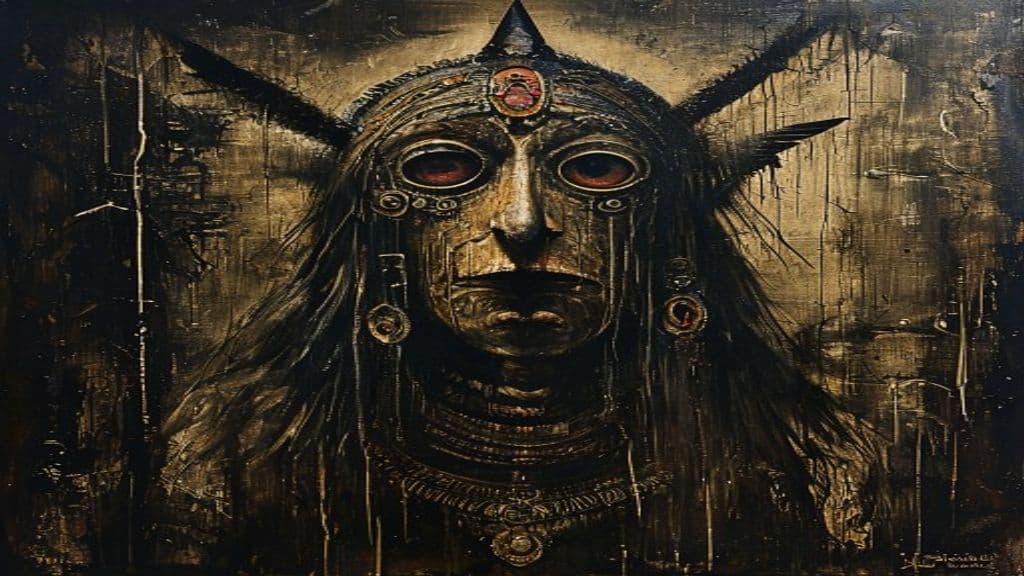
Pachakutic represents a change in the cosmos, specifically the sun or Earth's movement, which brings about a new cycle of creation and renewal. It marks the completion of cycles of creation and renewal, signaling the start of new eras.
No physical description exists for Pachakutic; it is described as an event or phenomenon rather than a being with a discernible form.
Pachakutic's transformative power is implicit in its ability to bring about significant changes in the world, including the end of one era and the beginning of another. Its occurrence is associated with geological changes, astronomical events, or possibly even metaphorical transformative processes.
Huacas (Mountain Deities)
In the Quechua mythology, Huacas are mountain deities revered as protectors of regional ethnicities and central figures in myths. (Note: 1. Power tier: Primordial seems too high given that Huacas are mountain deities and not cosmic entities. 2. Appearance: Should be added that there is no physical description provided for the Huacas, b)
Inkarri
Supernatural vengeful entity that resurrects and avenges Atahualpa's death, restoring balance between Pacha Mama and humanity. (Note: 1. Power tier: Inkarri's abilities don't suggest Primordial level; it seems more like Greater or Ancient. 2. Appearance: Add a description of what Inkarri looks like after resurrecting (e.g., how its )
Paqariq Tampu
Sacred cave and birthplace of the Ayar Brothers, ancestral beings responsible for creating humans in Inca mythology. (Note: * Power tier should be Ancient instead of Primordial, as the Ayar Brothers are considered ancestral beings but not cosmic entities. * Origin story is accurate, but it could be more specific: "Accordin)
Qantu (Cantua buxifolia)
A culturally significant evergreen shrub with pink flowers in the Inca tradition. (Note: 1. Add origin story based on the Inca tradition. 2. Change Power tier to Greater: Qantu's cultural significance, association with Andean shamanism, and connection between music and flowers suggest a m)
Taki Unquy
A millenarian movement in Inca tradition that believed themselves to be reincarnations of ancient rulers and gods, seeking to restore their ancestors' rule over the Andean regions. (Note: * Power tier: Primordial is not plausible given the described abilities (resistance through armed conflict, purification rituals, and cultural revitalization efforts). A more fitting power tier would )
Yanantin
In Inca tradition, Yanantin is a philosophical concept representing the interdependent and essential parts of a harmonious whole, based on complementary opposites. (Note: 1. Power tier should be Ancient (deity-level), as it's a fundamental concept in Andean thought. 2. The appearance section is correct ("no physical description"). 3. Abilities section needs to reflect )
Pacha Mama
Pacha Mama is an Andean/Inca mother-deity representing 'space-time' and a universal, life-sustaining principle tied to earth, fertility, and the totality of the cosmos. Revered across the Andes, she functions as a foundational generative presence from which major cosmological principles are said to trace their origin.
Pachacuti
Pachacuti is the name of the ninth Sapa Inca credited in Inca historiography with transforming the Cuzco chiefdom into the Tawantinsuyu empire and, simultaneously, a Quechua cosmological concept meaning a 'turning of the world' (pacha-kutiy). Sources present him both as a (possibly historic) ruler and as an ideological/cosmogonic signifier for epochal change.
Pachacámac
Pachacámac (Quechua: Pachakamaq) is both the name of a major pre-Columbian pilgrimage and temple complex on the central Peruvian coast and the creator deity associated with that sacred precinct. Sources portray Pachakamaq as an earth-making figure within regional Andean cosmologies whose cult endured at the Pachacámac site from ca. A.D. 200 through the late pre-Columbian period and was incorporated, in a subordinate role, into Inca religious administration.
Padma (Vishnu)
One of the four attributes of the Hindu deity Vishnu, representing creation and birth. (Note: * Power tier should be Ancient, as it represents a deity-level aspect of Vishnu. * Abilities: Padma doesn't have distinct abilities itself; the description should be revised to reflect its association)
Padmaprabha
Padmaprabha is the sixth tirthankara (ford-maker) of the current Jain cosmic age (avasarpini). A perfected arihant who attained omniscience (Kevala Jnana) and later moksha, he is venerated in Jain devotion and iconography, especially by his red lotus emblem and meditative depiction.
Padmāvatī
Padmāvatī is a polyvalent South Asian female name and identity applied across Hindu, Jain, and literary-legendary contexts — used for a Vaishnava consort (Alamelu Manga), a Jain yakṣiṇī (attendant goddess), and multiple legendary or historical queens and heroines (notably the Rani Padmini/Padmāvati of the Padmavat tradition). The figure functions variously as a devotional goddess, attendant protective figure in Jainism, and as a narrative heroine across classical and modern media.
Community Record
- [1]Pachakutic. Wikipediawiki