
The tarand appears in the corpus of classical natural-history writers rather than in a mythic cosmogony: Aristotle names a rare beast called tarandos in Scythia that changes the colour of its hair to its surroundings; Pliny and Aelian repeat and expand the marvel in their natural histories (placing it in Scythia), and Solinus records a related-sounding Parandrus in Aethiopia. Medieval and Renaissance authors (e.g., the York Mystery Cycle, Rabelais) inherit and adapt the creature from these classical attestations, using it both as a natural wonder and as a rhetorical or allegorical trope.
Classical descriptions present a large, sturdy ungulate about the size of an ox or bullock with a stag-like head bearing branched/branching horns, cloven hooves, very long hair likened to that of a bear, and an exceptionally tough hide. Pliny and later writers emphasize the hide's toughness (noting its use in making breast-plates and covering shields). The overall impression in the sources is of a heavily built, hairy, horned beast with armour-like skin.
The central extraordinary trait reported in the sources is the ability to change external colour — Aristotle and Pliny describe the tarand taking on the colours of trees, shrubs, grass, rocks and the ground so as to be difficult to catch. Pliny explicitly compares the tarand to the chameleon and to other colour-changing animals (polypus, certain wolves/Lycaon). Aelian and Rabelais amplify the account: Aelian stresses transformation of hair as well as skin into many colours, and Rabelais gives anecdotal, quasi-volitional instances (the animal turning grey near one person, red near another; shifting through green, yellow, blue, tawny and purple over time). The classical authors treat the trait as a natural marvel rather than a supernatural power; behaviourally the colour-change is often linked to fear and hiding.
Weaknesses
None recorded.
Wards
- otherHide used as armor by humans (breast-plates, shield coverings)
Pishacha
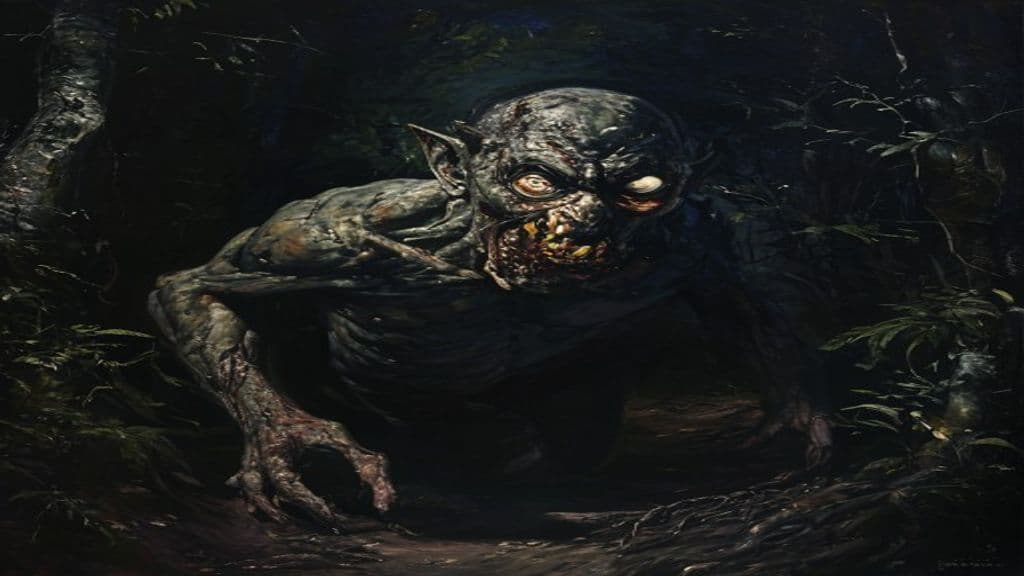
Flesh-eating spirits of Hindu mythology that haunt cremation grounds and are associated with disease, madness, and possession. The lowest class of demon in the Vedic hierarchy.
Yaksha
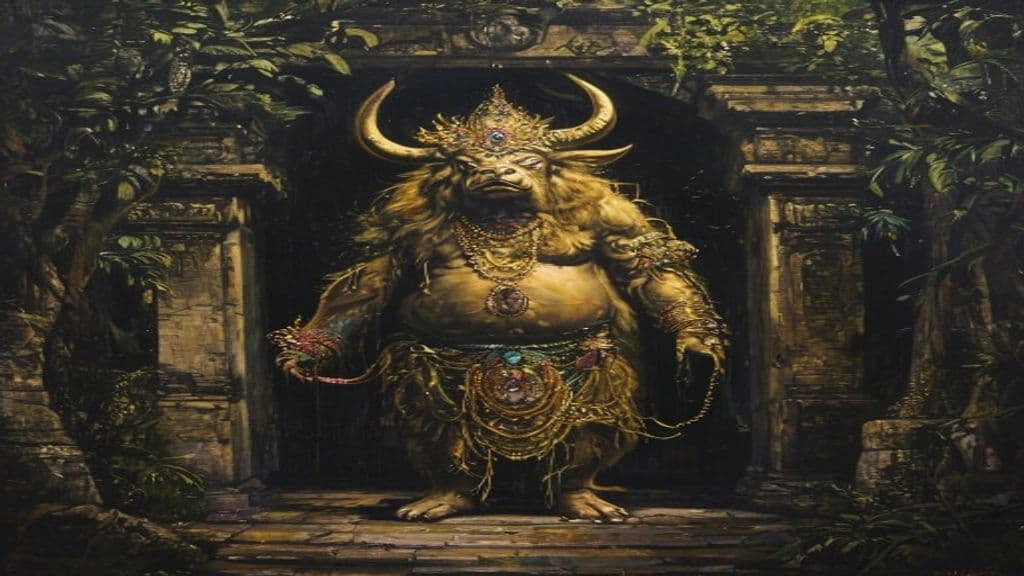
Nature spirits of Hindu, Buddhist, and Jain cosmology — guardians of forests, treasures, and wilderness. Ambivalent beings, capable of great benevolence to the respectful and terrible harm to the greedy.
Taotao Mo'na
Taotao Mo'na (also taotaomona, taotaomo'na) are ancestral spirits in Chamorro belief on the Mariana Islands, regarded as the "people before" who inhabit and protect wild places and mountains. They function as landscape guardians whose favor or displeasure affects living people and whose presence is negotiated through cultural protocols and specialist healers.
Taphians
A mytho-historical island people of the Ionian Sea in Homeric and later Greek tradition, the Taphians are portrayed as seafaring, piratical islanders who engage in raiding, slave-trading, and metal commerce and who appear in heroic-age genealogies and episodic narratives (not as supernatural beings).
Tapio
Tapio is attested in the supplied sources as the name of "a god or spirit in Eastern Finnish mythology" and is also widely used as a modern Finnish personal name and in toponymy and cultural references. The provided materials contain no further folkloric detail about Tapio's appearance, duties, or rituals.
Tapio
Tapio is a Finnish forest spirit and personification of the woods who functions as the owner/ruler of forests and a recipient of hunters' prayers and offerings. He appears both as an individualized forest-being with household members (wife Mielikki, children such as Tellervo and Nyyrikki) and, in runic song usage, as a synonym for the forest itself.
Tarakamaya War
Conflict sparked by the elopement of Tara, consort of Brihaspati, in Hindu mythology. (Note: 1. Power tier: Primordial seems excessive; given that it's an "ancient conflict" (Source 1), a more fitting power tier would be Ancient. 2. Abilities: Although no specific powers or abilities are attr)
Taranaki (Tuturu)
Taranaki (Tuturu) is a Māori iwi (tribal group) of Aotearoa/New Zealand whose identity is anchored in the Taranaki region and Mount Taranaki. The iwi has a long-standing presence in the region, were active in 19th‑century conflicts (the Taranaki Wars), and participate in contemporary Treaty settlement and political processes.
Taranga
Taranga is a maternal figure in Māori whakapapa best known as the mother of the culture-hero Māui (Māui-tikitiki-a-Taranga). In the accounts supplied she appears in the origin episode of Māui’s birth and abandonment at the sea and functions primarily as a genealogical progenitor rather than an independently characterised supernatural being.
Taranis
Taranis is a deity of the ancient Celtic (principally Gallic) religious sphere attested in Roman-era literary commentary and in inscriptions; the figure is principally associated by etymology and interpretatio with thunder and sky-power and is named alongside other native gods in classical sources.
Tariaksuq
Tariaksuq are Inuit 'shadow-people'—humanoid beings associated with shadows, invisibility, and a separate realm. They are described as socially parallel to humans (houses, families, tools) yet are not seen when looked at directly, instead disappearing into their own world or appearing only as shadows; they reportedly become visible if killed, said to appear as half-man, half-caribou.
Tarqeq
Tarqeq is presented in two overlapping registers in the provided sources: (A) the modern astronomical name for a small prograde satellite of Saturn (Saturn LII), and (B) the Inuit moon spirit / personification of the Moon, a named lunar figure in Inuit lexical and mythic material. Modern astronomical naming explicitly draws from the Inuit lunar figure.
Tarqiup Inua
Tarqiup Inua (also Tatqim Iñua) is the lunar spirit or 'Master of the Moon' in Inuit thought, described as a man — a mighty hunter — who dwells in the skies and is associated with fertility, moral authority, and (for Alaskan Inuit) the animals.
Tartalo
A one-eyed giant from Basque mythology, known for enormous strength and hunting habits. (Note: - Power tier: Primordial (due to similarity with a Greek mythological figure, suggesting a more cosmic or archetypal power level) - Abilities: Expand on eating habits, specifically mentioning the cons)
Community Record
- [1]Aristotle — Natural-history attestations (summary). Aristotle, referenced in modern summaries: description of 'tarandos' in Scythia that changes the colour of its hair according to its surroundingsliterary
- [2]Pliny the Elder — Natural History (summary). Pliny, as summarized in modern sources: Tarandus in Scythia, ox-sized, stag-like head with branched horns, bear-like hair, hide used for breast-plates, changes colour like the chameleonliterary
- [3]Aelian — On the Characteristics of Animals (summary). Aelian: account stressing transformation of hair and skin into many colours and noting Scythians' use of hide for shieldsliterary
- [4]Solinus — Parandrus in Aethiopia (summary). Solinus' mention of a similarly named Parandrus placed in Aethiopia (uncertain identity with Scythian tarand)literary
- [5]Rabelais — Pantagruel (summary). Rabelais: Renaissance literary adaptation describing ox-sized tarand, bear-like hair, anecdotal colour shifts responsive to surroundings and persons; compares hair-changing to chameleon and polypusliterary
- [6]Wikipedia: Tarand (animal). Modern encyclopedia summary consolidating classical and later attestations (Aristotle, Pliny, Aelian, Solinus, Rabelais, York Mystery Cycle)wiki