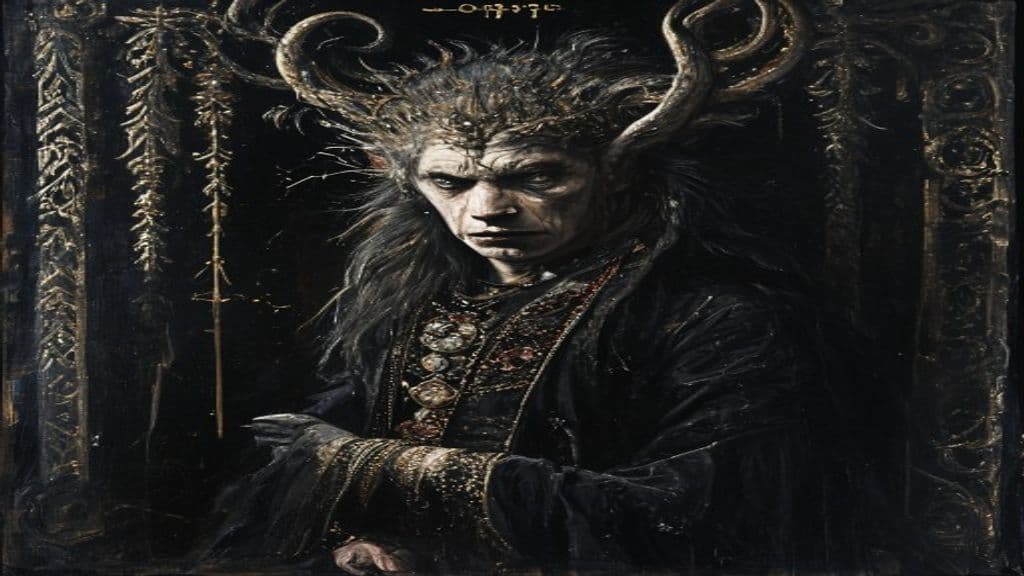
The Tietäjä reflects the worldview of traditional Finnic culture, where wisdom and knowledge were highly valued.
No physical description is provided in the Wikipedia article.
Their supernatural powers arise from their great knowledge.
Altgermanische Religionsgeschichte
A historical survey of Germanic religious history, providing an overview of the pantheon of gods and goddesses. (Note: - Power tier is not applicable to historical surveys - The article should reflect that it's a historical survey, not an entity with abilities or appearance - Consider adding information on the signifi)
Tiberinus
Tiberinus is the Roman name attested for the divine personification of the River Tiber and separately for a legendary king, Tiberinus Silvius, listed among the early kings of Alba Longa. The name thus appears in two registers of Roman tradition: as a river-god tied to Rome's central watercourse and as a figure in mytho-historical genealogies.
Tibetan Mountain Spirit (Lu / Srin)
Lu (klu) and srin (srin / srin sngon) are classes of local mountain, earth, and water-associated spirits in Tibetan cosmology. They function as site deities, ancestral/household spirits, and ambiguous local powers that may be beneficent or dangerous depending on ritual relations; tantric adepts in Buddhist tradition are recorded as subjugating or oath-binding them into protector roles.
Tibetan Rakshasa (Dämo / Takma)
Rakshasa (Sanskrit: rākṣasa) in the supplied materials appears as a class of malevolent non‑human beings — rendered in English as “demons” or “ogres” — known from South Asian epic literature and referenced in Himalayan/Tibetan geographic and popular materials. The sources do not provide a single, systematic Tibetan doctrinal account; instead rakshasas appear across epic narrative (e.g., Ravana) and place‑names (e.g., Lake Rākṣasatāla / Rakshastal), suggesting their presence in a shared South Asian–Himalayan imagination as antagonistic beings associated with danger and certain locales.
Tiddalik the Frog
Tiddalik is a giant frog figure from Australian Aboriginal Dreaming (Dreamtime) narratives whose waking thirst causes him to drink all local fresh water; other animals make him laugh and so release the water, restoring rivers and lakes. The story functions as an etiological Dreaming tale explaining drought and the distribution of water and teaches communal response to crisis.
Tieke (tīeke)
Tieke (Māori: tīeke) is the Māori name for the saddleback, a native New Zealand bird (genus Philesturnus) of the family Callaeidae. In the provided sources it is treated primarily as a species of cultural and natural-historical significance — appearing in place-names and cited in at least one account of ritual invocation for rain — rather than as a distinct supernatural personage.
Tiera
In Finnish mythology and runic songs, Tiera is a male warrior entity with unknown powers and abilities. (Note: - The power tier should be Primordial, as it's unclear what its "powers and abilities" are, but since it's described as appearing in Finnish mythology and runic songs (which are often deeply connected)
Tiferet
Tiferet (תִּפְאֶרֶת, Tif'eret) is the sixth sefirah on the Kabbalistic Tree of Life, a metaphysical emanation or divine attribute that functions as the harmonizing and balancing center among the sefirot, often associated with beauty, glory, and the Sun.
Tiger spirit (Hu jing)
A provisional, research-note reconstruction: no direct primary or secondary sources in the supplied corpus document a discrete Taoist entity named "Hu jing" (虎精). The entry frames how a hypothetical "tiger spirit" might be situated within Chinese yaoguai and Taoist cosmological templates based only on general sources about animal-spirits and Taoist practice.
Tigmamanukan
A Tagalog augural bird — a class of omen-bearing bird (and by extension other animals) read as messages from the creator deity Bathala. Its flight direction and song were interpreted to authorize or forbid journeys and, in some origin myths, a bird identified as the tigmamanukan acts as an agent opening the primordial bamboo.
Tikbalang
A Philippine nature spirit/phantom associated with wild, liminal places; often depicted in later accounts as a tall, lanky half-horse, half-human trickster that can mislead travelers, guard trees or territories, and in some versions be tamed or domesticated by humans.
Tikoloshe (Tokoloshe)
In Nguni (Zulu/Xhosa) belief the tikoloshe is a small, dwarf‑like water spirit invoked as a mischievous or malevolent agent. It is commonly described as an implement of human malice—used to frighten children or to cause illness and even death—and is countered by household precautions (e.g., raising beds) and intervention by spiritual specialists such as sangomas or certain pastors.
Community Record
- [1]Tietäjäwiki