
In Tagalog cosmogony variants recorded in colonial-era sources, a bird identified as the tigmamanukan (in some accounts named Manaul, in others the bird-form of the wind/peace deity Amihan) pecked open a primordial bamboo or otherwise enabled the emergence of the first humans (Malakas and Maganda). Sources differ on whether the bird is a distinct named actor (Manaul) or a form/agent of Amihan; colonial chroniclers and later summaries preserve these variant tellings.
Colonial observers consistently describe the tigmamanukan as blue-plumaged and roughly the size of a thrush or turtledove; several later commentators and modern commentators suggest identification with Asian/Philippine fairy-bluebirds (Irena spp.). Early Spanish chroniclers explicitly noted a 'blue bird, as large as a thrush' or 'as large as a turtledove.' The term tigmamanukan in early sources also functions as a functional class and was sometimes applied more broadly to other omen birds (including certain kingfishers) or to other animals used in augury.
The tigmamanukan's culturally ascribed ability is augury: its flight direction and song are read as a sign of Bathala's will. San Buenaventura's summary records that a flight across a traveler's path to the right (labay) signified success and authorized proceeding, while flight to the left foretold that travelers would not return. In origin narratives the bird acts as an agent of creation (pecking open bamboo). People treated encounters as authoritative divine messages and altered plans accordingly; specialist diviners also performed sacrificial chicken entrail-reading as part of the wider augury complex in which tigmamanukan sightings were interpreted.
Weaknesses
None recorded.
Wards
- ritualcapture-release petition with beak-cutting
- conditionaborting journey on unfavorable omen
Bathalà
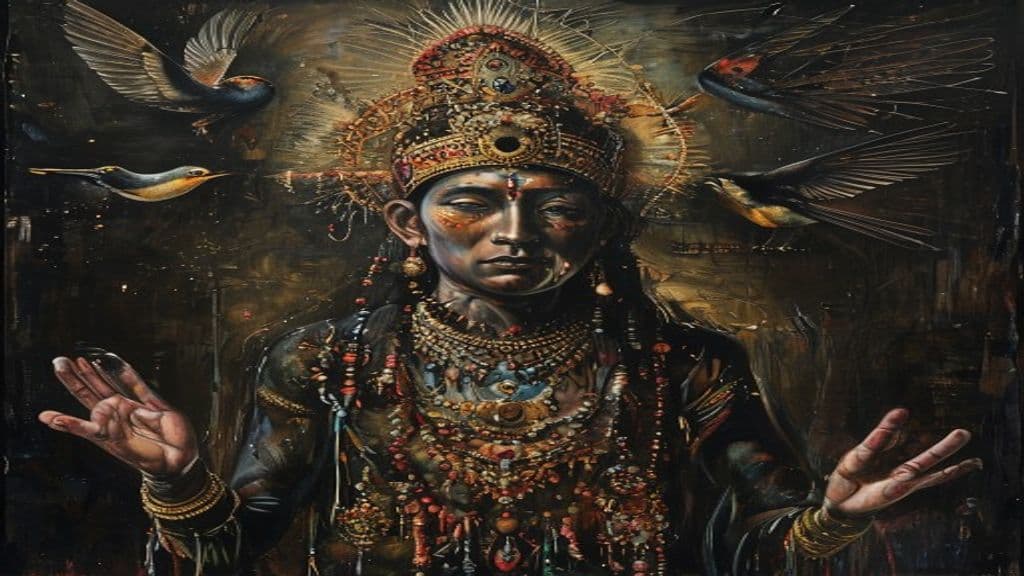
In pre‑colonial Tagalog religion Bathalà (also Maykapál) functions as the transcendent supreme creator-preserver — the originator and ruler of the universe. The lexeme also served as an honorific applied to lesser tutelary spirits and portentous phenomena, and was later syncretized with the Christian Dios after Spanish contact.
Will-o'-the-Wisp
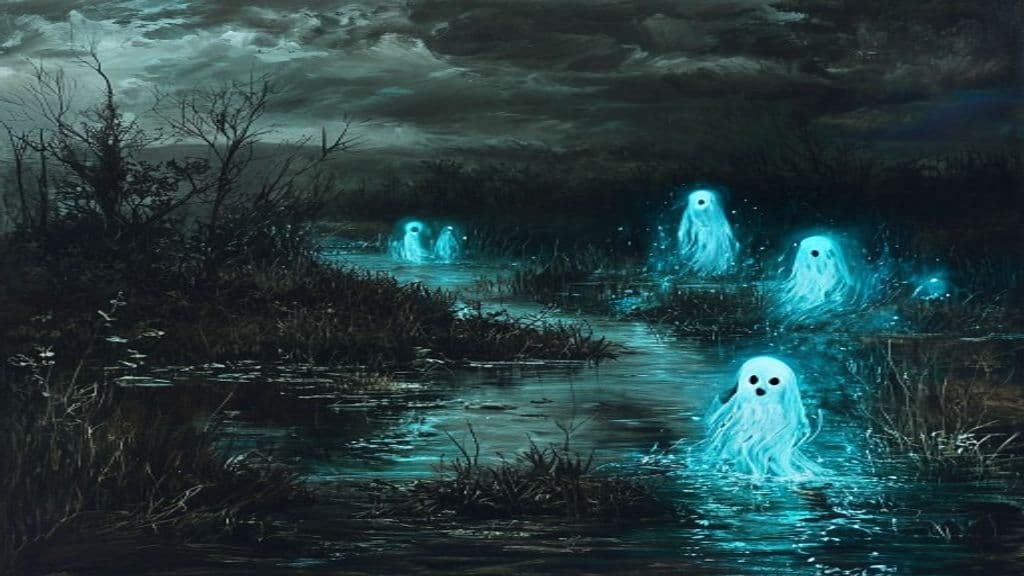
A wandering light seen over marshy ground at night, leading travellers astray into bogs and fens. Possibly a spirit, possibly the soul of the unbaptised dead, possibly the devil himself.
Amihan
Amihan is a figure in Tagalog/Philippine tradition presented both as a bird-deity in origin narratives and as the name for the northeast monsoon season (a cool trade wind). In mythic accounts Amihan appears in the Malakas and Maganda creation story as the bird who frees or rescues the first humans from a bamboo; in cultural usage the same term denotes the recurring amihan season across the Philippines.
Anito
Anito is a category of non‑human and post‑human spiritual beings in indigenous Philippine animistic worldviews, encompassing ancestor spirits, nature spirits/local deities, and sometimes carved effigies (taotao) that house or represent those spirits. They mediate relations between the living and the unseen world, functioning as household guardians, owners of places, intercessors, or occasional agents of harm when offended.
Bakla
Bakla is a Philippine social and gender category—commonly an assigned‑male‑at‑birth person who adopts a feminine gender expression and is often treated as a third gender. Historically some bakla served as indigenous ritual specialists (babaylan, katalonan), but the term itself denotes a social identity, not a supernatural being.
Manaul
Manaul is a birdlike mythic figure in multiple Philippine indigenous traditions, variously portrayed as an omen-bearing bird sent by Bathala or Amihan, a king who guides destinies and instigates cosmic conflict, and a rebellious/cosmogonic agent who creates islands.
Tiera
In Finnish mythology and runic songs, Tiera is a male warrior entity with unknown powers and abilities. (Note: - The power tier should be Primordial, as it's unclear what its "powers and abilities" are, but since it's described as appearing in Finnish mythology and runic songs (which are often deeply connected)
Tietäjä
A magically powerful figure in traditional Finnic culture, possessing supernatural powers derived from great knowledge. (Note: 1. Power tier should be Primordial as "Ancient" is typically reserved for deities and the source doesn't specify otherwise. 2. The sentence in the Origin story could be rephrased to better reflect tha)
Tiferet
Tiferet (תִּפְאֶרֶת, Tif'eret) is the sixth sefirah on the Kabbalistic Tree of Life, a metaphysical emanation or divine attribute that functions as the harmonizing and balancing center among the sefirot, often associated with beauty, glory, and the Sun.
Tiger spirit (Hu jing)
A provisional, research-note reconstruction: no direct primary or secondary sources in the supplied corpus document a discrete Taoist entity named "Hu jing" (虎精). The entry frames how a hypothetical "tiger spirit" might be situated within Chinese yaoguai and Taoist cosmological templates based only on general sources about animal-spirits and Taoist practice.
Tikbalang
A Philippine nature spirit/phantom associated with wild, liminal places; often depicted in later accounts as a tall, lanky half-horse, half-human trickster that can mislead travelers, guard trees or territories, and in some versions be tamed or domesticated by humans.
Tikoloshe (Tokoloshe)
In Nguni (Zulu/Xhosa) belief the tikoloshe is a small, dwarf‑like water spirit invoked as a mischievous or malevolent agent. It is commonly described as an implement of human malice—used to frighten children or to cause illness and even death—and is countered by household precautions (e.g., raising beds) and intervention by spiritual specialists such as sangomas or certain pastors.
Tiktik
Tiktik is a named variant within the Philippine aswang tradition: a feared nocturnal, shape‑shifting predator-type figure treated in folklore and adapted in modern Philippine media. Sources emphasize its placement inside the broader aswang umbrella and a cultural motif linking some aswang variants to ominous birdlike calls.
Timalcus
Timalcus (Ancient Greek: Τίμαλκον) is presented in Greek mythic genealogies as a Megarian prince, son of Megareus and Iphinoe, known primarily as a member of that royal house and as being killed by Theseus during a campaign with the Dioscuri against Aphidnae. Sources are brief and genealogical, and a competing tradition noted by Alcman casts doubt on Theseus' presence in the episode.
Community Record
- [1]Tigmamanukan - Wikipedia. Wikipedia entry 'Tigmamanukan' (summary synthesizing colonial-era sources such as San Buenaventura, Plasencia, Chirino, Colin)wiki
- [2]Wikidata: Tigmamanukan. Wikidata entry Q7801675 for Tigmamanukanother
- [3]Philippine fairy-bluebird - Wikipedia. Wikipedia entry on Irena cyanogastra (used for zoological correlation mentioned in historical identifications)wiki
- [4]Tigmamanukan : The Omen Bird - Mythlok. Mythlok summary article on the Tigmamanukan (compiles colonial accounts and modern commentary)other
- [5]Fr. Juan de Plasencia, 'Customs of the Tagalogs' (as cited). Fr. Juan de Plasencia, Customs of the Tagalogs (1589) — cited in modern summaries noting returning home on certain omen-encountersfolk
- [6]San Buenaventura (1613) entry (as cited). San Buenaventura (1613) — cited in summaries recording the right/left flight omen formula ('labay' = proceed; left = never return)folk
- [7]Pedro Chirino and Francisco Colin (as cited). Pedro Chirino (1604) and Francisco Colin (1663) — colonial chroniclers cited in summaries describing Tagalog reverence for a blue bird called tigmamanuquin and its association with Bathalafolk