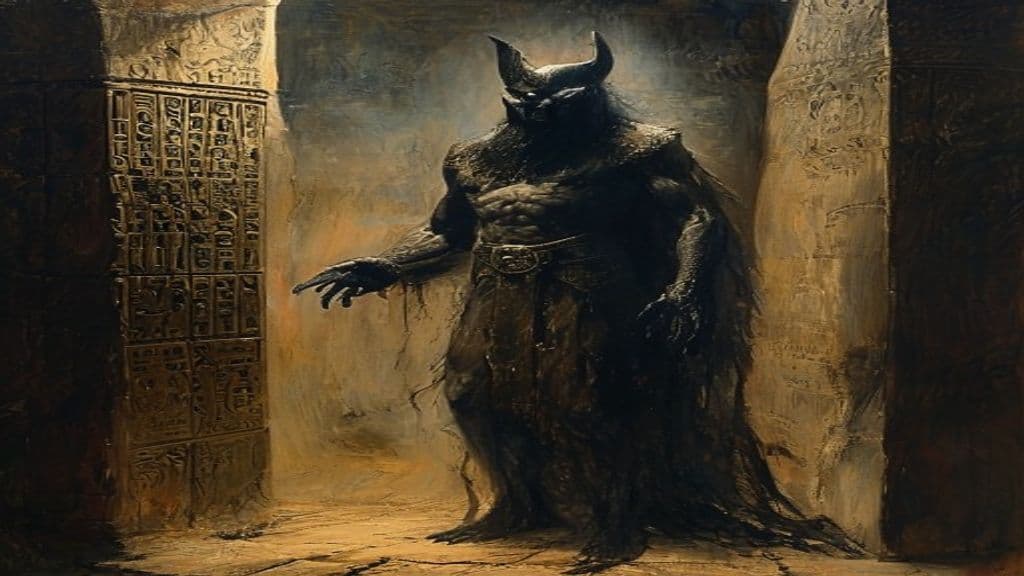
The udug are described in Mesopotamian texts as beings associated with the Kur (the underworld) and are presented as distinct from the gods (dingir/Anu-nna-Ki and the Igigi). Sources do not supply a single consolidated origin myth; rather, various texts portray them as underworld‑born or underworld‑linked agents, and the category functions both as a generic label for demonic presences and as a name applied to specific named shadow‑demons.
No secure pictorial type for the udug is attested in the surviving material; sources state that no definitive visual representations have been identified. In incantatory descriptions udug are characterized as shadowlike and formless — 'the one who... was not called by name... never appeared with a form' — and are associated with darkness, absence of light, and occasionally with motifs such as poison or an overpowering voice. Some scholars have tentatively proposed possible depictions (e.g., figures on cylinder seals or paired images with Lama at doorways), but these identifications remain interpretive and not definitive.
In the exorcistic corpus the 'evil udug' is primarily linked to causing physical and mental illness and misfortune; many incantations focus on driving out the evil udug to cure disease. Textual descriptions emphasize a shadowlike, formless presence, venom/poison, and a deafening voice. Certain named demons within the broader category (e.g., Mukīl rēš lemutti) are described as capable of possessing or afflicting human bodies; possession is therefore attested for some allied or named entities rather than as a universally detailed attribute in every text. The tradition also records 'good udug' invoked as protective allies against hostile udug.
Weaknesses
- ritualudug-ḫul / utukkū lemnūtū (exorcistic incantations)
- ritualinvocation of a 'good udug' (protective counterpart)
- ritualcalling of protective counterparts such as 'good galla' as paired opposition
Wards
- ritualudug-ḫul (Sumerian exorcism corpus)
- ritualutukkū lemnūtū (Akkadian exorcism corpus)
- otherplacement/invocation of protective figures (interpretive evidence for images at doorways)
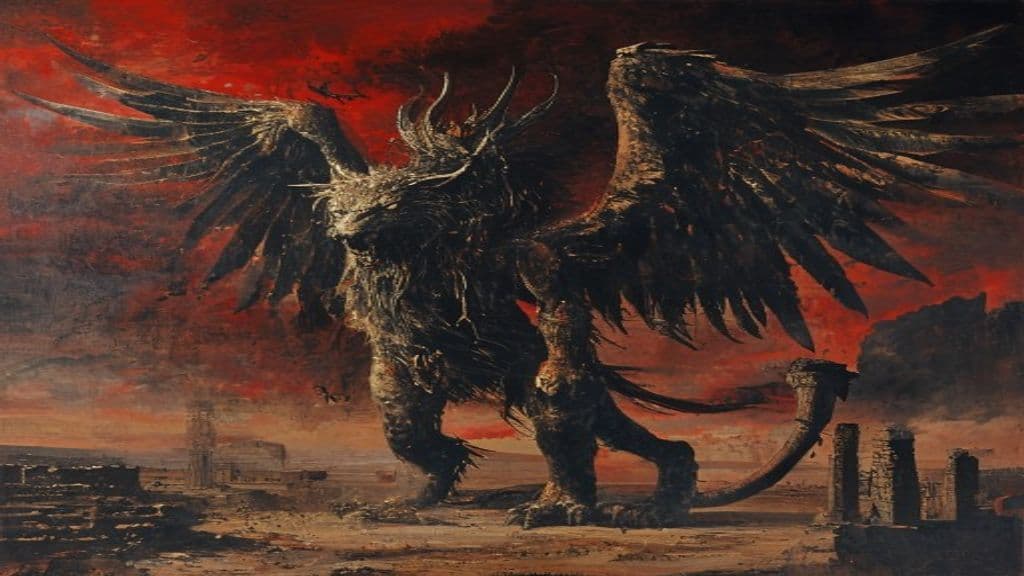
Pazuzu
The king of the wind demons of ancient Mesopotamia, lord of the southwest wind — paradoxically invoked as a protector against Lamashtu and other demons despite being evil himself.
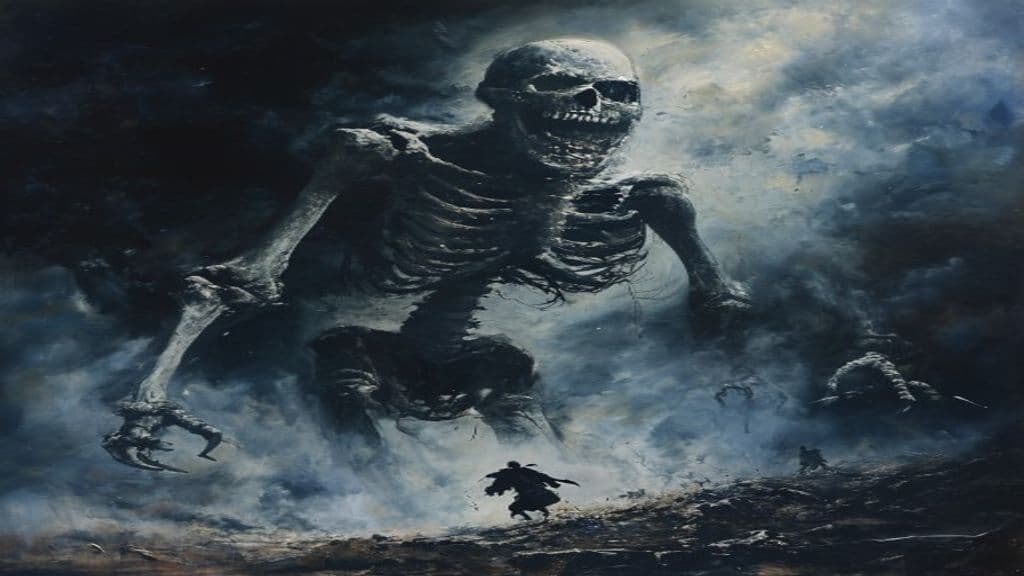
Gashadokuro
A fifteen-times-human-height skeletal yokai formed from the bones of those who starved to death or died on battlefields, their unburied remains fused together into a hungry colossus.
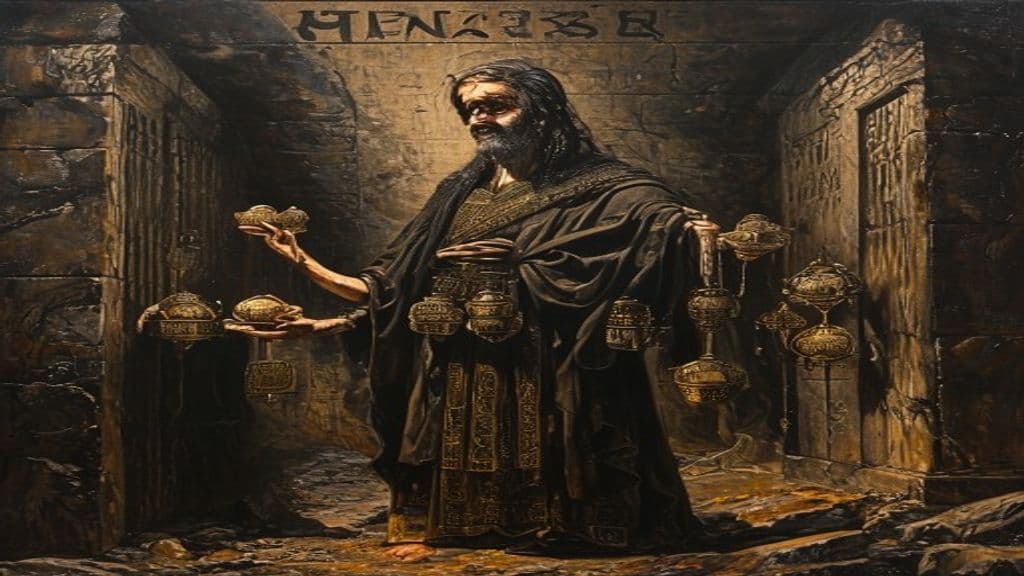
Namtar
The Sumerian god-demon of fate and disease, vizier of the Underworld who carries sixty diseases and acts as herald of death — he who determines the day of dying.
Adad
Adad (also Hadad, Haddad; Sumerian Iškur) is the storm- and rain-deity attested in ancient Mesopotamian and Canaanite religious contexts. Sources identify him as a principal weather god whose domain is storms and rainfall and whose name appears across multiple Near Eastern languages and sites, including Ebla (as Hadda, c. 2500 BCE).
Adapa
Adapa is a mythic figure from ancient Mesopotamian (Sumerian and Akkadian) literature: a mortal fisherman and temple sage of Ea at Eridu endowed with exceptional wisdom. He appears in a fragmentary tale in which he breaks the wings of the south wind and is summoned to the divine court; his name was later invoked in exorcistic and ritual contexts as an authoritative identity.
Aga of Kish
Aga of Kish (Aga, Agga, Akka) is an Early Dynastic Mesopotamian king recorded in the Sumerian King List, the Tummal Inscription, epigraphic objects, and the Sumerian poem "Gilgamesh and Aga." He functions in texts as a historical/legendary political actor who attempted hegemonic demands on Uruk and was ultimately captured and released by Gilgamesh.
Akhkhazu
Akhkhazu (also Ahhazu; Sumerian Dimme-kur) is an Akkadian-era Mesopotamian malignant spirit described as a demon of jaundice who 'seizes' victims, brings fever and plagues, and is cited in later summaries as one member of a triad with Labasu and Labartu. Later popular summaries also describe her as preying on nursing infants while mothers slept.
Alulim
Alulim is the legendary antediluvian 'first king' of Eridu in Mesopotamian tradition, presented in king lists and mythic compositions as the initial ruler appointed by the gods. He functions etiologically to explain the origin of kingship and, in late ritual texts, is invoked in agricultural incantations associated with driving off field pests.
Alû (Alu)
A named lemma attested in modern reference lists as 'ALU / Alu', but for which the supplied research corpus contains no substantive primary- or secondary-source information about nature, appearance, powers, or rituals in Mesopotamian tradition.
Ama-arḫuš
Ama-arḫuš is attested in Mesopotamian sources as a divine figure associated with compassion and healing. She is presented both as an independent goddess and as an epithet applied to other goddesses (notably as a title designating them compassionate, for example in association with Gula).
Amurru (Martu)
Amurru, Sumerian Martu, is a Mesopotamian deity who functions as the divine personification of the Amorites. Originating in Mesopotamian textual practice, he is associated with the steppe and mountains, depicted with a crooked staff, portrayed in hymnography as warlike and lightning-armed, and from the Old Babylonian period acquires a prominent exorcistic cultic role.
Ancestors of Enlil (Enki-Ninki deities)
A sequence of Sumerian divine pairs (en-/nin- names) conceived as the primordial ancestors culminating in Enlil; chiefly attested in god lists and invoked as authoritative primordial names in ritual, especially in incantations and exorcisms.
Anshar
Anshar is a Mesopotamian primordial deity whose name (Cuneiform AN.ŠÁR) literally means "whole sky" or "the whole heaven." He functions as an abstract ancestral figure in theogonic genealogies (not actively worshiped as a regular cult deity) and appears in literary contexts—most notably the Enūma Eliš—and in god lists where he legitimizes later supreme gods.
Anu
Anu (Sumerian An; Akkadian Anu/Anum) is the divine personification of the sky in ancient Mesopotamian religion, traditionally ranked at the top of god‑lists as the source of heavenly authority (anûtu/anuti) and the fount of legitimate rule for gods and kings. Though supreme in genealogies and astronomical schema, many periods portray him as a relatively passive or figurehead deity whose active cultic role is limited until a late Seleucid reinvention in Uruk.
Anunnaki
A variable collective of major deities in ancient Sumerian, Akkadian, Assyrian and Babylonian religious literature, described as offspring or descendants linked to the sky god An (Anu) and an earth/mother figure (Ki/Ninhursag). Texts portray them as participants in the divine assembly, decreers of human fate, and in some traditions a group of seven underworld judges; their number, membership, and functions vary across sources.
Community Record
- [1]Udug (Wikipedia). Udug. Wikipedia entry summarizing scholarly literature and primary-text tradition on the Mesopotamian udug and the udug-ḫul corpus.wiki
- [2]Wikidata: Udug. Wikidata entry for Udug, providing linked data identifiers and summary metadata.other
- [3]Electronic Text Corpus of Sumerian Literature — Inana and Bilulu (composite text). ETCSL text resources illustrating uses of udug terminology and related mythic materials referenced in exorcistic tradition.academic
- [4]Electronic Text Corpus of Sumerian Literature — Critical display. ETCSL critical display for Sumerian texts relevant to udug references and incantatory material.academic
- [5]Unicode Cuneiform sign 'udug' information. Unicode metadata and sign identification for the Sumerian cuneiform sign transliterated as udug (U+1231C referenced in source summaries).other