
Uriel appears in Second Book of Esdras (2 Esdras) as the angel sent to Ezra who identifies himself as Uriel (the angelus interpres), and in Ethiopian homiletic narrative he acts at the crucifixion, dipping his wing in Christ's blood and scattering it over Ethiopia, where churches arise where drops fell. Beyond these texts, later apocryphal, Gnostic, kabbalistic and occult sources diversify his origins and roles, sometimes conflating him with other named angels (e.g., Phanuel, Jeremiel) and assigning him functions such as regent of the sun or keeper of the pit.
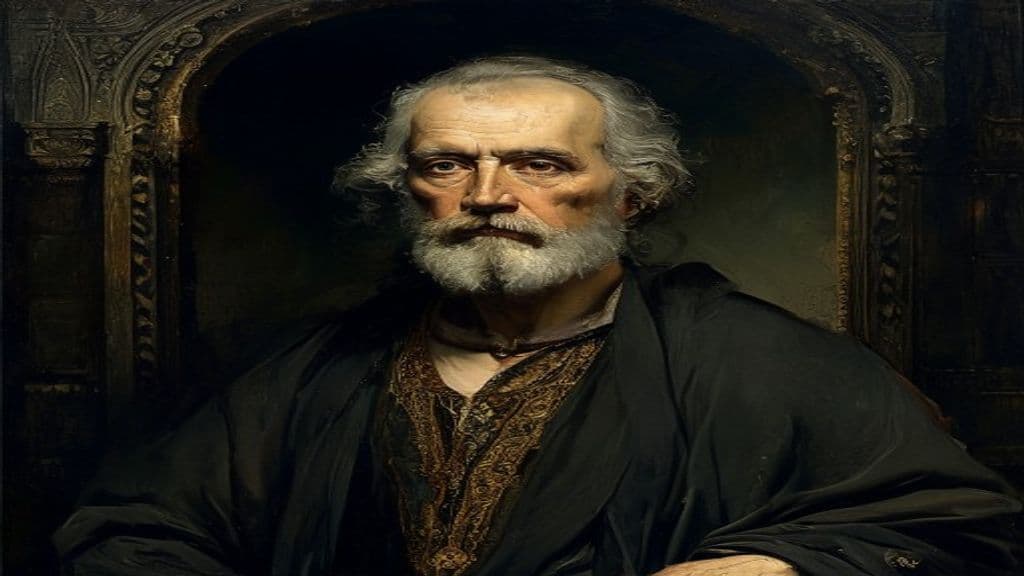
Descriptions vary by source: Uriel is commonly pictured carrying a book or papyrus scroll (symbolizing interpretation and wisdom), in some accounts stands at the Gate of Eden with a fiery sword, and in Ethiopian iconography is shown carrying a chalice filled with Christ's blood. Taxonomic labels in different texts identify him variously as a cherub, a seraph, or a regent of the sun, reflecting divergent imaginations rather than a single fixed corporeal form.
Attested roles include: interpreter of prophecy (angelus interpres to Enoch and Ezra), guide/protector (instructing Ezra in 2 Esdras; said in some traditions to lead Abraham west; rescuing John the Baptist in certain apocryphal gospel accounts), guardian/warden (standing at Eden's gate with a fiery sword; described in some texts as holding the key to the pit/Tartarus at the end-times), agent of repentance/judgment (called angel of repentance and depicted as pitiless in the Apocalypse of Peter), and patron of wisdom, arts and sciences. Gnostic and related texts attribute to him control over spirits or demons in certain cosmogonic episodes (e.g., Secret Book of John account of demons helping Yaldabaoth).
Weaknesses
- otherno consistent weaknesses/wards in sources
Wards
- otherno consistent weaknesses/wards in sources
Michael
Michael is presented in the supplied sources as a masculine given name and disambiguation headword applied to people, historical rulers, cultural works, places, and other uses; the provided material treats it as an onomastic item rather than as a single supernatural being.

Gabriel
A principal heavenly messenger in Jewish, Christian, and Islamic literatures, Gabriel is portrayed as an archangel who reveals and explains divine messages, announces births and divine intent, and executes certain divine judgments in apocalyptic texts.
Upyr
Upyr (variants upir, upiór, upierz, впир/onpyr) is a Slavic and Turkic folkloric revenant-category described in collected Slavic tales and modern summaries as a prototype of the vampire: a corpse-like harmful dead blamed for infant deaths, disease, and other misfortunes in pre-modern communities. The term and concept occupy a boundary category between ordinary dead and active harmful forces in Slavic folk belief and figure in 19th‑century tale-collections and later popularizations.
Ura (not attested as a folkloric entity)
The sources consulted do not document a supernatural being named 'Ura.' The string "Ura" appears across place-names, language names, an English disambiguation page, a Romanian common noun (ură = 'hate'), and as part of a contemporary VTuber stage name, but none of these sources presents a traditional mythic or folkloric agent called Ura.
Urania
Urania is the Greek Muse presiding over astronomy and astrology, daughter of Zeus and Mnemosyne, traditionally portrayed as a heavenly inspirer who elevates human thought toward the cosmos and is depicted with a celestial globe and staff.
Urarina cosmology (mythic actors)
Urarina cosmology is an elaborately animistic system centered on ayahuasca shamanism and the ritualized use of Brugmansia suaveolens; myths record several named supernatural actors (for example, Kuanra and his son Kuanra Kajlaui, and an ayahuasca-associated god and his daughter) who appear in flood/deluge narratives and other origin stories.
Urcuchillay
Urcuchillay is an Inca pastoral deity venerated by herders as a protective llama spirit associated with the wellbeing of herd animals; the name was also applied to the constellation Lyra and in modern times adopted for the star Zeta2 Lyrae.
Urduja
Urduja is a legendary medieval warrior-princess and ruler recorded in Ibn Battuta's 14th-century travel writings and later adopted in Philippine regional and national memory as a proto‑national heroine associated—controversially—with Pangasinan. Sources treat her as a mortal political and military leader whose historicity and geographic provenance (Tawalisi/Kaylukari) are disputed.
Ursa Minor
Ursa Minor is a northern constellation (the 'Lesser Bear' or Little Dipper) historically used as a north marker because its brightest star, Polaris, currently marks the north celestial pole. It appears in multiple cultural star-systems (Greek, Babylonian, Chinese, Inuit) with varying asterism identities and has been included in classical and modern astronomical catalogues.
Urtzi (Basque Tradition)
A pre-Christian sky deity or concept associated with the celestial realm in Basque tradition. (Note: 1. Power tier: Primordial (since it's a "pre-Christian sky deity" and likely on a cosmic level) 2. Abilities: Should be left as "Unknown" since no abilities are mentioned in the source 3. Sensory cues)
Uru (Uros)
An indigenous ethnolinguistic people of the Lake Titicaca region known for living on self-fashioned floating totora‑reed islands and for a material culture tightly bound to lacustrine resources. Their identity, subsistence technology, and social history are documented in ethnographic sources.
Uruaokapuarangi
A great ocean-going canoe used by Māori ancestors to migrate and settle the South Island. (Note: - Power tier: Primordial (since it's a canoe used for migrating and settling an entire island, implying significant influence and power) - Abilities: More detail is needed on how it transported people)
Urutengangana
In Māori mythology, Urutengangana is a god of light and the firstborn child of Ranginui (Sky father) and Papatūānuku (Earth mother). He plays a significant role in the creation myth and balance between light and darkness. (Note: 1. Power tier: Primordial does not necessarily imply Urutengangana has cosmic powers; consider reclassifying to Ancient or leaving unspecified. 2. Origin story: The article states "firstborn child" bu)
Urðr
Urðr is one of the three Norns in Norse mythic tradition, commonly interpreted as the figure associated with the past. She is attested in the Poetic Edda (Völuspá) and in Snorri Sturluson's Prose Edda (Gylfaginning) as one of the fate-determining women who sit at Urðarbrunnr beneath Yggdrasil and measure or mark the destinies of gods and humans.
Community Record
- [1]Uriel - Wikipedia. Wikipedia, 'Uriel' (entry summarizing Uriel in apocryphal, liturgical, and later traditions)wiki
- [2]Wikidata: Uriel. Wikidata entry for Urielwiki