
Born near the Caspian Sea (Gīlān) in the late 11th century (ca. 1077/1078) and later active in Baghdad, ʿAbd al‑Qādir underwent intensive intellectual and mystical training in hagiographical and scholarly accounts; after receiving the khirqa (robe of initiation) he established the tariqa that bears his name (the Qādiriyya). His persona functions historically as both a jurist and mystical master whose recorded discourses and attributed works became the core of a living spiritual lineage and shrine-centered devotional practice.
The supplied sources do not provide a consistent textual physical description. He is sometimes represented in later visual art (e.g., a late Mughal depiction in the Victoria & Albert collection), but no reliable contemporaneous physical traits are given in the provided excerpts.
Described primarily as a preacher, teacher, Hanbali jurist, and Sufi spiritual authority whose majalis (discourses) delivered in the ribat and madrasa of Baghdad attracted very large crowds and many scribes. His works are treated as revelatory spiritual guidance for seekers; hagiography records transmission practices such as receiving the khirqa, and his name functions as the source of institutional baraka and authorization for the Qādiriyya order. The provided materials do not foreground explicit miracle narratives or supernatural powers beyond the saintly authority and efficacy of his teachings and transmitted robe.

Apsara
Celestial dancers and water nymphs of Hindu cosmology — beautiful semi-divine beings who dance at the court of Indra and, by his command, descend to earth to distract sages from excessive asceticism.
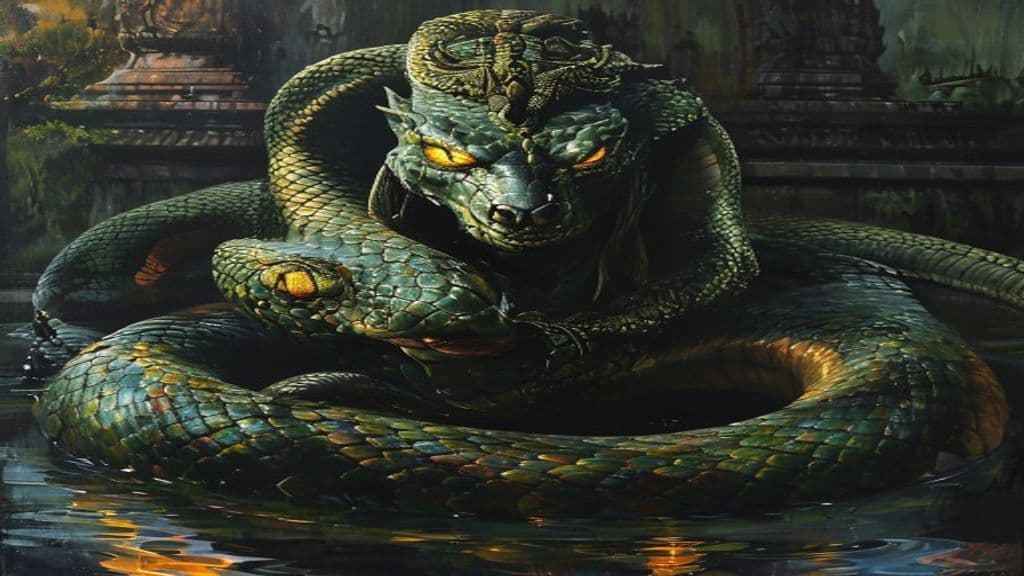
Naga
Divine serpent beings of Hindu, Buddhist, and Jain cosmology — powerful guardians of water, earth, and underground treasures. Revered as deities in South and Southeast Asia.

Baba Yaga
Baba Yaga is an ambivalent female figure of East Slavic folktale tradition, depicted variously as a fearsome, child-eating crone or as a helpful, maternal donor. She is associated with the deep forest, a hut described as standing on chicken legs, and the motific accoutrements of a mortar and pestle.
Abdul Qadir Gilani
A historical 11th–12th century Hanbali jurist, preacher, and Sufi shaykh who became the eponym and principal early figure of the Qadiriyya tariqa; venerated in Sunni Sufi traditions as an Awliya (saint) and often given exalted hagiographical ranks such as Muḥi al‑Dīn and Ghawth.
Al‑Masih ad‑Dajjal
An Islamic eschatological antagonist described in hadith and later apocalyptic literature as a false Messiah who will deceive many before the Day of Judgment. He is depicted variously as an individual man or as a devil in human form, performs counterfeit miracles, and is ultimately defeated by the return of ʿĪsā (Jesus).
Shams al-Ma'arif
A 13th-century grimoire attributed to Ahmad al-Buni, containing knowledge on Arabic magic and esoteric spirituality. (Note: - Power tier should be Ancient (deity-level) instead of Primordial (cosmic), as the abilities described do not imply cosmic powers. - The origin story should clarify that the authorship is disputed, r)
Šumugan
Šumugan (also Šamagan, Šumuqan, Šakkan; logogram 𒀭𒄊) is a Mesopotamian and ancient Syrian pastoral deity who functions as a divine shepherd responsible for herd animals, grazing landscapes, and watering places. Attested in southern Mesopotamian cities and in western Syrian polities, he appears in cultic, literary, and incantatory contexts and occasionally in texts with underworld associations.
Šēp lemutti
Šēp lemutti (Akkadian šēp lemutti) is the ritual idiom and title of a Mesopotamian ritual corpus (not a single named individual) meaning “foot of evil” used for blocking or expelling an intrusive hostile force from a private house. The ritual prescribes manufacture, invocation, and deposition of apotropaic figurines and the invocation of gods and protective beings to prevent sickness, death, and other misfortunes attributed to netherworld demons entering the household.
Žaltys
A household spirit in Lithuanian mythology embodied by the grass snake; sacred to the sun goddess Saulė, kept near the stove as a guardian of the home and a symbol of fertility, and believed to bring good harvest and wealth while bringing misfortune if killed.
ʻAumakua
An ʻaumakua is a Hawaiian personal or family deity that originates as a deified ancestor and functions as a protective and evaluative spirit for a particular family line. It may manifest through various 'spirit vehicles' such as animals or natural objects and acts as guardian and moral arbiter for descendants.
ʻElepaio
The ʻelepaio is a species of bird (monarch flycatcher) endemic to the Hawaiian Islands, known for its adaptability and survival in various environments. (Note: 1. Power tier is not supported by source material; ʻelepaio's abilities and behaviors as a monarch flycatcher species do not imply Minor Spirit classification. 2. Add sensory cues (e.g., distinctive c)
ʿAmm
ʿAmm (Sabaean: 𐩲𐩣, romanized ʿm; Arabic: عمّ) is attested in the Old South Arabian record as a moon god worshipped in the kingdom of Qataban (ancient Yemen) who also bears weather attributes, notably lightning. He figures in Qatabanite cult life with a named consort, Asherah, and an associated oracle-judge, Anbay; the population identified itself as the Banu ʿAmm (“Children of ʿAmm”).
Ḥabīb
Ḥabīb (حبيب) is an angelic figure attested in Islamic Miʿrāj (Night Journey) literature, traditionally described as miraculously composed of both fire and ice and used in exegetical and Sufi writings as a theological sign of divine power to reconcile opposites.
Ḫegir
Ḫegir (also attested Ḫegirnunna) is a Mesopotamian temple deity associated with the state of Lagash and the cult-center Girsu. She functions as a member of the household of Ningirsu and Bau, attested in Early Dynastic and later inscriptions (including Urukagina and Gudea) as a lukur (temple-woman/priestess-like attendant) and at times as a daughter of Ningirsu and Bau.
Ṣàngó (Shango / Chango / Xangô)
Ṣàngó is a major orisha in the Yorùbá pantheon identified as a deified royal ancestor (the third Alaafin of Oyo) and as the spirit who governs thunder, lightning, fire, virility, drumming, dance, strength and justice. He is venerated across Yorubaland and in African-derived New World religions (e.g., Candomblé, Santería, Vodou) where his attributes, symbols and rituals have been adapted and occasionally syncretized with Catholic saints.
Community Record
- [1]Abd al-Qadir al-Jilani (Wikipedia). Wikipedia: Abdul Qadir Gilaniwiki
- [2]Wikidata: Abdul Qadir Gilani (Q307365). Wikidata entry Q307365other
- [3]The Sublime Revelation (al Fath Ar Rabbani) – Shaikh ' Abd Al Qadir Al Jilani (Archive description). Archive: Al Fath Ar Rabbani (62 Discourses)academic
- [4]The Shrine of ʿAbd al‑Qādir al‑Jīlānī in Baghdad & the Shrine of ʿAbd al‑ʿAzīz al‑Jīlānī in ʿAqra (thesis). University of Glasgow thesis: Mapping the multiple orientations of two Qādirī Sufi shrines in Iraqacademic
- [5]Searching for 'Abd al‑Qādir al‑Jīlānī (Substack summary). Substack summary of scholarship and receptionother
- [6]Baghdad during the time of ʿAbd al‑Qādir al‑Jīlānī (Gorgias Press). Gorgias Press contextual studyacademic
- [7]Jilani (wordtrade summary). Wordtrade summary on Jilaniother
- [8]Concerning the Excellent Qualities that are Peculiar to the Month of Ramadan, Shaykh ‘Abd al-Qadir al-Jilani (translation posting). Online translation of a treatise attributed to ʿAbd al‑Qādirother
- [9]The Secret of Secrets by Hadrat Abd Al-Qadir Al-Jilani (Fons Vitae). Modern publication listing of an attributed workother
- [10]AMAR MA'RUF NAHI MUNKAR APPROACH ACCORDING TO AL-JILANI IN KITAB AL-GHUNYAH (journal article). Journal article discussing al‑Jīlānī's approach to enjoining good and forbidding wrongacademic