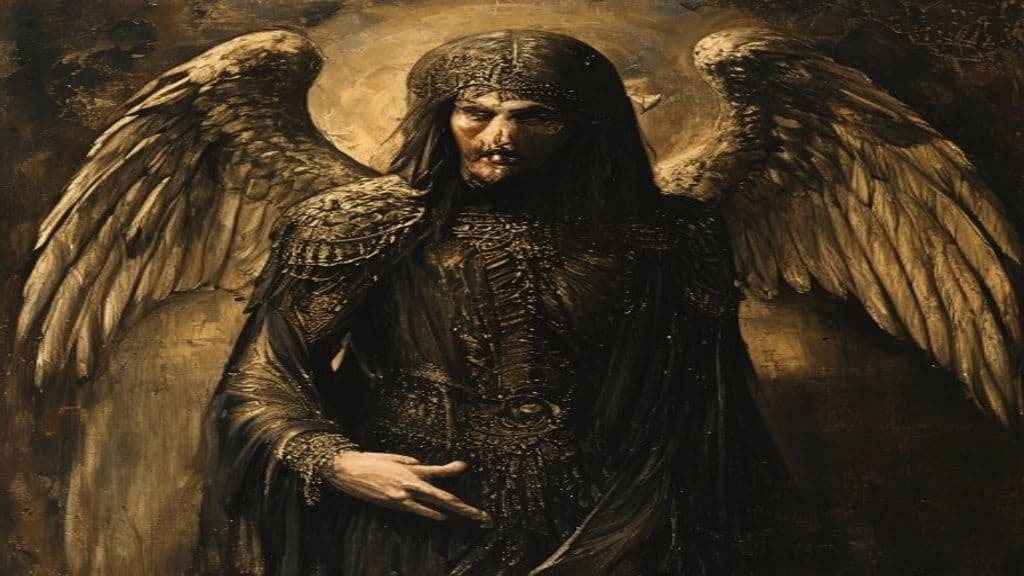
There is no mythic origin narrative preserved in the provided ancient-oriented sources. The primary historical attestation cited here identifies Adrammelech succinctly as "a god of 'Sepharvaim'" (the reference derives from the Book of Kings as summarized in modern reference works). Scholarly discussion included in the sources commonly — though not certainly — links Sepharvaim to the twin Sippar cities (Sippar Yahrurum and Sippar Amnanum) on the Euphrates north of Babylon. The name is probably translatable as "Magnificent king," suggesting a titulary or royal epithet, but the sources do not supply a fuller philological or mythic biography.
The ancient textual attestation provides no physical or anthropomorphic description of Adrammelech. Later modern and fictional uses imaginatively re‑describe or repurpose the name in many different ways (examples in the dataset include depictions as an afterlife figure and a narrative calling Adramelech "the talking donkey"), and the name appears as a motif in music, band identities, and online pseudonyms. These later depictions vary widely and are creative elaborations rather than evidence for an original cultic iconography.
In the historically grounded sources Adrammelech is named only as a local deity of Sepharvaim and the ancient material does not list specific powers, functions, or cultic deeds. Modern fictional texts in the provided corpus attribute a range of narrative roles and actions to figures called Adramelech — for example, interactions with humans, requests for sacrifice, afterlife agency, attempted merging with a human, and conflict with other named fictional figures — but these are literary inventions and not part of the brief ancient attestation.
Admetus of Pherae
Admetus of Pherae is a mortal king of Thessaly in Greek myth whose household and fate intersect with Olympian gods (notably Apollo and Artemis), the Fates, the personification of Death (Thanatos), and the hero Heracles. He is celebrated for hospitality and justice and is best known from the tragic cycle surrounding his wife Alcestis, who dies in his stead and is later recovered.
Adonai
Adonai (אֲדֹנָי) is one of the sacred Hebrew names used in Judaism to refer reverently to the singular God. It functions as a liturgical and devotional substitute or form for the divine Name and is treated with linguistic and ritual care in Jewish practice; it also appears in Christian liturgy (e.g., the Advent antiphon “O Adonai”).
Adonay
Adonay (אֲדֹנָי, often transcribed Adonai or Adonay) is a sacred Hebrew appellation meaning roughly "Lord" or "Master," used in Jewish liturgical and scriptural language as a reverent name for the divine. In the provided sources it functions as a theological title within Judaism rather than a personified folkloric being; discussions around it center on reverent usage and the communal care taken with divine names.
Adonia
The Adonia festival is a ritual mourning celebration for Adonis, the consort of Aphrodite in ancient Greek mythology. (Note: 1. The draft claims that the article is about a "ritual mourning celebration", but the source only mentions the festival as a mourning celebration. 2. Power tier should be Primordial or Ancient since )
Adonijah
Adonijah (Hebrew: אֲדֹנִיָּה, ’Ǎḏōnīyyā, "my lord is Yah") is presented in the Hebrew Bible as the fourth son of King David who made a bid for the throne during David's final illness, secured some elite support, took sanctuary at the altar, was pardoned conditionally, and later executed after petitioning Solomon to marry Abishag.
Adonis
Adonis is a mythic mortal youth in ancient Greek tradition, beloved by goddesses (notably Aphrodite and Persephone) whose death and seasonal return are the focus of the women’s midsummer festival Adonia. The cultic practices—planting short-lived 'gardens of Adonis' on rooftops, ritual lamentation, and casting an effigy and withered plants into the sea—symbolically link him to vegetation cycles and Near Eastern dying-and-regenerating god traditions.
Adranus (Adranos)
Adranus (also spelled Adranos) is a fire deity worshipped by the Sicels of ancient Sicily, attested as having island‑wide cult recognition with a principal sanctuary at the town called for him near Mount Etna. Classical summaries report a notable cultic presence of many sacred dogs associated with his temple.
Adraste / Adrasteia
Adraste (also Adrasta, Adrasteia) is a name applied across Greek and later European literary traditions to multiple minor figures: an Oceanid listed as a nurse of the infant Zeus, a Homeric attendant of Helen, and a named dramatic character (jailer/antagonist) in plays and operatic retellings. The sources show the name reused in different roles rather than a single, coherent supernatural ontology.
Adrasteia
Adrasteia is an ancient Anatolian/Greek goddess associated with mountain-mother cults and later identified with the Greek notion of inescapable fate and retributive necessity. She appears in Phrygian contexts as a mountain goddess connected to Cybele, in Cretan myth as a nurse of the infant Zeus, and by the fifth century BC is often equated or associated with Nemesis and other personifications of necessity.
Adrastus
Adrastus (Ancient Greek: Ἄδραστος or Ἄδρηστος) is a legendary king of Argos in the Greek mythic-historical tradition, best known as the leader of the expedition of the Seven against Thebes and as a figure tied to oracular counsel, dynastic marriages, and local hero cults.
Adrastus of Argos
Adrastus is a legendary mortal king in the Greek Theban cycle, traditionally king of Argos (with variant traditions placing him first at Sicyon). He is best known as the ruler who housed the exiled Polynices and organised the expedition known as the Seven against Thebes, acting as a dynastic and military patron whose choices precipitate tragic loss.
Adrestia (Adrasteia)
Adrasteia (also Adrestia and multiple orthographic variants) is a figure in classical Greek tradition whose roles shift from a Phrygian mountain/mother-goddess probably associated with Cybele, to a Cretan nymph entrusted with nursing the infant Zeus, and by the fifth century BC identified with Nemesis as a deity/personification of divine retribution and balance.
Community Record
- [1]Adramelech - Wikipedia. "Adrammelech is an ancient Semitic god mentioned briefly by name in the Book of Kings, where he is described as a god of 'Sepharvaim'."; "The name Adrammelech probably translates to 'Magnificent king.'"wiki
- [2]Adramelech - Wikidata. Wikidata entry label: "god of Sepharvaim"wiki
- [3]Without Bloodshed (fiction) — starbreaker.org. Modern fictional use depicting narrative episodes involving a figure called Adramelech (creative reworking).literary
- [4]MIZTAVLA Discography (Archive). Archive entries in the dataset showing modern musical uses of the name Adramelech.other
- [5]Adramelech - Psychostasia (Archive). Archive entry representing modern cultural reuse (band/album) of the name.other