
In Tagalog accounts cited in the sources, Amihan is named among the earliest inhabitants of the universe, appearing alongside deities such as Bathala and Aman Sinaya. In the familiar origin tale of Malakas and Maganda, Amihan is described as a bird that saved or released the first human beings from a bamboo plant, functioning within the cosmogonic narrative as an agent who enables the emergence of humans.
Sources repeatedly describe Amihan in mythic contexts as being depicted as a bird. No detailed or consistent physical descriptions (plumage, size, color, or anthropomorphic traits) are provided in the cited excerpts beyond this avian depiction.
The primary mythic action attributed to Amihan in the provided materials is rescuing or freeing the first humans (Malakas and Maganda) from a bamboo in the origin legend. Separately, the lexical and cultural identity of amihan names the northeast trade wind/monsoon season in the Philippines; in that sense Amihan personifies or embodies the cool northeast wind and the seasonal pattern dominated by those trade winds. The sources do not list additional supernatural powers beyond these roles.
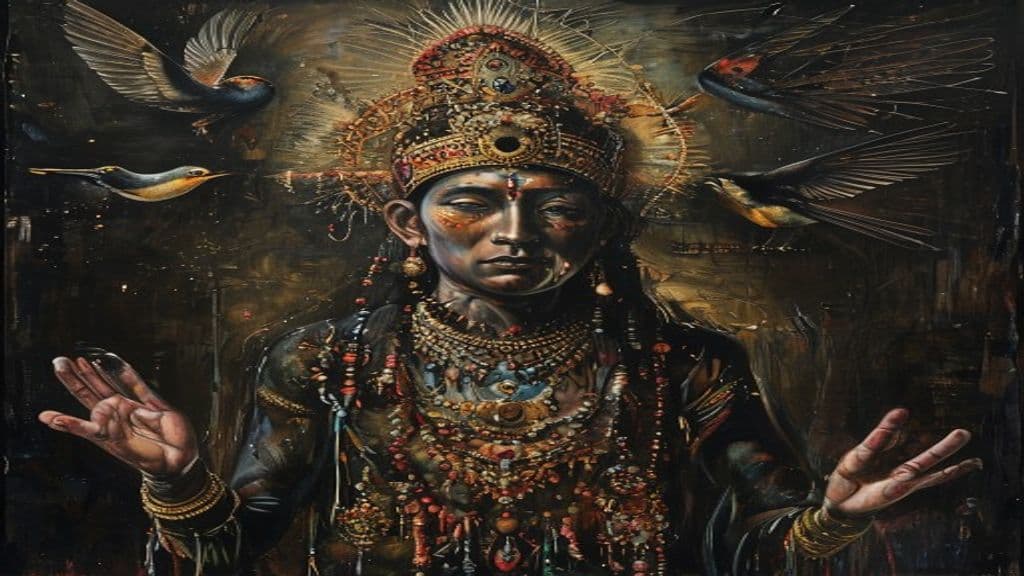
Anito
Anito is a category of non‑human and post‑human spiritual beings in indigenous Philippine animistic worldviews, encompassing ancestor spirits, nature spirits/local deities, and sometimes carved effigies (taotao) that house or represent those spirits. They mediate relations between the living and the unseen world, functioning as household guardians, owners of places, intercessors, or occasional agents of harm when offended.
Bakla
Bakla is a Philippine social and gender category—commonly an assigned‑male‑at‑birth person who adopts a feminine gender expression and is often treated as a third gender. Historically some bakla served as indigenous ritual specialists (babaylan, katalonan), but the term itself denotes a social identity, not a supernatural being.
Manaul
Manaul is a birdlike mythic figure in multiple Philippine indigenous traditions, variously portrayed as an omen-bearing bird sent by Bathala or Amihan, a king who guides destinies and instigates cosmic conflict, and a rebellious/cosmogonic agent who creates islands.
Tigmamanukan
A Tagalog augural bird — a class of omen-bearing bird (and by extension other animals) read as messages from the creator deity Bathala. Its flight direction and song were interpreted to authorize or forbid journeys and, in some origin myths, a bird identified as the tigmamanukan acts as an agent opening the primordial bamboo.
Amestris
Amestris is primarily a proper name attested for Achaemenid royal women in classical sources and reused in modern fiction as a toponym (not a supernatural being). Historically it denotes at least one queen consort of Xerxes I and a daughter of Artaxerxes II; in modern culture it is best known as the nation-state named Amestris in the manga/anime Fullmetal Alchemist and as an evocative proper name in various creative works.
Amethyst, Princess of Gemworld (tradition)
No supplied sources document a supernatural entity called 'Amethyst, Princess of Gemworld.' The available materials instead discuss the mineral amethyst (etymology, physical properties, and historical beliefs), the use of 'Amethyst' as a given name, and an incidental modern music credit containing the word 'Amethyst.' Therefore this entry reports only what is attested in those sources and explicitly notes the absence of any attested folkloric figure by that name.
Amethyste (Amethystos)
Amethyste (Ancient Greek: Amethystos) appears in later European literary tradition as a beautiful maiden or nymph transformed into the amethyst gemstone; the story is a post-classical etiological invention explaining the stone's purple color and linking the gem to an ancient belief that it prevented drunkenness.
Amida Nyorai
Amida Nyorai (Amitābha / Amitāyus) is a principal Mahayana Buddha venerated across East Asia as the embodiment of Infinite Light and Infinite Life who presides over a Western Pure Land and is invoked as the savior who receives the dying into rebirth there.
Amikiri
An illustrated yōkai first attested in Toriyama Sekien's Gazu Hyakki Yagyō (1776), later described in modern writings as a small creature that cuts nets, mosquito curtains, and bamboo blinds. Scholarly commentary treats it as primarily an iconographic invention or pun by Sekien rather than a well‑attested folkloric agent.
Amikuk
Amikuk is a Yup'ik / Alaskan Inuit spirit-creature associated with the ground and coastal waters; sources describe it as a shapeshifter that lives within the earth, can swim through earth and water, may take human form, and is dangerous to hunters and travelers.
Amimitl (Opochtli)
A Mexica/Aztec deity associated with fishing, hunting, and water-related technologies; identified in sources with the better-documented figure Opochtli, "The Left," who functions as a specialized patron of implements and as a representative or attendant of the rain god Tlaloc. A temple in the Tira de la Peregrinación has been interpreted by a scholar as possibly belonging to a figure labeled Amimitl, but that identification is uncertain.
Amir Arsalan-e Namdar (The Exalted Prince Arsalan)
A powerful, potentially benevolent figure in Persian mythology with magical abilities. (Note: 1. Power tier needs to be adjusted based on abilities described (as benevolent figure with magical abilities), could be Lesser or Minor Spirit instead of Greater. 2. Summary should mention specific my)
Community Record
- [1]Amihan (mythology) - Wikipedia. "Amihan is a deity that is depicted as a bird in the Philippine mythology."; "Amihan is the first creature to inhabit the universe, along with the gods called Bathala and Aman Sinaya."; "In the legend, Amihan is described as a bird who saved the first human beings, Malakas and Maganda, from a bamboo plant."wiki
- [2]Amihan - Wikipedia (season/meteorology). "In the Philippines, amihan refers to the season dominated by the trade winds, which are experienced in the country as a cool northeast wind."wiki
- [3]Amihan (mythology) - duplicate entry. Repeats descriptions of Amihan as bird-deity and first inhabitant alongside Bathala and Aman Sinaya; references rescue of Malakas and Maganda.wiki
- [4]Philippines Seasons: Amihan and Habagat Monsoons. "Amihan and Habagat refer to the two kinds of winds and seasons that occur in the country every year. Amihan is known as the Northeast monsoon while Habagat is known as the Southwest monsoon."other
- [5]WKD (04) WORLD Kigo Database: Amihan wind. Discussion of amihan as a wind/season term in Filipino usage (northeast wind).other