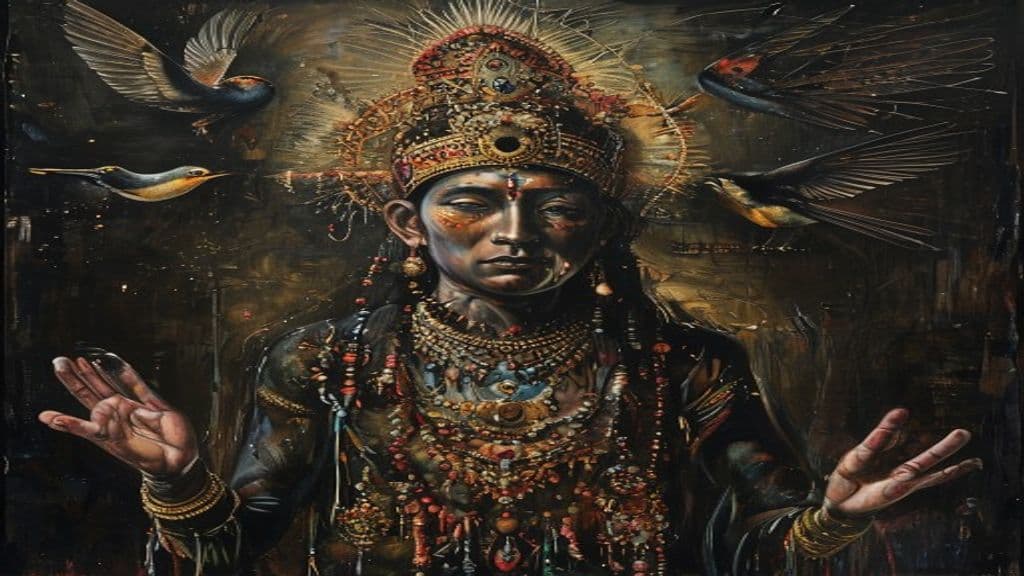
Historical sources and later scholarship present Bathalà/Maykapál as the Tagalog transcendent supreme being credited with creation and preservation of the world. Colonial-era records and later commentators record a range of names and epithets; scholars have proposed multiple competing etymologies — a common hypothesis derives Bathalà from Sanskrit bhattara/bhattaraka (cf. batara in Maritime Southeast Asia), other proposals include derivation from avatara, connections to Malay berhala, or to Arabic Allah-ta'ala, while José Rizal argued the phrase may reflect the native expression Bahalà ang May Kapál and that Tagalogs often avoided pronouncing the deity's name. Isabelo de los Reyes and other commentators distinguished Maykapál or Lumikhâ as the proper name for the supreme creator while treating Badhala/Bathalà as a more general honorific applied to deities, omens, and feared beings.
The sources supplied do not record a consistent corporeal iconography for Bathalà; the deity is described as a transcendent supreme god rather than an embodied figure. Separately, the same word was historically applied to omen birds, comets, and other heavenly bodies and to personal tutelary spirits, but colonial summaries do not present a single bodily depiction for the supreme Bathalà.
Cited sources attribute cosmogonic and sovereign functions to Bathalà — described as the originator, creator, and preserver of all things. In the pre‑colonial Tagalog lexicon the term also operated as an honorific that could be applied to lesser tutelary spirits, omen birds, comets, and other heavenly portents; those uses indicate a cultural expectation that entities labeled with the term could function as protectors or predictors of events. After Spanish missionary contact, Bathalà/Maykapál was equated with the Christian Dios, reflecting syncretic overlap in ascribed divine authority.
Berberoka
A water-associated swamp spirit or creature from northern Luzon (Philippines) said to prey on people at ponds, lakes, rivers, and swamps by manipulating water—draining and reflooding sites to drown victims. Described in summaries as a 'swamp creature' or 'water ogre'; some modern adaptations portray it as a scaled ogre.
Buso
A capacious Bagobo category for malevolent non-human beings in Mindanao animistic belief; buso are implicated in disease, death, and consumption of flesh and are managed through offerings, avoidance, and local ritual practice. The term covers many named types (tigbanua, mantianak, karokung, etc.) rather than a single mythic personality.
Nuno sa Punso
A Philippine localized nature spirit described as a small, elderly mound-dweller tied to anthills, termite mounds, and other specific landscape features; considered an ancestral/guardian presence that punishes those who disturb its territory and is placated through ritual etiquette, offerings, and traditional healer intervention.
Philippine mythical creatures
A broad, plural category of legendary beasts, monsters, and supernatural beings found across more than 140 ethnic groups in the Philippines; these beings occupy local folkloric cosmologies and are distinct from major deities and heroes. They appear in traditional tales and in contemporary retellings and media, which continue to reinterpret and popularize them.
Tikbalang
A Philippine nature spirit/phantom associated with wild, liminal places; often depicted in later accounts as a tall, lanky half-horse, half-human trickster that can mislead travelers, guard trees or territories, and in some versions be tamed or domesticated by humans.
Tiyanak
The tiyanak is a malevolent Philippine supernatural being typically depicted as an infant‑shaped spirit that lures people by imitating a baby’s cry and then attacks or abducts them. It is variously understood as the restless soul of an infant who died unnamed or unbaptized and, in older Spanish‑era accounts, as an obstetric spirit (patianac) that obstructs childbirth.
Batea
Batea is a polysemous term found in scientific, geographic, material-culture, mythological, and modern technical contexts. In the supplied sources it appears as a genus of amphipod crustaceans, two named figures in Greek mythology (without further detail in these sources), a municipality in Catalonia, a traditional gold-panning pan, and as the name/acronym of contemporary technical and policy documents.
Batea of Troad
Batea (Ancient Greek: Βάτεια) is a mythic female ancestor and eponym in early Greek accounts tied to the foundation myths of the Trojans/Dardanians. Presented as a member of the Teucrian royal house and consort of Dardanus, she is credited with giving her name to a hill in the Troad and to the town Bateia and functions mainly to link genealogical descent and territorial claims.
Batgirl
Batgirl is a comic-book superheroine identity published by DC Comics, used by multiple human characters as a female counterpart and ally to Batman within the shared Gotham City vigilante continuity. The mantle has been assumed by different women across publication history and has been used to explore themes of gender, disability, and editorial continuity in modern popular culture.
Bathin
Bathin is a named non‑human spirit from the early modern European grimoire tradition, listed among ranked intelligences that magicians could summon and command. Descriptions and attributes vary across grimoires, but he is commonly portrayed as a ducal spirit who knows the virtues of plants and stones, transports people, and rules multiple legions of subordinate spirits.
Batibat
The Batibat is a vengeful, tree-dwelling female spirit in Philippine (Ilocano and Tagalog) folklore associated with causing suffocative sleep afflictions, nightmares, and sleep paralysis when trees that house it are felled and used near human sleeping spaces.
Batman
Batman is a fictional, human costumed persona created for American comic books, adopted by Bruce Wayne to combat crime in the fictional Gotham City. Presented in mainstream continuity as a non‑superpowered figure, he relies on intellect, physical training, gadgets, and wealth and functions as an iconic cultural symbol across comics, film, television, and games.
Community Record
- [1]Bathala (Wikipedia). Wikipedia contributors, 'Bathala,' Wikipedia, The Free Encyclopedia.wiki
- [2]Bathala (King of the Diwatas) — marvunapp appendix. Marvunapp, 'Bathala (King of the Diwatas)'.other