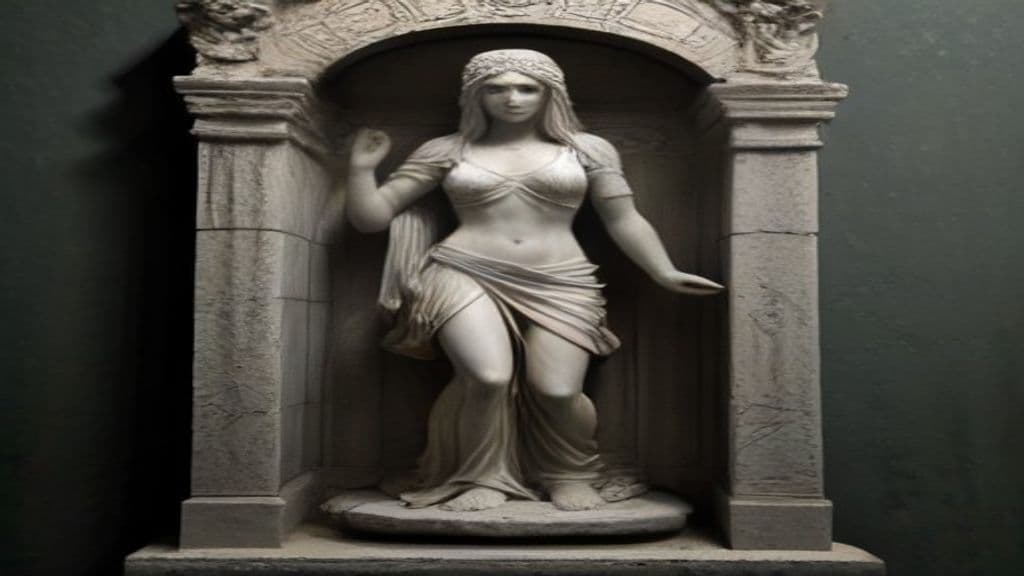
No surviving mythic narrative or origin legend for Icaunis is recorded in the supplied sources. What is attested is an epigraphic theonym, Dea Icaunis, tied to the river Icauna (modern Yonne) and found at Auxerre in Burgundy. Within the broader cultural context of Roman Gaul, many local natural features — rivers, springs, and other landscape elements — were personified and venerated as female deities in local cults; Icaunis should be understood as one such localized river theonym attested only by inscriptional evidence rather than a narrated origin or founding myth.
The sources provide no description of Icaunis's appearance or any iconography. No statues, reliefs, or literary descriptions are cited in the supplied material. While Gallo‑Roman river goddesses were sometimes depicted in later comparative material as female figures associated with water, vessels, or aquatic attributes, there is no direct evidence in the provided sources to attribute any specific visual traits to Icaunis herself.
There are no recorded powers, actions, or behaviors attributed specifically to Icaunis in the supplied material. The lone attestation identifies her as the goddess of the river Yonne, which places her within the general category of localized river deities in Gallo‑Roman practice, but the sources do not document any functions (such as bestowing fertility, healing, or protection) for her personally. Any assignment of specific abilities would be speculative beyond the inscriptional identification.
Acionna
Acionna is a local Gallo-Roman water goddess attested by a single votive inscription found at a spring in the Orléanais region. The inscription, discovered by Jollois in 1822 and datable by style to the 2nd century CE, dedicates a portico and ornaments "AUG(ustae) ACIONNAE" and was recovered from the Fontaine de l'Étuvée in Orléans; archaeological work in 2007 uncovered remains of a Gallo-Roman temple and a section of an aqueduct at the site.
Ambisagrus
Ambisagrus is a local Gaulish deity attested in Gallo‑Roman religion, worshipped at Aquileia in Cisalpine Gaul and identified there with Jupiter Optimus Maximus under Roman interpretatio. The name is tentatively analyzed from Proto‑Celtic elements *ambi‑ + *sagro‑.
Arduinna
Arduinna is a local Gallo-Roman tutelary goddess of the Ardennes (Arduenna) — a divine personification of wooded heights — attested in two inscriptions and later equated with the Roman Diana. Iconography associating her with a boar-riding huntress exists in modern literature but the identification is uncertain.
Loucetios
Gallic god associated with Mars, lightning, and war; worshipped in the Rhine-Moselle region. (Note: 1. Power tier: Primordial is unlikely, given the lack of information about his abilities or behaviors; a more plausible tier would be Greater (powerful regional). 2. Abilities: No direct information a)
Ritona
Ritona (also attested as Pritona) is a named local goddess of Roman‑period Gaul, chiefly attested among the Treveri of the Moselle valley. She is understood from inscriptions and temple remains as a divine patron of fords, river crossings, springs and associated sanctuary spaces, worshipped in formal civic cult contexts at sites such as Augusta Treverorum (Trier) and Contiomagus (Pachten).
Ibaraki-dōji
Ibaraki-dōji (茨木童子 / 茨城童子) is an oni from Heian-period tale cycles, portrayed as a powerful, place-associated demon-child who served in Shuten-dōji’s gang based on Mount Ōe and acted as an antagonist to warrior-heroes such as Minamoto no Yorimitsu and his retainers. Multiple local traditions (Settsu/Osaka and Echigo/Niigata variants) give differing origin episodes that emphasize unnatural birth, early signs of monstrosity, and later violent behavior.
Iblis
The primordial deceiver in Islamic theology; a jinn who refused God's command to bow before Adam and was expelled from heaven. The source of all temptation and whispered suggestion.
Ibong Adarna (Adarna Bird)
A magical legendary bird from an early 19th‑century Filipino corrido/epic (Ibong Adarna) whose song, droppings, and capture drive a quest narrative: its song induces sleep, its droppings petrify unwary listeners, and bringing the bird is the cure for a king's malady.
Icarius of Sparta
Icarius of Sparta is a mortal figure in Greek mytho-historical tradition: a Spartan king/prince best known as the father of Penelope, wife of Odysseus. He appears in epic and genealogical accounts to situate Penelope within Spartan royal lines and to link Sparta with the Ithacan cycle of the Odyssey.
Idas (son of Aphareus)
Idas is a Messenian prince and heroic figure in Greek myth remembered as an Argonaut, a hunter in the Calydonian Boar hunt, and, in later summaries, a mortal who came into contention with the gods. He is described in modern summaries as 'keen and spirited' and figures among the pan-Hellenic roster of heroes rather than as a supernatural being.
Ide
Not attested as a supernatural entity in the provided sources. The term 'Ide' in the supplied materials appears as a Wikipedia disambiguation headword, a toponym for a village in Devon, England, and as the acronym 'IDE' in modern computing contexts (Integrated Development Environment) or as part of archival filenames.
Idis (Germanic)
The idis (Old Saxon; pl. idisi) is a term for a divine or supernatural female being in the pre-Christian Germanic linguistic and poetic record. Cognate with Old High German itis and Old English ides, the term carries senses of a dignified or well‑respected woman and appears in poetic, folkloric, and comparative discussions alongside related female figures such as the Norse dísir.
Community Record
- [1]Icaunis — Wikipedia. Wikipedia contributors. "Icaunis." Wikipedia, The Free Encyclopedia.wiki
- [2]Icaunis — Wikidata Q2276535. Wikidata entry Q2276535, label and short description for Icaunis.wiki
- [3]Matronae | Gods | The Troth. The Troth. "Matronae." Summary of Matres/Matronae inscriptions in the western Roman Empire.other