
The Eight Legions arise in Buddhist literary and classificatory contexts as an umbrella grouping of multiple non-human classes drawn from Buddhist and pre-Buddhist South Asian cosmology. The term aṣṭasenā (Sanskrit: अष्टसेना) literally means 'eight hosts' or 'eight legions' and is used in Mahāyāna sūtras—explicitly in texts such as the Lotus Sutra and the Golden Light Sutra—where these mixed assemblies are reported among the audience of the Buddha and described as protectors of the Dharma. The grouping functions as a doctrinal and iconographic category rather than a single indivdual mythic personage; regional and temple traditions sometimes vary which specific classes or named figures are included.
Sources treat the Eight Legions as a collective composed of distinct classes rather than as a single uniform figure. Typical constituent classes named in the sources include devas (heavenly beings), nāgas (serpent/dragon-spirits, often shown serpentine or draconic), yakṣas (nature-spirits or guardian spirits), gandharvas (celestial musicians), asuras (titans or demigods), garuḍas / karura (bird-like beings), kiṃnaras (half-human, half-bird or musical spirits), and mahoragas (serpentine/subterranean beings). Temple statuary and local rosters (for example the list attested at Kōfuku-ji) present heterogenous anthropomorphic, serpentine, avian, and semi-divine forms according to the iconography of each class, and membership and depiction vary by regional and temple tradition.
In the supplied sources the principal described function of the Eight Legions is protective: they are presented in Mahāyāna sūtras as beings whose role is to protect and uphold the Dharma and who form part of the Buddha's audience. Because the grouping aggregates beings from lower heavens and nature-spirit types, sources characterize them as inhabitants of various lower heavens (for example Cāturmahārājakāyika) and the Asura realm; beyond this classificatory placement and the broad protective role, the provided materials do not enumerate specific magical abilities, combat feats, or individual powers.
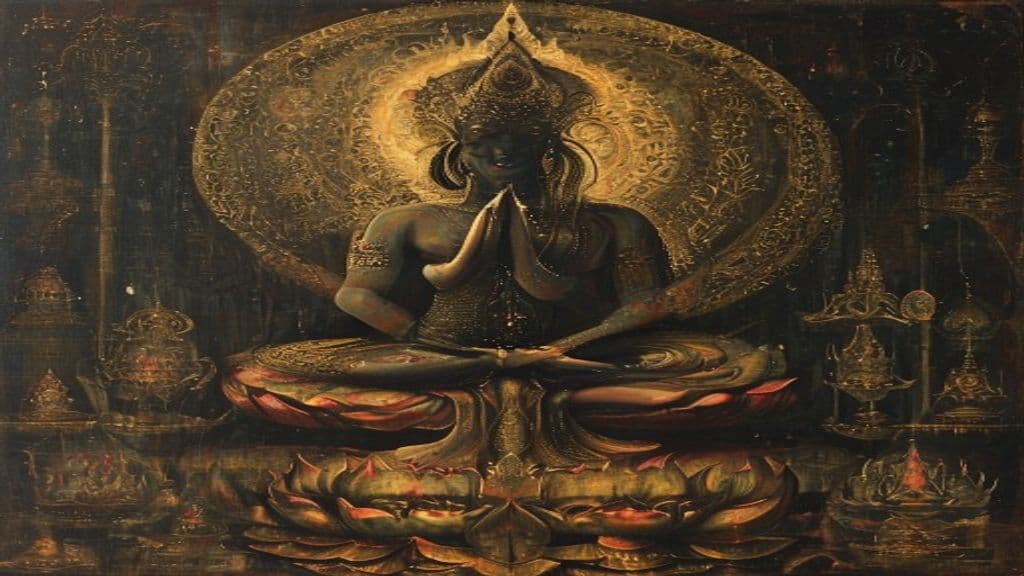
Deva (Buddhism)
In Buddhist cosmology a deva is a class of celestial being or heavenly rebirth occupying higher planes than humans; devas are longer‑lived, more powerful, and generally happier than humans but remain impermanent and subject to karma. The category spans formless meditative beings through subtle form devas to sensual gods, and maps onto the three dhātus (Ārūpyadhātu, Rūpadhātu, Kāmadhātu).
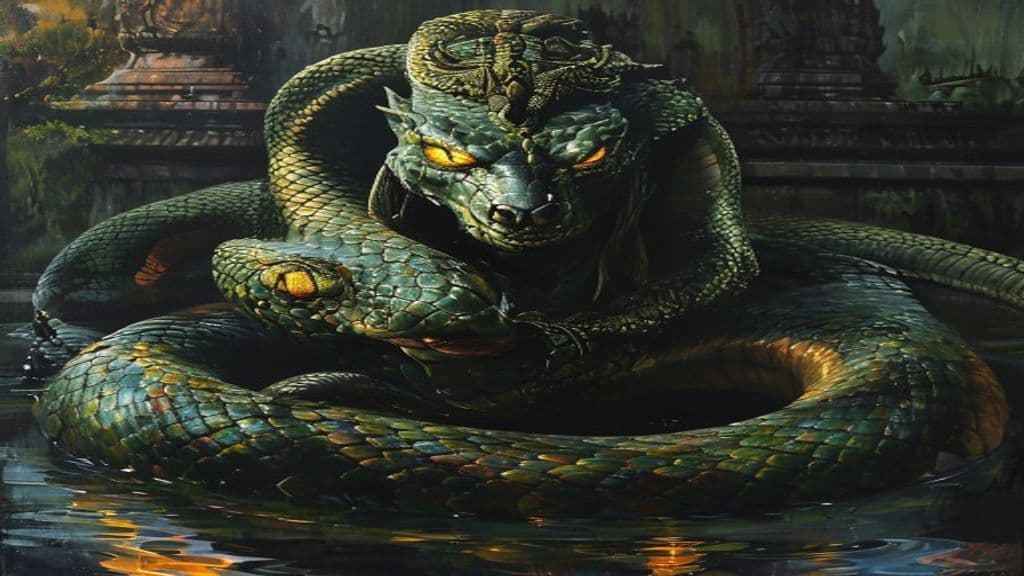
Naga
Divine serpent beings of Hindu, Buddhist, and Jain cosmology — powerful guardians of water, earth, and underground treasures. Revered as deities in South and Southeast Asia.
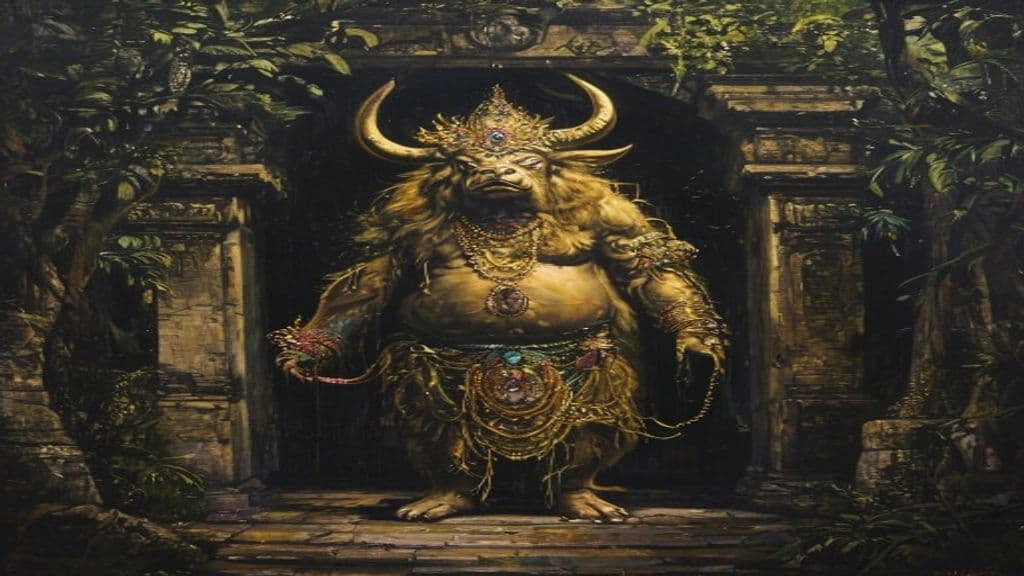
Yaksha
Nature spirits of Hindu, Buddhist, and Jain cosmology — guardians of forests, treasures, and wilderness. Ambivalent beings, capable of great benevolence to the respectful and terrible harm to the greedy.
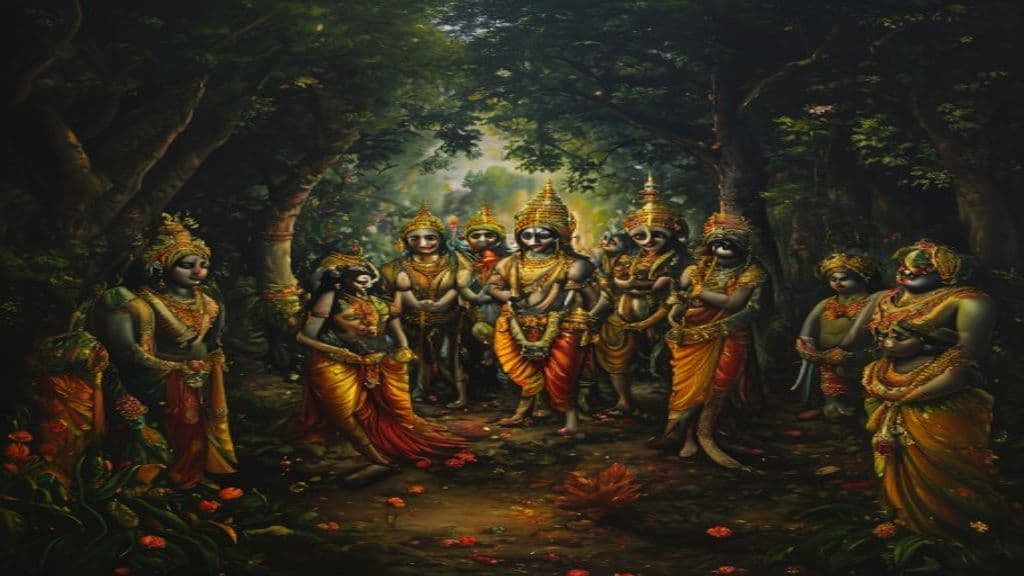
Gandharva
A class of non-human celestial or semi-celestial beings in Indic religions associated principally with music, song, dance, fertility, and an escort/guardian role for liminal arrivals (such as Soma or beings). In Hinduism they are minor deities and musicians of the devas; in Buddhist cosmology they are a low rank of devas and the term (gandhabba in Pāli/commentary) is also used doctrinally for a sentient intermediate state between death and rebirth.

Asura
Asura (Sanskrit: असुर) are a class of supernatural beings in Indian religious traditions. In Hinduism they are described as power-seeking beings related to, and often oppositional toward, the Deva; in Buddhist cosmology they form a demigod/titan class characterized by passions such as wrath and envy. Individual asura figures (notably the asura Svarbhānu) appear in myths that produce the eclipse-entities Rahu and Ketu.
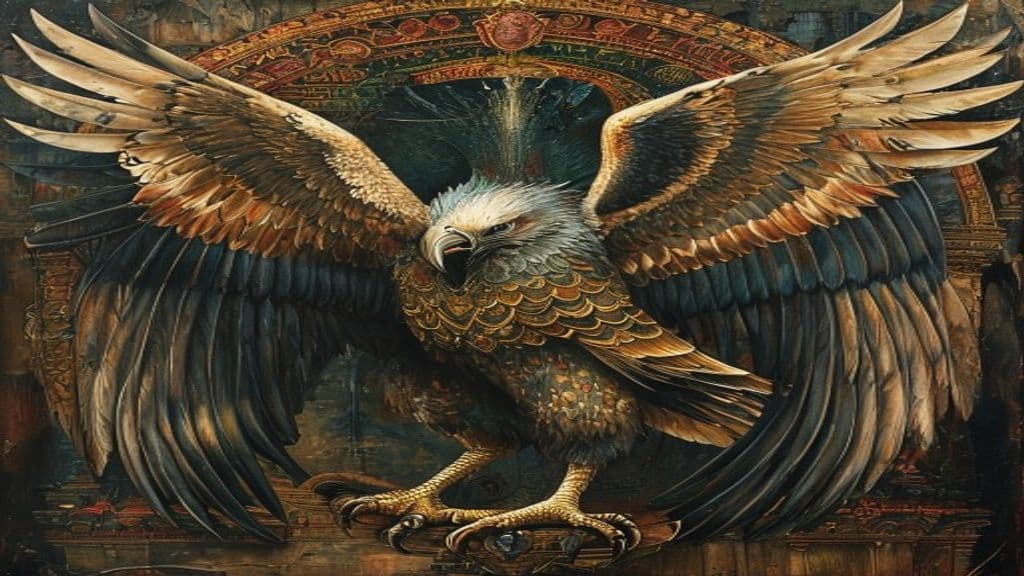
Garuda
Garuda is a divine, eagle-like being in South Asian traditions best known as the vahana (mount) of the god Vishnu. In Vedic, Purānic and later texts he appears as a powerful, solar-associated bird-personage who is both an individual mythic personality (son of the sage Kaśyapa and Vinatā) and an archetype invoked in temple iconography and theological metaphor.
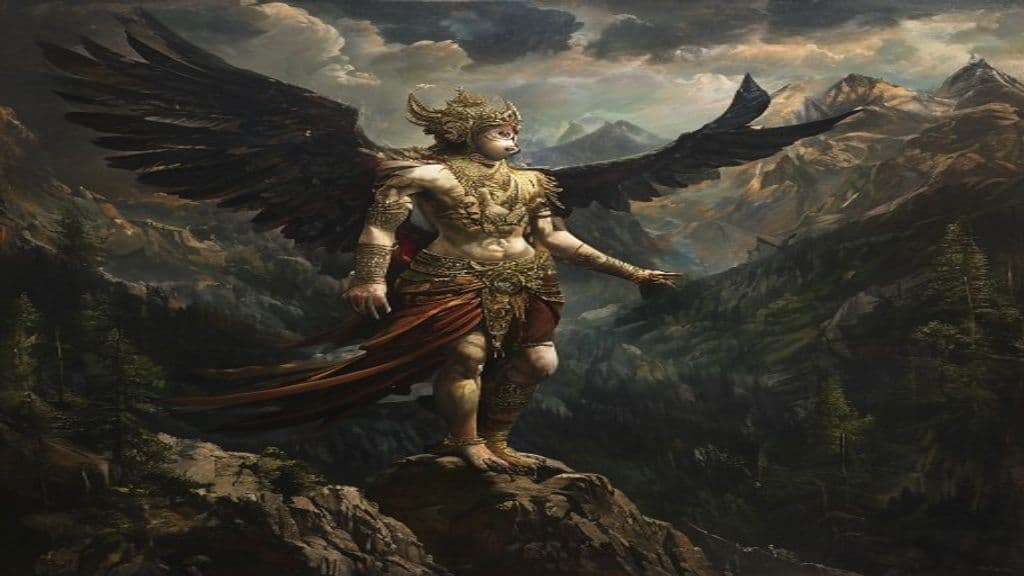
Kinnara
A benevolent, part-human and part-bird entity from Tibetan tradition associated with music and protection. (Note: - Power tier: Primordial (due to its association with Hindu and Buddhist mythology) - Appearance: The exact description isn't provided, but it's mentioned that they are part human and part bird; more )
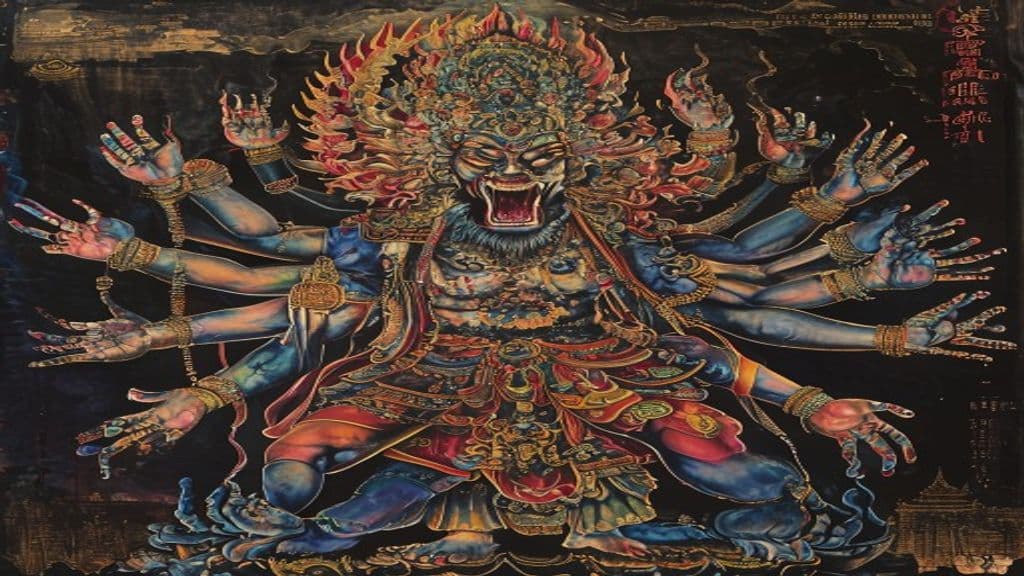
Dharmapāla
In Buddhist traditions, a dharmapāla is a protective deity or guardian whose role is to defend the Dharma (the Buddha's teaching) and to avert obstacles to spiritual practice. Appearing across Mahāyāna and Vajrayāna contexts (notably Tibetan, Chinese, and Japanese), dharmapālas range from local worldly guardians to wrathful enlightened emanations invoked in tantric ritual.
Akshobhya
Akshobhya is a transcendent buddha of Mahāyāna and Vajrayāna Buddhism, one of the Five Wisdom (Dhyāni) Buddhas. He personifies 'mirror knowledge' (ādarśa-jñāna), is conventionally placed in the East, and is lord of the eastern Pure Land Abhirati; in esoteric texts he is associated with the eastern Vajra division and invoked in mantra/mandala ritual contexts.
Amitābha
Amitābha is a central celestial Buddha of Mahayana Buddhism who presides over the western Pure Land called Sukhāvatī. Devotional practices invoking his 'measureless' light and life (nianfo/nembutsu) are presented in Pure Land traditions as a path by which beings may be reborn in his buddhafield and quickly attain Buddhahood.
Anantacāritra
Anantacāritra (Sanskrit: अनन्तचारित्र) is a bodhisattva figure in the Lotus Sūtra, identified as one of the four great perfected bodhisattvas who attend Gautama Buddha. The name is glossed as "Boundless Practice" and, in Tiantai commentary, is read as representing eternity.
Arhat
An arhat (Sanskrit: arhat; Pāli: arahant) is in Buddhist traditions a human practitioner who has gained insight into the true nature of existence, attained nirvāṇa, and been liberated from the cycle of rebirth. The status and valuation of arhatship vary by school: some traditions equate it with full liberation, while others treat it as distinct from or inferior to the bodhisattva/buddha ideal.
Avalokiteśvara
A central Mahāyāna and Vajrayāna bodhisattva who embodies great compassion (mahākaruṇā), Avalokiteśvara hears the cries of sentient beings and manifests in many forms to relieve suffering. Venerated across South, Central, and East Asia, the figure functions devotionally (mantra and sutra recitation) and iconographically in multiple gendered and regional guises.
Bhaisajyaguru
Bhaisajyaguru (Bhaiṣajya‑guru; Medicine Buddha) is a Mahāyāna buddha associated with healing, medicine, and a pure land called Vaiḍūryanirbhāsa (Pure Lapis Lazuli). He functions as a therapeutic savior whose remedies operate through the "medicine of his teachings," vows, devotional practice, and radiance associated with lapis‑lazuli light.
Bhaiṣajyarāja (Medicine King Bodhisattva)
Bhaiṣajyarāja (Sanskrit: Bhaiṣajyarāja; Chinese: 藥王 Yào Wáng) is a Mahāyāna bodhisattva associated with healing, medicine, and supreme self‑offering. He appears in the Lotus Sūtra and in visualization/contemplation sutras and is often connected ritually and iconographically with the Medicine Buddha (Bhaiṣajyaguru) and with the paired bodhisattva Bhaiṣajyasamudgata.
Bhaiṣajyasamudgata
A Mahāyāna bodhisattva associated with the therapeutic activity of the Buddha and invoked in visualization (Guan) sūtras. He is named alongside the Medicine King (Bhaiṣajyarāja) and is the co-subject of a dedicated contemplation sūtra used in meditative-healing practice.
Cintāmaṇicakra (Nyoirin Kannon / Ruyi-lun Guanyin)
Cintāmaṇicakra is a bodhisattva-manifestation of Avalokiteśvara (Guanyin), identified with the wish-fulfilling jewel (cintāmaṇi) and wheel (cakra). In Mahāyāna sources the figure functions as one of six Avalokiteśvara forms tied to deliverance across the six realms (especially the deva realm) and is invoked through a dhāraṇī for karmic purification, protection, and fulfillment of aspirations.
Dharmapāla
In Buddhist traditions, a dharmapāla is a protective deity or guardian whose role is to defend the Dharma (the Buddha's teaching) and to avert obstacles to spiritual practice. Appearing across Mahāyāna and Vajrayāna contexts (notably Tibetan, Chinese, and Japanese), dharmapālas range from local worldly guardians to wrathful enlightened emanations invoked in tantric ritual.
Five Wisdom Kings
A class of wrathful, mantric protector-deities in East Asian Mahāyāna (notably Japanese) Buddhism, identified with the Sanskrit Vidyārāja and Japanese Myō-ō and described in sources as guardians of the cosmic Buddha Dainichi (Vairocana) and of esoteric teachings.
Green Tara
Green Tara (Tārā, Ārya Tārā, Jetsün Dölma) is a central female buddha/bodhisattva figure in Mahāyāna and especially Vajrayāna Buddhism, venerated as a liberator who grants swift assistance, removes obstacles, and functions as a meditation deity (yidam) embodied in green form.
Community Record
- [1]Eight Legions. Wikipedia, 'Eight Legions' entry (summary, etymology, variations, and cultural context).wiki
- [2]Wikidata: Eight Legions. Wikidata entry for Eight Legions (classificatory data and linked concepts).wiki
- [3]Hachi Bushu - The Eight Legions, Buddhist Protectors, Japanese Buddhism Photo Dictionary. Onmarkproductions, 'Hachi Bushu' (Japanese names, alternative labels such as Ninpinin and Tenryū Kijin, notes on temple variation).other