
Sources present Cintāmaṇicakra not as an independent origin-figure but as a specific manifestation or form of Avalokiteśvara (Guanyin). Textual summaries describe this form as one of six distinct Avalokiteśvara incarnations aligned with the salvation of beings in the six realms of saṃsāra; Cintāmaṇicakra is especially associated with saving those in the deva (heavenly) realm. East Asian renderings sometimes further identify this form with an honorific Brahma-like title (rendered in Chinese as 大梵深遠觀音, translated in some sources as “Mahābrahmā the Profound”), indicating syncretic honorific linkage rather than an independent origin narrative.
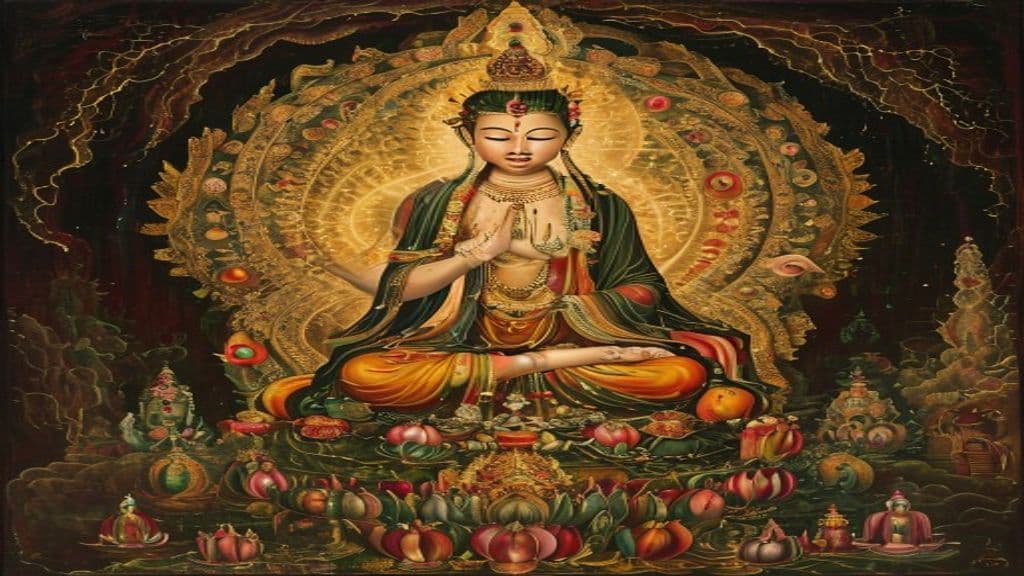
Iconography varies from two to sixteen arms, with two-armed and six-armed forms common in Chinese and Japanese art (source: iconographic summaries). The six-armed form is often shown wearing a crown bearing an effigy of Amitābha Buddha, seated in a royal pose (mahārājalīlāsana) atop a lotus on a rock rising from the ocean (symbolic of Mount Potalaka). In the typical six-armed scheme the first right hand touches the face in a pensive mudrā, the second right hand holds a cintāmaṇi (wish-fulfilling jewel), and the third right hand holds prayer beads (mālā); the first left hand touches the rock base, the second left hand holds a crimson lotus (padma), and the third left hand holds a Dharma wheel (cakra). Two-armed variants may hold a jewel and a water vase or omit the jewel; monumental modern examples (e.g., Tsz Shan Monastery Guanyin) illustrate such variants. Cintāmaṇicakra is also represented abstractly by its attributes (cintāmaṇi and cakra).
According to the Cintāmaṇicakra Dhāraṇī Sutra and associated sadhana summaries, the dhāraṇī/mantra associated with this form is described as having great power and majesty — likened to a celestial wish-fulfilling tree that rains down treasures — and is promised to fulfill superior aspirations of sentient beings. The sutra explicitly claims that sustained recitation and visualization will eradicate grave karmic offenses (including the four major offenses, the five rebellious sins, and the ten evil acts) and can remove obstacles that would lead to Avīci Hell; produce auspicious dreams signaling karmic purification; bring both worldly and transcendental wishes to fulfillment; and cause the sacred Avalokiteśvara to appear and bless or protect the practitioner. These powers are presented in the textual sources as doctrinal/promissory effects tied to prescribed recitation, visualization, and offerings, rather than empirical description.
Weaknesses
- otherSources do not specify vulnerabilities or weaknesses for Cintāmaṇicakra
Wards
- otherSources do not provide rituals to ward against Cintāmaṇicakra; the figure is presented as benevolent and the tradition prescribes invocation rather than warding
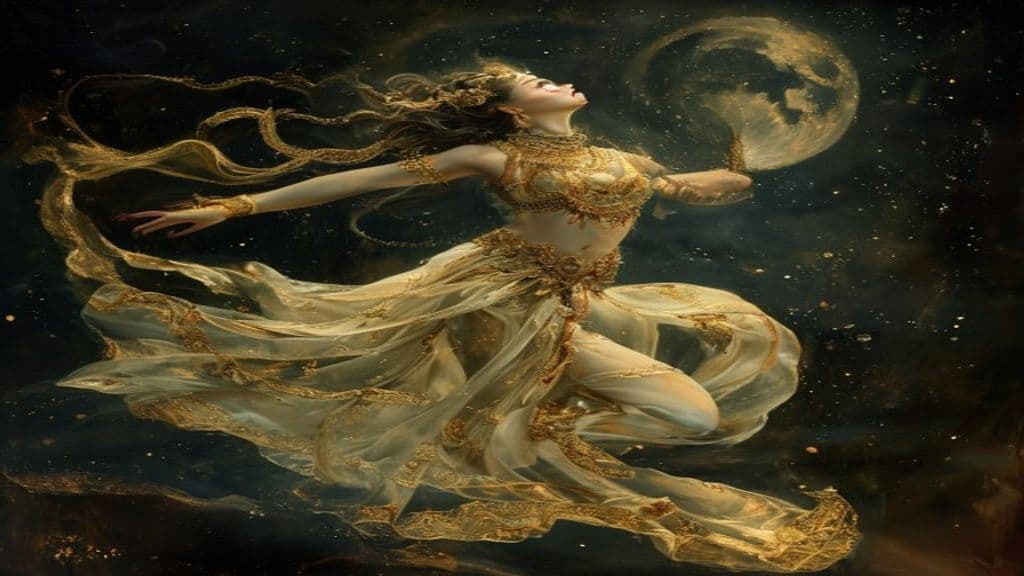
Apsara
Celestial dancers and water nymphs of Hindu cosmology — beautiful semi-divine beings who dance at the court of Indra and, by his command, descend to earth to distract sages from excessive asceticism.
Amitābha
Amitābha is a central celestial Buddha of Mahayana Buddhism who presides over the western Pure Land called Sukhāvatī. Devotional practices invoking his 'measureless' light and life (nianfo/nembutsu) are presented in Pure Land traditions as a path by which beings may be reborn in his buddhafield and quickly attain Buddhahood.
Akshobhya
Akshobhya is a transcendent buddha of Mahāyāna and Vajrayāna Buddhism, one of the Five Wisdom (Dhyāni) Buddhas. He personifies 'mirror knowledge' (ādarśa-jñāna), is conventionally placed in the East, and is lord of the eastern Pure Land Abhirati; in esoteric texts he is associated with the eastern Vajra division and invoked in mantra/mandala ritual contexts.
Amitābha
Amitābha is a central celestial Buddha of Mahayana Buddhism who presides over the western Pure Land called Sukhāvatī. Devotional practices invoking his 'measureless' light and life (nianfo/nembutsu) are presented in Pure Land traditions as a path by which beings may be reborn in his buddhafield and quickly attain Buddhahood.
Anantacāritra
Anantacāritra (Sanskrit: अनन्तचारित्र) is a bodhisattva figure in the Lotus Sūtra, identified as one of the four great perfected bodhisattvas who attend Gautama Buddha. The name is glossed as "Boundless Practice" and, in Tiantai commentary, is read as representing eternity.
Arhat
An arhat (Sanskrit: arhat; Pāli: arahant) is in Buddhist traditions a human practitioner who has gained insight into the true nature of existence, attained nirvāṇa, and been liberated from the cycle of rebirth. The status and valuation of arhatship vary by school: some traditions equate it with full liberation, while others treat it as distinct from or inferior to the bodhisattva/buddha ideal.
Avalokiteśvara
A central Mahāyāna and Vajrayāna bodhisattva who embodies great compassion (mahākaruṇā), Avalokiteśvara hears the cries of sentient beings and manifests in many forms to relieve suffering. Venerated across South, Central, and East Asia, the figure functions devotionally (mantra and sutra recitation) and iconographically in multiple gendered and regional guises.
Bhaisajyaguru
Bhaisajyaguru (Bhaiṣajya‑guru; Medicine Buddha) is a Mahāyāna buddha associated with healing, medicine, and a pure land called Vaiḍūryanirbhāsa (Pure Lapis Lazuli). He functions as a therapeutic savior whose remedies operate through the "medicine of his teachings," vows, devotional practice, and radiance associated with lapis‑lazuli light.
Bhaiṣajyarāja (Medicine King Bodhisattva)
Bhaiṣajyarāja (Sanskrit: Bhaiṣajyarāja; Chinese: 藥王 Yào Wáng) is a Mahāyāna bodhisattva associated with healing, medicine, and supreme self‑offering. He appears in the Lotus Sūtra and in visualization/contemplation sutras and is often connected ritually and iconographically with the Medicine Buddha (Bhaiṣajyaguru) and with the paired bodhisattva Bhaiṣajyasamudgata.
Bhaiṣajyasamudgata
A Mahāyāna bodhisattva associated with the therapeutic activity of the Buddha and invoked in visualization (Guan) sūtras. He is named alongside the Medicine King (Bhaiṣajyarāja) and is the co-subject of a dedicated contemplation sūtra used in meditative-healing practice.
Dharmapāla
In Buddhist traditions, a dharmapāla is a protective deity or guardian whose role is to defend the Dharma (the Buddha's teaching) and to avert obstacles to spiritual practice. Appearing across Mahāyāna and Vajrayāna contexts (notably Tibetan, Chinese, and Japanese), dharmapālas range from local worldly guardians to wrathful enlightened emanations invoked in tantric ritual.
Eight Legions (Aṣṭasenā / Hachi Bushū)
The Eight Legions (Sanskrit aṣṭasenā; Japanese Hachi Bushū 八部衆) are a grouped category of Buddhist divine and semi-divine beings assembled from multiple non-human classes whose described function in Mahāyāna sources is to protect the Dharma. They appear as part of the Buddha's audience in sutras such as the Lotus Sutra and the Golden Light Sutra and are represented in temple iconography with locally variable memberships.
Five Wisdom Kings
A class of wrathful, mantric protector-deities in East Asian Mahāyāna (notably Japanese) Buddhism, identified with the Sanskrit Vidyārāja and Japanese Myō-ō and described in sources as guardians of the cosmic Buddha Dainichi (Vairocana) and of esoteric teachings.
Green Tara
Green Tara (Tārā, Ārya Tārā, Jetsün Dölma) is a central female buddha/bodhisattva figure in Mahāyāna and especially Vajrayāna Buddhism, venerated as a liberator who grants swift assistance, removes obstacles, and functions as a meditation deity (yidam) embodied in green form.
Community Record
- [1]Cintāmaṇicakra — Wikipedia. Wikipedia: 'Cintāmaṇicakra' article (iconography, identity, dhāraṇī, sutra summary)wiki
- [2]Wikidata item Q11446712 — Cintāmaṇicakra. Wikidata entry for Cintāmaṇicakra (identifier and basic identity data)other
- [3]Cinta-Mani-Cakra Sutras and Sadhanas - Như Ý Luân Bồ Tát Pháp Kinh (Archive). Archive collection restoring mantras/dhāraṇīs and sadhanas; source for sutra practice instructions and Sanskrit mantrasother