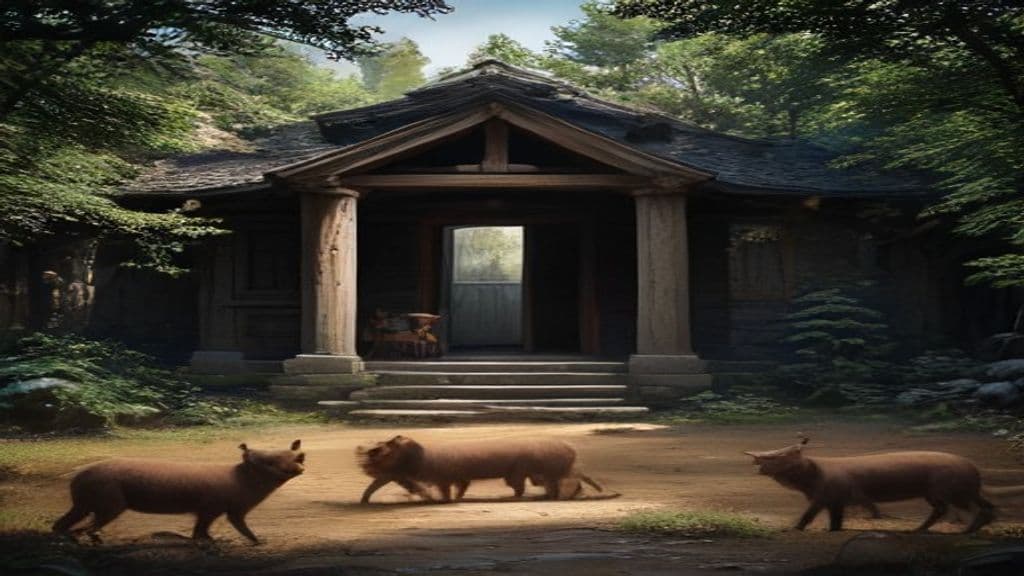
In the Homeric account and later summaries, Eumaeus is presented as a child of Ctesius, king of the island of Syra, who as a youth was taken by Phoenician sailors and subsequently bought and brought to Ithaca, where he was raised in Laertes' household alongside Odysseus. In the Odyssey narrative he serves as Odysseus's swineherd and faithful household retainer during Odysseus's absence and return.
Homeric passages emphasize Eumaeus's rustic setting and role rather than an elaborate physical portrait: he dwells in a sylvan lodge/hut with a rustic threshold and a rural portico of rough stone, tends a herd of swine guarded by watchful dogs, and is described in scenes rising to meet and embrace Odysseus. Classical descriptions focus on his humble, rural garb and the domestic environs of a swineherd rather than precise anthropometric detail.
Eumaeus possesses no supernatural powers in the sources. His notable capacities are practical and social: expert swineherd and keeper of dogs and pigs; skilled in animal husbandry; observant and prudent (suspicious of false claims about Odysseus's return); observant of religious/moral norms of hospitality (xenia), showing generosity to strangers and reverence for Zeus as patron of guests; loyal and courageous — he aids Odysseus and Telemachus (alongside Philoetius) in the slaughter of the suitors. He also exercised household agency such as acquiring a servant (Mesaulius) for duties.
Weaknesses
- conditionmortal vulnerability (no supernatural protection)
- othersocial limitation as a servant/slave – reliant on household status and human patrons
Wards
None recorded.
Amphimedon
In Homer's Odyssey, Amphimedon (Ancient Greek: Ἀμφιμέδων) is an Ithacan, son of Melaneus, one of the suitors of Penelope who fights in Odysseus's hall, is killed during the slaughter of the suitors, and (within the Homeric narrative) later appears among the dead in the Underworld to recount the events of that slaughter. The same name is also used in modern biological taxonomy for a genus of sponges; that referent is distinct.
Arnaeus (Irus)
Arnaeus, commonly called Irus in English translations, is a mortal beggar who appears in Book XVIII of Homer's Odyssey as a hanger‑on in the hall of Odysseus on Ithaca. He functions in the narrative as a social type and a foil for the disguised Odysseus, provoking a public fight that illustrates themes of hospitality, social disorder, and appearances versus reality.
Elpenor
Elpenor is a named human figure in the Homeric epic tradition (Odyssey) who dies accidentally on Circe’s island and later appears as a shade in Hades during Odysseus’ katabasis to plead for a proper cremation and burial. He functions in the poem as an example of neglecting funerary obligation and the moral duty of the living to care for the dead.
Eudoros
Eudoros (Ancient Greek Εὔδωρος) is a Homeric heroic-age leader, the second of Achilles' five commanders in the Iliad. Presented as a demigod son of Hermes and the mortal Polymele, he commands a contingent of Myrmidons and is praised for speed and fighting skill.
Eurylochus
Eurylochus is a mortal seaman in Homer's Odyssey, serving as Odysseus' second-in-command and leader of contingents of crewmen. He is portrayed through actions and speech as a cautious but quarrelsome subordinate whose persuasion and dissent contribute to critical narrative catastrophes (notably the slaughter of Helios' cattle).
Halitherses
Halitherses (Ancient Greek: Ἁλιθέρσης) is an Ithacan seer and elder in the Homeric Odyssey cycle, named as the son of Mastor. He interprets signs from Zeus, pronounces their meaning publicly, and counsels restraint and deference to the gods; his warnings are often disregarded by the suitors and portions of the community.
Iamenus
Iamenus (Ancient Greek: Ἰαμενός) is a named Trojan warrior in Homer's Iliad (Book XII) who takes part in the cavalry charge against the Achaean wall and is recorded as slain there by the Greek warrior Leonteus. He is a minor mortal participant in the epic rather than a supernatural being.
Eudaf Hen
Eudaf Hen (Eudaf "the Old") is a legendary dynastic figure in medieval Welsh and Breton literature, remembered as a king of the Britons and an ancestral founder used in royal and saintly genealogies. He appears in narrative sources (notably The Dream of Macsen Wledig and Geoffrey of Monmouth's Historia) and in various pedigrees where his identity organizes claims to rulership, descent, and regional foundation (including links to Brittany).
Eufydd fab Dôn
A minor figure in medieval Welsh mythic genealogies and bardic poetry, named among the children of the mother-goddess Dôn and remembered as a skilled practitioner of magic in the Book of Taliesin and the genealogical tract Bonedd yr Arwyr.
Euippe (daughter of Tyrimmas)
Euippe (Ancient Greek: Εὐίππη, Euíppē or Evippe, literally 'good mare') is a mortal woman in Greek mythic genealogies identified as a daughter of Tyrimmas, king of Dodona, who bore Odysseus a son, Euryalus, later mistakenly slain by his father. She functions in surviving sources as a genealogical link tying Odysseus into local dynastic traditions rather than as a supernatural figure.
Eumelus (name borne by several mythic figures)
Eumelus (Ancient Greek: Εὔμηλος, 'rich in sheep') is a personal name applied to multiple mytho-historical figures in Greek tradition — including a son of Poseidon and co‑ruler of Atlantis (called Gadeirus/Eumelus in Plato's account), a king of Pherae and Achaean charioteer who succeeded Admetus and fought at Troy, and several local founders, poets, and family figures in genealogical and epic fragments. These bearers are mortal or semi‑divine actors within mythic narratives rather than a recurring supernatural class.
Eumolpus
Eumolpus is a legendary Greek culture-hero and priest associated with Demeter and the founding of the Eleusinian Mysteries; he is remembered as a singer, ritual teacher, and sometimes as a Thracian leader in conflict with Athens. Later Roman literature repurposes his name as a poetic persona in satire.
Community Record
- [1]Eumaeus - Wikipedia. Wikipedia contributors, 'Eumaeus,' Wikipedia, The Free Encyclopediawiki
- [2]The Odyssey, Book XIV (Monamnock / Project Gutenberg excerpts). Homer, Odyssey, Book XIV (translations and excerpts as provided)literary
- [3]The Odyssey, Book XVI (Internet Classics Archive / Butler translation). Homer, Odyssey, Book XVI, Butler translation (Internet Classics Archive)literary
- [4]The Odyssey, Book XVII (Monamnock / Project Gutenberg excerpts). Homer, Odyssey, Book XVII (translations and excerpts as provided)literary
- [5]Eumaeus (butterfly) - Wikipedia. Wikipedia contributors, 'Eumaeus (butterfly),' Wikipedia, The Free Encyclopediawiki
- [6]Eumaeus childrenae (Great Cycadian) - BackyardNature / Kim & Mike pages. BackyardNature / species pages referring to Eumaeus childrenaeother
- [7]Wikidata: Eumaeus (Q1760331). Wikidata entry for Eumaeusother
- [8]The Odyssey, Book XVI (Butler translation, PageByPageBooks). Homer, Odyssey, Book XVI, Butler translation (PageByPageBooks reproduction)literary