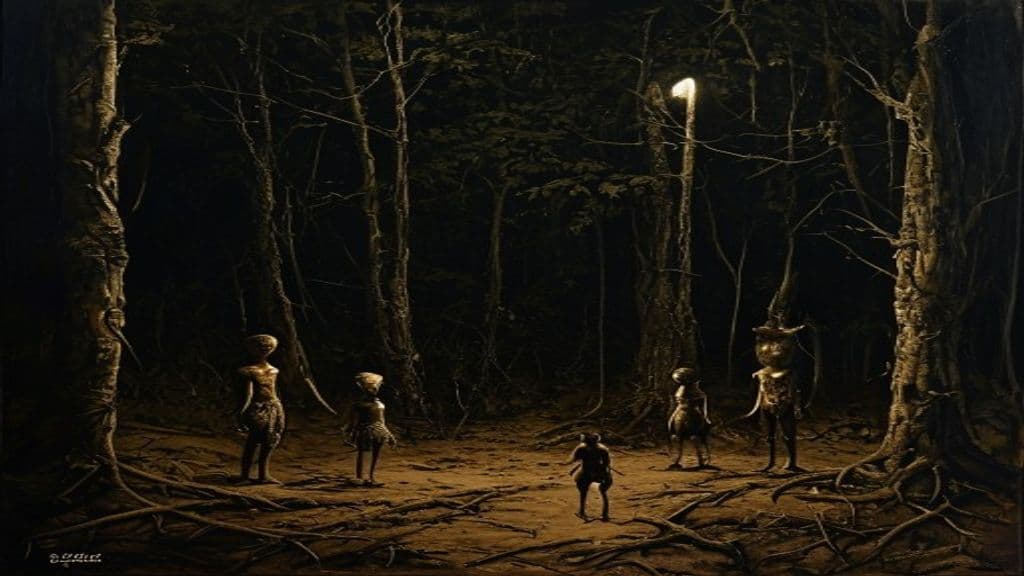
The cited source does not record a single origin myth for the Aziza. Rather than a narrated cosmogony, the available material presents them as an established category of forest inhabitants within West African cosmologies: small supernatural beings long recognized as part of the unseen population of the forest who interact with humans. This positional origin suggests cultural antiquity tied to forest environments and subsistence practices (particularly hunting), where specialized knowledge and techniques are sometimes explained as coming from relationships with non-human forest intelligences rather than solely human invention.
The Aziza are described in the source as 'little people.' No further physical detail is provided in the cited material. From that description alone one can only note that they are conceived as diminutive humanoid beings associated with woodland dwelling; they are specifically said to live in anthills and in silk‑cotton (kapok) trees. The documentation does not elaborate on variant appearances, clothing, or distinguishing features, and thus any detailed visual reconstruction would go beyond the provided source.
According to the source the Aziza provide 'good magic for hunters' and have been known to give practical and spiritual knowledge to people. Their functions are therefore both pragmatic (assistance connected to hunting success and forest survival) and instructive (transmission of spiritual or technical knowledge). The source frames their interactions as beneficent and does not describe malevolent behavior, hostility, or predatory practices.
Weaknesses
- otherNo specific weaknesses recorded in the cited source
Wards
- otherNo wards, protections, or prohibitions against Aziza are described in the cited source
Azazel
In earliest biblical usage Azazel is a ritual locus or destination in the Yom Kippur scapegoat rite to which communal sins are sent; in later Second Temple and subsequent Christian and Islamic receptions Azazel becomes personified as a fallen angel associated with rebellion and the transmission of forbidden knowledge to humans.
Azazil
Azazil (Arabic: ʿAzāzīl; also recorded as Ḥārith) is the pre-fall name or identity in Islamic tradition of the being later identified as Iblis. In exegetical and mystical literature he appears as a high-ranking celestial figure—variously described as leader of angels or as of jinnly origin—whose prideful refusal to obey God's command to prostrate before the newly created human results in his expulsion and permanent damnation as Iblis.
Azeus
Azeus (Ancient Greek: Ἀζεύς; also Aezeius Ἀζειός) is a mortal figure in Greek mythic genealogies, identified as a Minyan prince of Orchomenus. He is recorded as the youngest son of King Clymenus and as a participant in a vengeance expedition against Thebes; through his descendants he is an ancestor of leaders who fought at Troy.
Azhdaha (Aždahā)
Azhdaha (also Aždahā) is a serpentine/draconic monster in Persian literary and folkloric tradition, depicted as a gigantic, often dangerous creature that may inhabit air, sea, or land and appears in epic and cosmological texts.
Azhdahak
Azhdahak (Old Armenian Աժդահակ, also spelled Ashdahak) is the Armenian form of the Avestan figure Azhi Dahaka. In Armenian reception the name refers to the same mythic adversary of Iranian tradition — an imprisoned serpent/dragon-type antagonist who, in Iranian accounts cited by Armenian sources, is bound (on Mount Damavand) and destined to break out at the end of time before being finally defeated.
Azimua
Azimua (earlier Ninazimua) is a Mesopotamian goddess attested from the Ur III period onward, primarily known as the wife/consort of the god Ningishzida and in some traditions functioning as an underworld-associated figure or scribe. She was worshiped in southern Mesopotamia (notably Ur and Umma) and appears in a fragmentary myth, Ningishzida and Ninazimua, which concerns an exchange of messages with her temporarily deceased husband.
Azovka (Azov Girl)
Azovka, often called the Azov Girl in English summaries, is a female supernatural figure named in Pavel Bazhov’s Ural skaz tale "Beloved Name." The supplied sources identify her as a character from Ural-region folklore as represented in Bazhov’s miners’ tales but provide no detailed description or independent folkloric tradition beyond that tale reference.
Azrael
Azrael is the canonical angel of death in Islamic tradition and appears earlier in apocryphal Christian literature; portrayed as a high‑ranking, God‑ordained psychopomp who removes and transports souls, keeps a register of human fates, and acts only under divine command. In some extra‑Quranic and exegetical accounts he is depicted with vast, awe‑inspiring physical attributes and in a few apocryphal Christian texts he is associated with punitive afterlife functions.
Azukiarai
Azukiarai is a Japanese folkloric phenomenon — a yokai-associated auditory apparition characterized by the uncanny sound of azuki (red) beans being washed or ground near water. In stories the sound can lure listeners toward rivers or ponds; accounts vary between treating it as an unseen spirit, a grotesque short humanlike yokai, or the misattributed noise of trickster animals such as tanuki or weasels.
Azukibabaa
Azukibabaa (あずきばばあ, "bean hag") is a Japanese yōkai represented as an old-woman figure whose presence is signaled by the sound of azuki beans being handled (azukiarai). Found in regional folk narratives around Kantō and nearby prefectures, she lures or unnerves night travelers and in some localities is said to scoop up or swallow passersby.
Azukihakari
Azukihakari (小豆はかり) is an Edo-period Japanese household yōkai described as an auditory-only phenomenon that produces the sound of red beans being sown or measured inside a house. The tale records audible disturbances and minor physical effects (debris falling) but no visible apparition or harmful actions.
Azumi-no-isora
Azumi-no-isora (阿曇磯良) is a Shinto kami of the seashore and the ancestral deity of the Azumi people. He is attested in late legends as a lesser sea deity who acted as a navigator in a story involving the loan of the tide jewels to Empress Jingū and is worshiped at several coastal shrines.
Community Record
- [1]Aziza (mythology) — Wikipedia. Wikipedia contributors. "Aziza (mythology)." Wikipedia, The Free Encyclopedia.wiki