
In Malay Annals–style retellings, Badang begins life as a weak, small-statured labourer or slave. While working at a river or fishing site he captures a water spirit (called jembalang air / hantu air) that had been stealing his fish. He ties the spirit by its hair to a rock; the spirit begs mercy and offers a boon. The spirit says that to gain great strength Badang must swallow whatever it coughs up. The spirit then expels a bodily discharge—rendered in variants as vomit or, in sanitized retellings, two red gems (geliga)—which Badang swallows. After ingesting this, he acquires superhuman strength, is freed by his owner on the condition that he never boast and uses his strength to help others, and becomes hulubalang (court champion) to Raja Sri Rana Wicrama (Wikrama) of Singapura.
Sources emphasize Badang's exceptional strength rather than detailed visual description. Narratives state he was small and weakest among his peers before transformation and thereafter is portrayed through his capacity to lift, throw, and split massive stones and to move vessels single-handedly. The water spirit he captures is described in retellings as having eyes 'red as fire', long matted hair, and a long beard reaching the chest or waist.
Badang's acquired abilities are described across multiple accounts as superhuman physical strength. Specific episodes include: single-handedly moving a royal boat when many men could not; carrying villagers' goods in place of horses and carriages; falling onto and splitting a rock later named Batu Belah (the 'Split Stone'); lifting a large palace rock above his head and throwing it so it landed at the mouth of the Singapore River (linked in tradition to the Singapore Stone); and defeating or matching foreign champions in wrestling and strength contests (narrative opponents include champions from Kalinga/Java). Behaviorally, he serves as a loyal champion of the court and helper of common people after his release on condition of humility and public service.
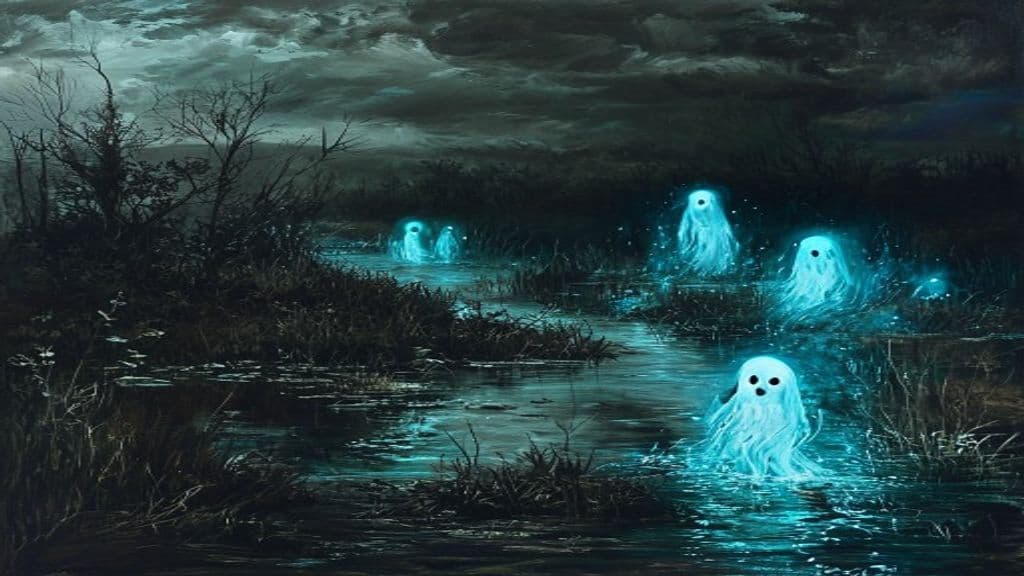
Will-o'-the-Wisp
A wandering light seen over marshy ground at night, leading travellers astray into bogs and fens. Possibly a spirit, possibly the soul of the unbaptised dead, possibly the devil himself.
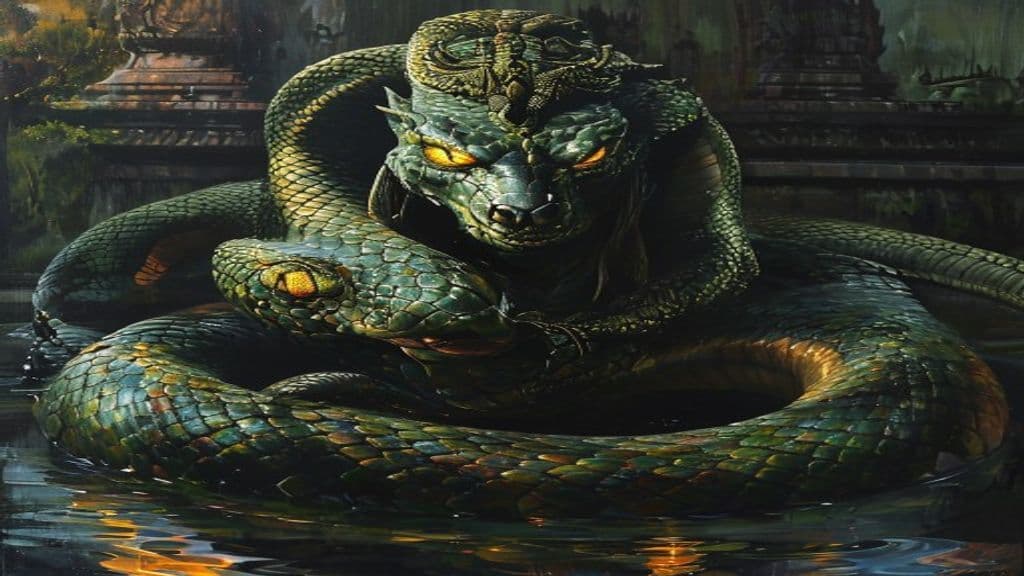
Naga
Divine serpent beings of Hindu, Buddhist, and Jain cosmology — powerful guardians of water, earth, and underground treasures. Revered as deities in South and Southeast Asia.
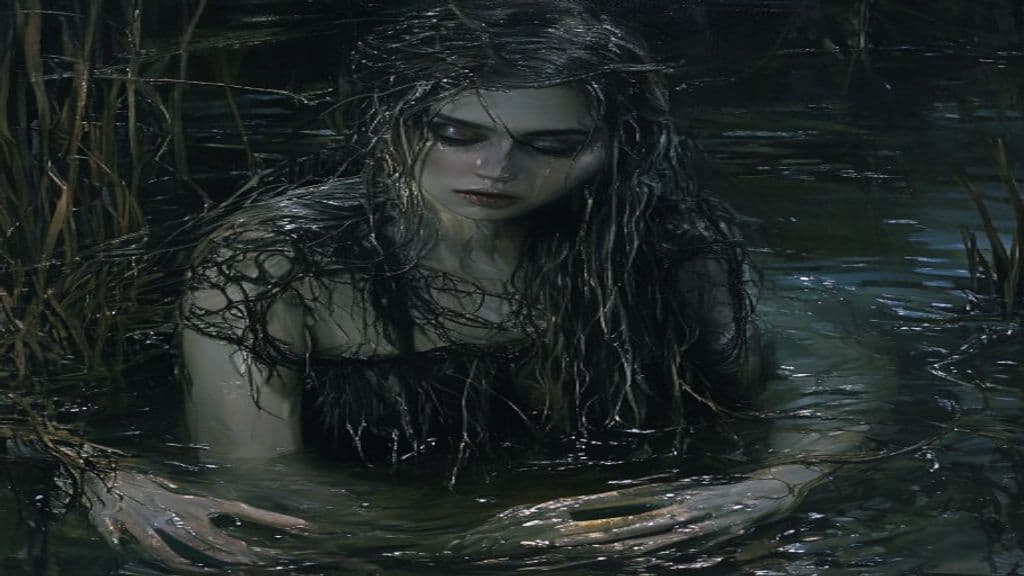
Rusalka
Water spirits in Slavic folklore — the spirits of young women who died by drowning or suicide, bound to rivers and lakes. Beautiful and dangerous, they can bewitch men to their deaths.
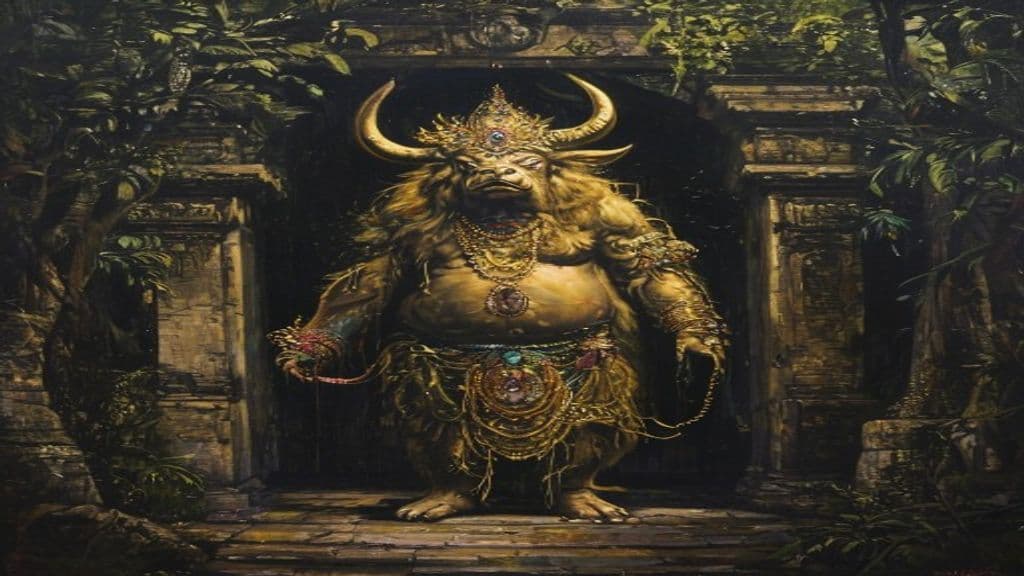
Yaksha
Nature spirits of Hindu, Buddhist, and Jain cosmology — guardians of forests, treasures, and wilderness. Ambivalent beings, capable of great benevolence to the respectful and terrible harm to the greedy.
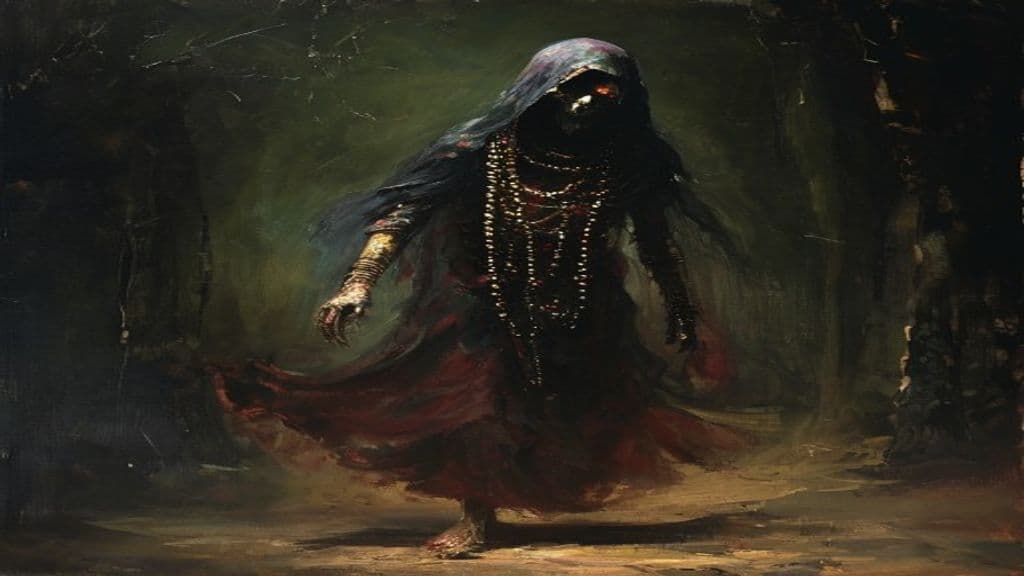
Bhoot (bhoota)
A bhoot (also bhoota, bhoot, bhut) is the culturally specific term across parts of the Indian subcontinent for a perturbed, restless spirit generally understood to be the ghost of a deceased person. Sources describe bhoots as arising when a person's death or post-death circumstances prevent them from moving on — for example violent death, unresolved affairs, or failures in funerary rites — and the term appears frequently in modern South Asian media and discussions.
Bacchus
Bacchus is the Roman identification of the Greek god Dionysus, a deity associated with wine, vegetation and fertility, ritual ecstasy and theatrical performance. In Roman religion he is conflated with the Italic Liber and known for rites that induce possession, frenzy (baccheia), and group revelry.
Bachué
Bachué is a Muisca primordial mother figure presented in colonial-era chronicles and modern summaries as the mother of humanity. She emerges from the sacred Iguaque Lake with an infant who becomes her companion; after populating the earth they transform into snakes and return to the lagoon. She was worshipped at a temple near Iguaque (present-day Chíquiza) and is described as an ancestral, life-giving protectress who sometimes returned from the underworld to guide her people in the accounts cited.
Backstreet Project
Backstreet Project is a 2000 single-issue American comic book tie‑in that depicts the pop group Backstreet Boys as themselves and, within the story, transformed into a superhero team called the Cyber Crusaders after receiving enchanted amulets from an alien. It functioned as a cross‑media promotional property with tie‑in Burger King action figures, three television commercials, and a short Flash webisode series.
Baco
A single modern reference (a Wikipedia disambiguation entry) lists "Baco (god)" with the brief descriptor "a Celtic god of the boar." Beyond that terse label, the supplied sources contain no primary or secondary evidence describing Baco's nature, cult, or mythology.
Badalisc
The Badalisc is a local ritual creature of Val Camonica (Andrista, Cevo) in northern Italy: an animal‑like masked figure captured in the woods at Epiphany, led into the village, and used as a mouthpiece for a satirical public speech that names communal misdeeds before being released back to the woods.
Badalona giants
The Badalona giants (Catalan: gegants de Badalona) are eight large, anthropomorphic effigies used in the civic festival life of Badalona, Catalonia. Constructed of wood, plaster and carton, they represent locally prominent historical or mythological figures and are carried and made to 'dance' in processions during the city's spring festival (May), its principal festival around 15 August, and other municipal occasions.
Badb
Badb is an Irish supernatural female figure associated with warfare, death, and prophecy. She commonly appears as a crow or raven and as a wailing omen, acts on battlefields to sow confusion and foretell slaughter, and is often treated as one member of the triadic Morrígna.
Badoon
The Badoon are a fictional reptilian extraterrestrial species and interstellar polity in Marvel Comics, created by Stan Lee and John Buscema and first appearing in Silver Surfer #2 (October 1968). In the comics they function as a technologically advanced, spacefaring empire notable for strict gender-segregated societies (the Brotherhood and the Sisterhood) and recurring roles as conquerors and antagonists in Marvel's cosmic milieu.
Badrock
Badrock (Thomas John McCall) is a fictional superhero from Image Comics who, as a transformed 16-year-old, possesses a body of organic rock and serves as a member of teams such as Youngblood. He appears across Image Comics titles and crossovers, participating in team-based national-security level missions and occasional metaphysical storylines.
Baduhenna
Baduhenna is a named female deity attested once in Tacitus (Annals) as having a sacred grove (lucus) in ancient Frisia; modern scholarship interprets her name as linking a battle element with the matronal name-element and therefore views her as a local matron-like goddess with associations to war and a cult-site.
Bael
Bael (also spelled Baal or Ba'al) is a named kingly spirit appearing in post‑medieval European demonological grimoires. He is listed as the opening or first spirit in some catalogs (notably the Pseudomonarchia Daemonum and The Lesser Key of Solomon) and is described in short summaries as a hoarsely voiced king; fuller ritual texts and attributes are not present in the supplied excerpts.
Baetyl
A Baetyl is a sacred stone believed to be the dwelling place of a god or deity in ancient Greek tradition, often housed in temples and venerated for its spiritual significance. (Note: 1. Power tier: Primordial (as it houses deities, indicating a higher power level) 2. Abilities: Remove claim that Baetyl's "potentially imbue them with supernatural powers and abilities" as this is no)
Community Record
- [1]Badang (Wikipedia). Wikipedia article 'Badang' summarising Malay Annals–style retellings and modern commentarywiki
- [2]Badang the Strongman: A Miracle-working Grave, A Folk Tale and a Nation’s Mythology. BiblioAsia podcast/article summarising the Badang legend, place-myth links, and modern reusefolk
- [3]Wikidata: Badang. Wikidata entry for Badangother