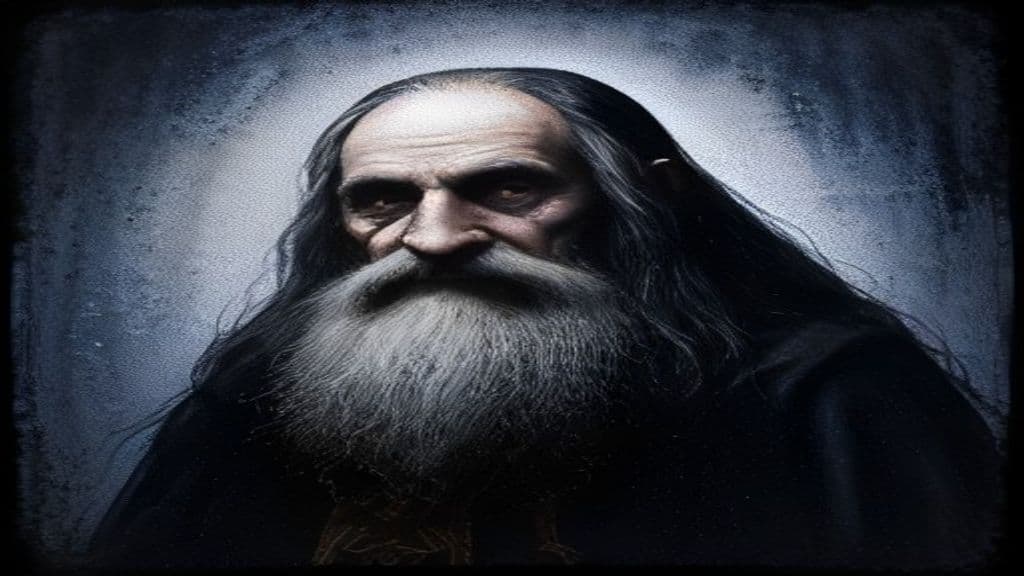
No origin story or mythological genesis for this character is provided in the supplied sources. The available material identifies Balin only as a named fictional character created by J. R. R. Tolkien and listed as a dwarf in his legendarium; further in-world origins would require primary Tolkien texts or scholarly sources not present here.
The supplied sources do not include any physical description of Balin. Aside from the classification as a 'dwarf' on an index entry, no details on stature, clothing, facial features, or other visual traits are attested in the provided material.
No abilities, powers, behaviors, or biographical actions are documented in the provided sources. The available entries are bibliographic/index records that identify Balin as a fictional dwarf in Tolkien's Middle-earth without elaboration.
Anárion
Anárion is a proper name attested as a fictional character in J. R. R. Tolkien's legendarium and as a contemporary proper-name used in music and online handles. The supplied sources identify it primarily as a literary/historical name within Tolkien's secondary world and as modern cultural usages (band name, user credits).
Aulë
Aulë is a divine artisan in J. R. R. Tolkien’s legendarium, one of the Ainur who entered the created world (Arda) to give it material form. Counted among the Valar, he is the principal craftsman and smith whose office is the shaping and working of the world's substance.
Barrow-wight
A wraith-like tomb-spirit coined by J. R. R. Tolkien that inhabits burial mounds (barrows). Modeled on Old Norse mound-spirits (haugbúar/draugr), Tolkien's barrow-wights animate or occupy ancient tombs and, in his narrative, can place living intruders under an enchanted sleep and arrange them with grave-goods until relieved by a powerful agent.
Beorn
A fictional individual in J. R. R. Tolkien's legendarium: a 'skin-changer' who is a man able to assume the form of a great black bear. He is a solitary chieftain who aids the company in The Hobbit and becomes the ancestor of the Beornings, a people retaining diminished bear-shaping power.
Denethor II
Denethor II is the twenty-sixth Ruling Steward of Gondor in J. R. R. Tolkien's legendarium: a human political leader of great will and foresight whose secret use of a palantír and ensuing despair lead to his tragic self-destruction during the War of the Ring.
Radagast (the Brown)
Radagast is a fictional Maiar in J. R. R. Tolkien's legendarium, one of the Istari sent to Middle-earth and chiefly associated with wild animals, plants, and the natural world. He appears only briefly in Tolkien's works and functions largely to aid other characters and to exemplify a nature-focused strand within the Istari.
Saruman
Saruman is a fictional Istari (wizard) in J. R. R. Tolkien's legendarium: originally 'Saruman the White', leader of the Istari and head of the White Council, he becomes a traitor who seeks power through knowledge, industry, persuasion and the creation of armies, and is ultimately defeated, stripped of office, and reduced before his final fall.
Bald Mountain (Slavic)
A location in Slavic folklore associated with witchcraft and the Witches' Sabbath. (Note: 1. Power tier should be Primordial since it's associated with witchcraft and has connections to deities (witches are often seen as having deity-level powers). Greater is too low of a power level. 2. A)
Balder the Brave
Balder the Brave is the Marvel Comics adaptation of the Norse figure Baldr: an Asgardian prince-warrior who serves as a member of Asgard's ruling family, participates in councils of gods, and whose death or wounding has been used as a catalyst in some Marvel storylines (including Ragnarök-style events).
Baldr
Baldr (Old Norse Baldr; Old English Bældæġ; Old High German Balder/Palter) is a god in Germanic mythology. In the Norse branch he is named as a son of Odin and Frigg and as a member of the Aesir, attested alongside brothers such as Thor and Váli in the supplied sources.
Balius and Xanthos
Balius and Xanthos are two named immortal horses in Greek epic associated with Achilles and his charioteer Automedon. Treated as semi-divine companions, they display autonomous behavior in battle and, in one Homeric reference, Xanthus is said to be granted the power of utterance to prophesy Achilles' death.
Balius and Xanthus
A paired set of exceptional, traditionally immortal horses from Greek myth, often given by gods to heroes and famed as the chariot steeds of Achilles. They are noted for divine parentage variants, great speed and endurance, emotional responsiveness, and — in one Homeric episode — a momentary prophetic speech granted by a goddess.
Community Record
- [1]Balin - Wikipedia. Wikipedia contributors. "Balin." Wikipedia, The Free Encyclopedia.wiki
- [2]Balin (Q780499) - Wikidata. Wikidata entry Q780499, "Balin".wiki
- [3]Cactus tracks & cowboy philosophy (archive listing). Archive.org listing included in research notes.other
- [4]Feri, Balin Planeta Zeilor V. 0.9.8 (archive listing). Archive.org listing included in research notes.other
- [5]CIA Reading Room document listing. Archive.org CIA Reading Room listing included in research notes.other