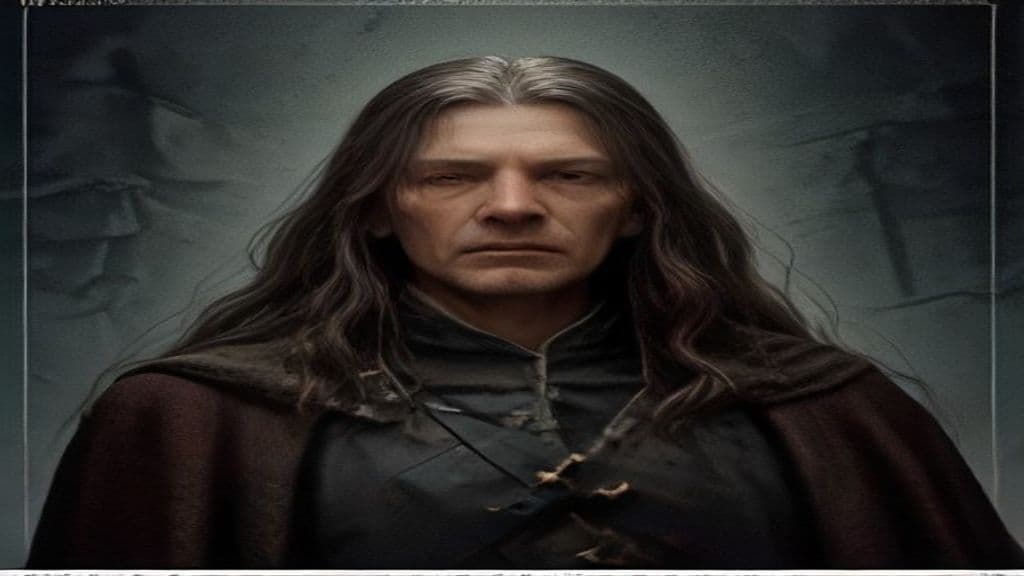
Denethor II is presented in Tolkien's narrative as the ruling Steward of Gondor during the War of the Ring, descended in the line of Stewards who governed in the absence of a king. He is father to Boromir and Faramir; the death of Boromir and the wounding of Faramir occur within the same war-time context that precipitates his descent into despair. As Steward he inherits civil authority, military command, and the ceremonial regalia of office (including the white rod); his tenure is set against Gondor's waiting for a returning king and the increasing pressure of Sauron's forces.
Primary textual sources emphasize Denethor's bearing and temperament rather than an elaborate physical portrait: he is depicted as proud, subtle, and grave, carrying the weight of stewardship, grief for Boromir, and mounting bitterness. Film portrayals (Peter Jackson's adaptation) present a more visually specific image—leaner, marked by visible indulgence and theatrical despair—but the literary emphasis remains on his stern demeanor, signs of embitterment, and the physical acts of his final scene (breaking the white rod, clasping the palantír on a funeral pyre).
Denethor's effective powers are political and psychological rather than supernatural: as Steward he commands Gondor's defenses (ordering beacon-lighting, mustering troops, directing evacuations and the defense of Osgiliath) and exerts strong will and insight in counsel and judgement. Tolkien records that he possesses 'long sight' as a gift of perception—he can, when he bends his will, perceive much of what is passing in the minds of men—making him difficult to deceive. He also secretly uses the palantír of Minas Tirith: contact with that seeing-stone enables remote perception but exposes him to Sauron's manipulations; while not wholly dominated, Denethor is deceived into believing defeat inevitable, and the effort and influence associated with the stone hasten his physical and mental decline. His trajectory culminates in ritualized self-destruction: breaking the white rod of office, preparing a funeral pyre in Rath Dínen, and lying upon it clasping the palantír.
Weaknesses
- conditionreliance on solitary counsel and secret use of the palantír
- conditiongrief and despair over personal and civic loss
Wards
- othercounsel and communal trust
- otherrefusal of solitary use of prophetic artefacts (avoid secret palantír contact)
- otheractive moral intervention by a trusted leader (exemplified by Gandalf’s corrective action)
Anárion
Anárion is a proper name attested as a fictional character in J. R. R. Tolkien's legendarium and as a contemporary proper-name used in music and online handles. The supplied sources identify it primarily as a literary/historical name within Tolkien's secondary world and as modern cultural usages (band name, user credits).
Aulë
Aulë is a divine artisan in J. R. R. Tolkien’s legendarium, one of the Ainur who entered the created world (Arda) to give it material form. Counted among the Valar, he is the principal craftsman and smith whose office is the shaping and working of the world's substance.
Balin
Balin is identified in the provided sources as a fictional character created by J. R. R. Tolkien, listed as a dwarf in Tolkien's legendarium of Middle-earth. The available references are index-style entries and do not supply in-world narrative details, appearance, abilities, or rituals.
Barrow-wight
A wraith-like tomb-spirit coined by J. R. R. Tolkien that inhabits burial mounds (barrows). Modeled on Old Norse mound-spirits (haugbúar/draugr), Tolkien's barrow-wights animate or occupy ancient tombs and, in his narrative, can place living intruders under an enchanted sleep and arrange them with grave-goods until relieved by a powerful agent.
Beorn
A fictional individual in J. R. R. Tolkien's legendarium: a 'skin-changer' who is a man able to assume the form of a great black bear. He is a solitary chieftain who aids the company in The Hobbit and becomes the ancestor of the Beornings, a people retaining diminished bear-shaping power.
Radagast (the Brown)
Radagast is a fictional Maiar in J. R. R. Tolkien's legendarium, one of the Istari sent to Middle-earth and chiefly associated with wild animals, plants, and the natural world. He appears only briefly in Tolkien's works and functions largely to aid other characters and to exemplify a nature-focused strand within the Istari.
Saruman
Saruman is a fictional Istari (wizard) in J. R. R. Tolkien's legendarium: originally 'Saruman the White', leader of the Istari and head of the White Council, he becomes a traitor who seeks power through knowledge, industry, persuasion and the creation of armies, and is ultimately defeated, stripped of office, and reduced before his final fall.
Demons in Mandaeism
In Mandaean cosmology, 'demons' are the hostile inhabitants of the World of Darkness, a structured underworld of kings, paired rulers, guards and lesser spirits that oppose the beings of Light. They appear throughout Mandaean scriptures (notably the Right Ginza and Diwan Abatur) as named personages, consorts, matarta (gate) guards, devourers and other functionaries encountered in mythic descent narratives.
Demophon of Athens
Demophon (Δημοφῶν / Δημοφόων) is a legendary Athenian hero and king of the heroic age whose narrative links the Theseus-cycle, the post‑Trojan War returns, and foundation stories for Athenian institutions. He appears in varied traditions as a Trojan War veteran, host to the Heracleidae, founder of the court of the Ephetae after an accidental homicide, and as party to the Phyllis/Acamas cycle of tragic return.
Demoptolemus
Demoptolemus (Ancient Greek: Δημοπτόλεμος) is a mortal figure named among the suitors of Penelope in the Homeric epic tradition. He is listed as one of the suitors present in Odysseus’s hall and is reported in the narrative tradition to have been killed during Odysseus’s slaughter of the suitors (Odyssey Book XXII).
Deoha
Deoha is the name of a river — a tributary of the Ramganga — that rises in the Shivalik Hills and flows through Uttarakhand into the plains of Uttar Pradesh, where it is known by the name Deoha and further downstream as the Garra. The supplied sources contain no documentation of a supernatural household guardian or offended spirit called Deoha or Deoha‑Rooh.
Deor
A poet and subject of an Old English poem found in the Exeter Book, reflecting on misfortune attributed to him. (Note: 1. Power tier should be Primordial, as it's an Old English poem and subject, not a supernatural entity with defined abilities. 2. Add description of Deor's reflection on misfortune from Source 1 as se)
Community Record
- [1]Denethor. Wikipedia: Denethorwiki
- [2]Denethor. Wikidata: Denethorwiki
- [3]Denethor II (ValarGuild article). ValarGuild: Denethor IIother
- [4]Denethor as Macbeth: The Tragedy of the Last Ruling Steward of Gondor. ValarGuild essay comparing Denethor to Shakespearean tragedyother
- [5]Denethor the impious | Alan Jacobs. Alan Jacobs: Denethor commentaryother
- [6]We Part 5 "Tying It All Together" (sermon excerpt). Archive sermon referencing Denethorother
- [7]Hot+keys #61: I Don't Need Wood On My Side (archive). Archive commentary and adaptations referencing Denethorother
- [8]Khraniteli (archive). Archive entry on adaptations referencing Denethorother
- [9]Why did Denethor choose to burn himself to death? (Scifi.StackExchange discussion). Scifi.StackExchange discussion of Denethor's motivesother
- [10]Denethor in Tolkien's Letters (Rogorn compilation). Compilation of letters and references concerning Denethorother
- [11]Lord of the Rings: The Return of the King (film notes). Film synopsis and notes on Denethor's depictionother
- [12]Denethor - Planet Tolkien. Planet Tolkien discussion and notesother
- [13]Various web essays and commentaries (aggregate). Collected scholarly commentaries cited in research notesother