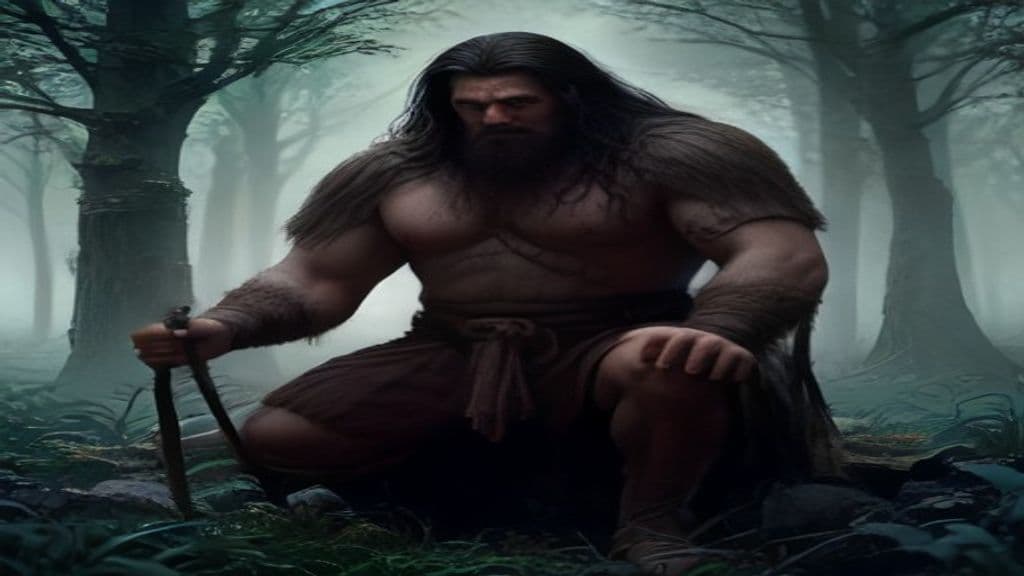
Within The Hobbit narrative, Beorn first appears as a solitary skin-changer who receives Gandalf, Bilbo, and the thirteen Dwarves after they flee the trolls and escape Mirkwood. He judges their tale, provides them lodging and supplies, and later acts as a regional chieftain, coming to fight in the Battle of Five Armies where, in bear-form, he kills Bolg and his bodyguards. Tolkien additionally frames his name and character in philological terms: Beorn evokes Old English beorn ('man', 'warrior') and Scandinavian Björn ('bear'), linking him to Northern heroic traditions; his later status as progenitor of the Beornings is presented in-text as historical/ancestral rather than as a mythic cosmogony.
In human form Beorn is of immense size and strength for a man: Bilbo notes that a child could pass between his legs without touching him; he has black hair, a thick black beard, great bare arms and legs with knotted muscles, and wears a wool tunic down to his knees. In bear-form he becomes a 'great black bear' retaining that great strength. He lives in a wooden house with livestock (horses, dogs, sheep, cows), keeps bees and plants clover, and is associated with the Carrock—a large rock on the River Anduin to which he had made steps.
Beorn's principal supernatural ability is shapechanging between man and a great black bear; Tolkien states that for many generations his line retained the power to take a bear's shape in diminished form. He possesses exceptional physical strength and combat prowess in either form; in the Battle of Five Armies his bear-form is credited with killing the Orc-chief Bolg and his attendants. Behaviorally he is an independent, solitary chieftain who judges visitors' trustworthiness (he verifies the company's story before aiding them), provides hospitality and provisions, and periodically leaves home for hours or days for unspecified journeys. Sources note variability among his descendants, some being 'grim men and bad', but most 'in heart like Beorn, if less in size and strength.'
Anárion
Anárion is a proper name attested as a fictional character in J. R. R. Tolkien's legendarium and as a contemporary proper-name used in music and online handles. The supplied sources identify it primarily as a literary/historical name within Tolkien's secondary world and as modern cultural usages (band name, user credits).
Aulë
Aulë is a divine artisan in J. R. R. Tolkien’s legendarium, one of the Ainur who entered the created world (Arda) to give it material form. Counted among the Valar, he is the principal craftsman and smith whose office is the shaping and working of the world's substance.
Balin
Balin is identified in the provided sources as a fictional character created by J. R. R. Tolkien, listed as a dwarf in Tolkien's legendarium of Middle-earth. The available references are index-style entries and do not supply in-world narrative details, appearance, abilities, or rituals.
Barrow-wight
A wraith-like tomb-spirit coined by J. R. R. Tolkien that inhabits burial mounds (barrows). Modeled on Old Norse mound-spirits (haugbúar/draugr), Tolkien's barrow-wights animate or occupy ancient tombs and, in his narrative, can place living intruders under an enchanted sleep and arrange them with grave-goods until relieved by a powerful agent.
Denethor II
Denethor II is the twenty-sixth Ruling Steward of Gondor in J. R. R. Tolkien's legendarium: a human political leader of great will and foresight whose secret use of a palantír and ensuing despair lead to his tragic self-destruction during the War of the Ring.
Radagast (the Brown)
Radagast is a fictional Maiar in J. R. R. Tolkien's legendarium, one of the Istari sent to Middle-earth and chiefly associated with wild animals, plants, and the natural world. He appears only briefly in Tolkien's works and functions largely to aid other characters and to exemplify a nature-focused strand within the Istari.
Saruman
Saruman is a fictional Istari (wizard) in J. R. R. Tolkien's legendarium: originally 'Saruman the White', leader of the Istari and head of the White Council, he becomes a traitor who seeks power through knowledge, industry, persuasion and the creation of armies, and is ultimately defeated, stripped of office, and reduced before his final fall.
Benthesikyme
Benthesikyme (Βενθεσικύμη; Latinized Benthesicyme) is a female sea-nymph in Greek myth, named etymologically from benthos (depth, deep-swells) + kyma (wave). Classical mythographers identify her as a daughter of Poseidon and Amphitrite and as the foster-mother of the hero Eumolpus; some sources place the narrative involving her in Aithiopia (Ethiopia).
Benzaiten
Benzaiten (弁才天/弁財天), often shortened to Benten, is an East Asian Buddhist protective goddess derived from the Indian Sarasvatī. In Japan she was syncretized with Shinto kami and local serpent/dragon spirits, functioning as a patron of speech, music, learning, wealth, and a protective deity whose vows in the Golden Light Sutra promise protection to those who recite or copy it.
Beor
Beor (Hebrew Bor) is a personal name attested in biblical and extrabiblical sources chiefly as the father of the non‑Israelite seer Balaam. He functions as a patronymic identifier that locates Balaam within ancient Near Eastern genealogical and onomastic networks; sources do not present Beor as an independent supernatural agent.
Beowa (Germanic Tradition)
A figure associated with barley and agriculture, appearing in Anglo-Saxon royal genealogies. (Note: - Power tier should be Primordial or Ancient, as it's associated with agriculture and fertility on a cosmic or deity-level. - The appearance section is missing, but since there's no description in the)
Beowulf
Beowulf is a legendary Geatish hero preserved in the Old English epic poem Beowulf. Presented as an exceptional human warrior and later king, he undertakes dangerous journeys to aid other polities (notably the Danes of Hrothgar) and to protect his own people, confronting monstrous threats such as Grendel and Grendel's mother.
Community Record
- [1]Beorn. Wikipedia: Beornwiki
- [2]Beorn (Wikidata). Wikidata entry Q1750830other
- [3]Beorn — Valar Guild (encyclopedic article). Valar Guild encyclopedia entry on Beornother
- [4]Archive: Could the Vikings Understand the Anglo-Saxons? Old Norse & Old English Mutual Intelligibility?. Archive.org video referenced in notes (linguistic/philological context)other