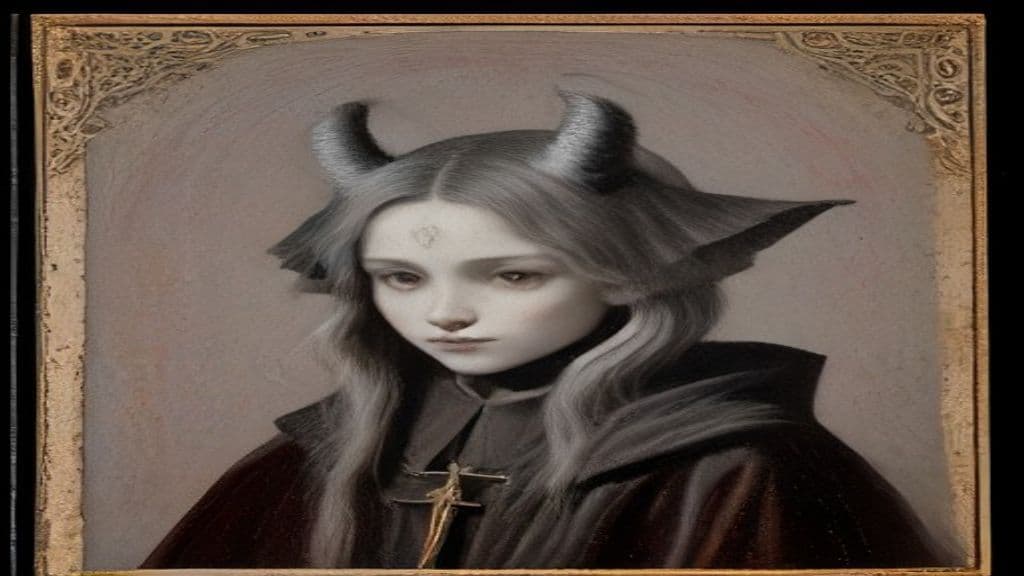
In medieval sources the name appears in trial records and polemical literature associated with allegations against the Knights Templar (early attestations in crusade chronicles and Provençal texts are recorded between the 11th and 13th centuries). Modern scholars summarized in the provided materials treat the Templar‑era name as an Old French corruption of 'Mahomet' (Muhammad), meaning the medieval use functioned as a polemical label for an alleged idol or foreign god in inquisitorial rhetoric. Éliphas Lévi and later occultists reinvented the figure in the mid‑19th century as a synthesized emblem used for philosophical and initiatory symbolism rather than as a continuation of a concrete medieval cult object.
Descriptions vary by historical layer. Medieval trial testimonies are inconsistent: some confessors described an idol as a severed head, a cat, a head with three faces, a painted wooden head, or sometimes a human skull. Éliphas Lévi's 1856 occult illustration established the now‑familiar image of a winged, androgynous human‑goat hybrid (the 'Sabbatic Goat') combining symbolic opposites. Later popular iconography distilled goat imagery further into the goat's head within an inverted pentagram (the Sigil of Baphomet) as a modern emblem associated with earthly or carnal symbolism.
Medieval inquisitorial records attribute efficacies to the alleged idol only as accusations recorded in indictments and confessions (for example, a cited indictment claims confessors said the head 'could save them' or 'made the trees flower'); these are claims within judicial testimony often obtained under coercion and are inconsistent across witnesses. 19th‑century occult sources treat Baphomet as a symbolic teaching device representing reconciliation of opposites and esoteric knowledge rather than as an agent with overt supernatural powers. Modern fictional and entertainment sources sometimes ascribe varied active powers to characters named Baphomet, but such abilities are creative reimaginings and not continuous with the medieval or Lévian symbolic uses documented in the provided materials.
Banjhākri and Banjhākrini
Forest-dwelling shamanic supernatural beings of the Kirati and related Himalayan traditions, presented as a male wilderness shaman (Banjhākri) who trains human shamans and a complementary female shamaness (Banjhākrini) who functions as an initiatory threat.
Bannik
A place-bound spirit of the Slavic banya (bathhouse) that inhabits the steam room and related spaces; he mediates divination, presides over births within the banya, and must be appeased by offerings or he may harm or otherwise vex users and the building.
Banshee
A female spirit of Irish and Scottish folklore whose wail heralds an impending death in a family of Gaelic descent. Not a cause of death — a witness to it.
Banu Goshasp
Important heroine in Iranian mythology, appearing in several Persian epics including the Banu Goshasp Nama. (Note: - The power tier should be Ancient, not Primordial, as there's no indication that she has cosmic-level abilities. - There are no sensory cues, weaknesses, or wards listed, but they could potentially b)
Baobh-shìth
A female fairy of Scottish Highland folklore portrayed as a beautiful but deadly supernatural woman who seduces and kills lone men at night. Tales place her within the Highland sidhe corpus while linking her actions to a motif in which nighttime wishes made without invoking divine protection are answered by malevolent agencies.
Baobhan Sith
A Scottish Highland vampire fairy — a beautiful woman in a green dress who appears to men alone in the wilderness and drains their blood, her deer hooves hidden beneath her skirts.
Bar Juchne
A colossal bird from Jewish tradition, described as having a massive wingspan large enough to block out the sun. (Note: * Power tier should be at least Ancient, given its ability to block out the sun. * Origin story section is missing, with no information provided by Source 1. * No specific weaknesses or wards mentione)
Barachiel
Barachiel (Hebrew: בַּרַכְאֵל, Baraḵʾēl, 'God has blessed') is an archangelic figure in Jewish mystical literature and in Byzantine Catholic and Eastern Orthodox Christian devotion, traditionally associated with blessings, guardianship of family and married life, and as chief of guardian angels. Mystical texts place him over the second heaven and attended by a vast retinue of ministering angels; Christian iconography portrays him with symbols of blessing such as a white rose, rose petals, a bread basket, or a staff.
Baraka (Mortal Kombat)
Baraka is a recurring fictional character in the Mortal Kombat franchise portrayed as a Tarkatan warrior and antagonist. First introduced as a playable fighter in Mortal Kombat II, he appears across multiple games and in film adaptations, varying between playable roster member and non-playable opponent depending on the installment.
Barama
The available sources do not describe a supernatural being named Barama. The string "Barama" appears in the supplied corpus as a toponym, a language name, an institutional name, and a radio-station name, but there is no folkloric, ritual, or mythological information about a goddess or spirit called Barama in these sources.
Barbad
Barbad (Persian: باربد) was a celebrated late 6th–early 7th-century Persian musician-poet, music theorist and composer associated with the Sasanian court of Khosrow II. Preserved mainly through later Arabic and Persian literature and oral tradition, he functions in medieval and modern memory as the archetypal court minstrel of Sasanian musical culture.
Barbara Gordon
Barbara Joan Gordon is a recurring fictional character in DC Comics' Batman mythos, introduced as the costumed vigilante Batgirl and later reimagined as Oracle, a paraplegic information broker and technical advisor to other heroes. She functions as a human, non-supernatural operative whose roles alternate between field crime-fighter and behind-the-scenes intelligence specialist across publication eras and media adaptations.
Community Record
- [1]Baphomet (Wikipedia). Wikipedia contributors. "Baphomet." Wikipedia, The Free Encyclopedia.wiki
- [2]Sigil of Baphomet (Wikipedia). Wikipedia contributors. "Sigil of Baphomet." Wikipedia, The Free Encyclopedia.wiki
- [3]Baphomet — Thelemapedia. Thelemapedia. "Baphomet." The Encyclopedia of Thelema & Magick.other
- [4]Baphomet (Primevalvoid summary). Primevalvoid. "Baphomet." (symbolic and cultural discussion linking goat imagery and occult themes).other
- [5]Archive: Kamala's Ties to Secret Societies (podcast). Podcast archive excerpt discussing modern conspiratorial uses of the Baphomet name.other
- [6]Archive: Make Armageddon Great Again (podcast). Podcast archive excerpt referencing Baphomet in polemical/conspiratorial discourse.other
- [7]Baphomet — Marvunapp (fictional usages). Marvunapp. "Baphomet (Son of Satan foe)." (entry documenting fictional character portrayals).other
- [8]Baphomet — bibliography/essay (Nicholas Creed). Nicholas Creed. "Baphomet Representing Transhumanism." (modern symbolic interpretation).other
- [9]Wikidata: Baphomet. Wikidata entry for Baphomet.wiki
- [10]Biblioteca Pleyades: Baphomet - The Secret of the Templar Fortune. Biblioteca Pleyades. Popular/conspiratorial discussion linking Templar accusations and later mythmaking.other