
The available ethnographic summaries do not record a single creation myth for buso; rather, the term functions as an umbrella category in Bagobo cosmology for numerous harmful lower beings and spirits. Colonial contact sometimes blurred local categories (Spanish usage of dios could be applied to both buso and diwata), but buso persist in local narratives as an array of agents responsible for sickness, death, and predation on flesh.
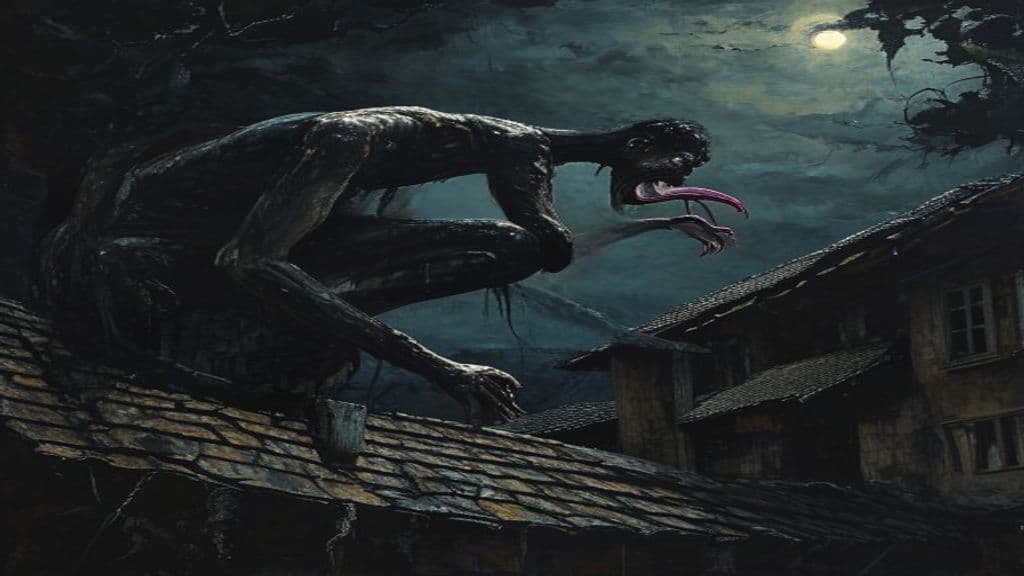
There is no single canonical form for buso; the category includes many named variants with distinct morphologies. Secondary summaries note motifs such as emaciated or long-necked bodies and long fingers, but distinctive named forms include: tigbanua (skinny, often one-eyed, sharp teeth and claws, flexible necks, hooked chin to catch blood), Abuy and Riiu (pig-like underground creatures), Blanga (insect-like with branching horns), Buntud (described as having nine faces and black skin in some accounts), Karokung (a beautiful river woman with white skin and flowing black hair, black or blue feet), Mantianak (female ghost with talons and a hole in the chest), and Kilat (giant storm-riding horses or carabao).
Buso commonly function as predators of flesh, consumers of the dead, and etiological agents of disease and fever; many types are said to send sickness or plague rather than always engaging in direct open attack. Specific behaviors vary by subtype: tigbanua are described as cannibalistic hunters who hunt in groups but may take single victims and can be physically attacked; Riwa-riwa listen to human talk and drop to inflict sickness if offended; Balinsugu stirs up enmity and feeds on blood after violent disputes; some buso (e.g., S'iring, Tagamaling) use deception by taking the form of loved ones or ordinary people to lure victims. At Mount Apo buso were said to depart as sulphureous vapor during eruptions and to be associated with invisible animals serving them.
Weaknesses
- conditionfear of dogs (noted for tigbanua)
Wards
- ritualshrines and offerings to buso
- conditionavoidance practices (not entering a neighbor's empty house; not traveling alone)
- otherkeeping dogs as deterrent against certain types (tigbanua)
Bathalà
In pre‑colonial Tagalog religion Bathalà (also Maykapál) functions as the transcendent supreme creator-preserver — the originator and ruler of the universe. The lexeme also served as an honorific applied to lesser tutelary spirits and portentous phenomena, and was later syncretized with the Christian Dios after Spanish contact.
Berberoka
A water-associated swamp spirit or creature from northern Luzon (Philippines) said to prey on people at ponds, lakes, rivers, and swamps by manipulating water—draining and reflooding sites to drown victims. Described in summaries as a 'swamp creature' or 'water ogre'; some modern adaptations portray it as a scaled ogre.
Nuno sa Punso
A Philippine localized nature spirit described as a small, elderly mound-dweller tied to anthills, termite mounds, and other specific landscape features; considered an ancestral/guardian presence that punishes those who disturb its territory and is placated through ritual etiquette, offerings, and traditional healer intervention.
Philippine mythical creatures
A broad, plural category of legendary beasts, monsters, and supernatural beings found across more than 140 ethnic groups in the Philippines; these beings occupy local folkloric cosmologies and are distinct from major deities and heroes. They appear in traditional tales and in contemporary retellings and media, which continue to reinterpret and popularize them.
Tikbalang
A Philippine nature spirit/phantom associated with wild, liminal places; often depicted in later accounts as a tall, lanky half-horse, half-human trickster that can mislead travelers, guard trees or territories, and in some versions be tamed or domesticated by humans.
Tiyanak
The tiyanak is a malevolent Philippine supernatural being typically depicted as an infant‑shaped spirit that lures people by imitating a baby’s cry and then attacks or abducts them. It is variously understood as the restless soul of an infant who died unnamed or unbaptized and, in older Spanish‑era accounts, as an obstetric spirit (patianac) that obstructs childbirth.
Busaw
A malign corpse‑stealing being that resembles humans by day, lives near burial grounds, and preys on freshly dead corpses—stealing them from coffins, transforming them into pigs, and consuming them. It also attempts to spread its condition by feeding stolen human flesh to neighbors.
Buschgroßmutter
A female wood/forest spirit of German folklore, especially attested in Thuringia, Saxony, German Silesia and parts of Bohemia and Transylvanian Saxon tradition. She is an ancient, ambivalent grandmotherly figure of the underwood who may reward respectful helpers or punish mockery and transgression of forest norms.
Busiris
Busiris (Greek: Bousiris, Βούσιρις) is a name used in Greek-language myth and geography for several Egyptian towns and for at least two mythic personages: a legendary king of Egypt portrayed in Heracles cycle stories and a mortal son of Aegyptus in genealogical lists. In Greek tradition the king-figure is remembered chiefly for instituting the sacrifice of foreigners and for his confrontation with Heracles.
Butes
Boutes (Ancient Greek: Βούτης, Boútēs, literally 'herdsman') is a personal name applied to several distinct figures in Greek mythology — mortal princes, Argonauts, warriors, and local cult-heroes — rather than a single supernatural species. Bearers of the name appear across multiple heroic cycles and locales, notably an Athenian priest-hero, an Argonaut rescued by Aphrodite, and a Thracian punished by Dionysus.
Button-Bright
Button-Bright is a fictional boy created by L. Frank Baum who appears as a recurring secondary protagonist in several Oz books. He is portrayed as an absent-minded, wandering child who participates in journeys around the Emerald City and its neighbouring lands rather than as a supernatural being.
Buttons (pantomime)
Buttons is a stock theatrical character in British and Australian Cinderella pantomimes, typically a male household servant who helps Cinderella, expresses affection for her, and provides comic and emotional engagement with the audience. The role is conventional to stage pantomime practice rather than a supernatural being.
Community Record
- [1]Buso (Philippine mythology) - Wikipedia. Wikipedia contributors, 'Buso (Philippine mythology),' Wikipedia, The Free Encyclopediawiki
- [2]The BUSO Complex in BAGOBO Folklore • THE ASWANG PROJECT. Aswang Project, 'The BUSO Complex in BAGOBO Folklore'folk
- [3]buso | Facts, Information, and Mythology (Pantheon.org). Pantheon.org, 'buso'other
- [4]Tigbanua buso | Forgotten Realms Wiki | Fandom. Forgotten Realms Wiki (Fandom), 'Tigbanua buso' (popular-culture adaptation noted but treated as derivative)wiki