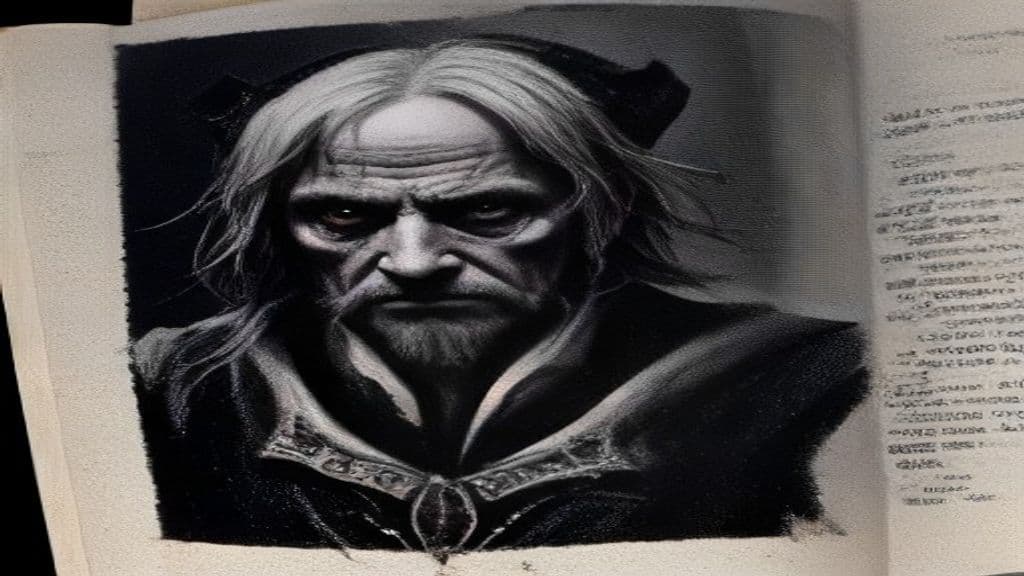
In Christian and European demonological reception Belphegor is traditionally identified with the biblical Baal‑Peor (Hebrew בַּעַל‑פְּעוֹר, baʿal‑pəʿōr), a local Baal associated in the Hebrew Bible with licentious cultic practices at Peor. Over time, polemical and demonological writings recast that named pagan deity as a personified infernal agent in Christian moral taxonomy and later literary works, a trajectory reflected in demonological lists and in fiction.
Descriptions vary across sources. Older demonological and occult lists typically treat Belphegor as a named infernal agent without a single canonical physical form; literary works (e.g., Machiavelli's Belfagor) portray him as capable of incarnate visitation and of appearing within human society. A modern anonymous archive excerpt gives a humanoid depiction (bearded, horned, hoofed) with idiosyncratic imagery, but that portrayal is a late, singular variant and is not corroborated by the classical sources cited.
Across the cited traditions Belphegor is said to tempt humans by promising or bestowing wealth and the means of discovery (he 'proposes incredible inventions that will make them rich'), and to lead people into sin by encouraging laziness (per Peter Binsfeld's classification) or, in one Lollard source, gluttony. Kabbalistic writings describe him as quarrelsome and an enemy of the sixth sefirah, Tiferet. Literary treatments use him as a tempter, satirical visitor, or corrupter of social relations. A number of modern archival or popular reworkings attach additional attributes (political corruption, scatological motifs), but those specific details are singular and are treated as uncertain.
Weaknesses
- otherOpposition by Christian intercession (literary/demonological attribution to saints such as Mary Magdalene)
Wards
- otherChristian virtue and opposition (implicit in demonological tradition; De Plancy names Mary Magdalene as his enemy)
Great Duke
A classificatory title used in Christian demonological systems to denote a high-ranking demon, analogous to earthly and angelic offices. The term functions as a rank within hierarchical taxonomies of infernal beings rather than a single, individuated monster in the provided sources.
Belisama
Belisama is a Gaulish goddess attested in Roman-period inscriptions and place-names. Epigraphic evidence records formal dedications (including a nemeton and a votive sacrum) and at least one inscription equates her with the Roman Minerva; scholars debate whether her name denotes brightness, strength, or a plant-name, and toponymic evidence also suggests riverine associations.
Bell Witch
A largely invisible, communicative haunting centered on the Bell family in early 19th‑century Robertson County, Tennessee. In nineteenth‑century accounts the presence spoke, mimicked voices, produced poltergeist‑style disturbances, caused bodily harm (pinching, hair‑pulling, paralysis), and was blamed in legend for the death of John Bell Sr.
Belled Buzzard
A figure of American folk tradition, the belled buzzard is a turkey vulture described as bearing a bell and treated in popular reportage and storytelling as a singular, recurring omen that foretells disaster or death by the sound of its bell. The legend originated from actual instances of people fastening bells to buzzards in the mid-19th century and rose to prominence in the late 19th century, especially after association with the 1878 Brownsville, Tennessee yellow fever epidemic.
Bellerophon
Bellerophon is a heroic figure of ancient Greek tradition, famed as a slayer of monsters and the tamer of Pegasus. Various accounts present him as of mixed divine and mortal lineage and as an exemplar of heroic achievement enabled by divine aid and constrained by social-ritual norms.
Bellōna
Bellōna is an ancient Roman goddess personifying war, especially the destructive, bloody, and tumultuous aspects of armed conflict. She had an active civic cult in Rome (including a temple associated with a war column, the columna bellica) and appears frequently in Roman literature and art as an armed, helmeted female figure who accompanies or intensifies battle.
Belobog
Belobog is a name appearing in modern summaries of Slavic religion as a deity associated with light and the sun, typically presented as the opposing pole to Chernobog in a binary contrast of light/dark. Attestations in the provided sources are fragmentary and largely secondary or modern; primary medieval evidence for a named Belobog is not supplied in the excerpts.
Belsnickel
Belsnickel is a traditional fur-clad Yuletide visitor from the Palatinate region of southwestern Germany who inspects children's behaviour, disperses sweets to the well-behaved, and threatens or administers punishment (often symbolically) to the naughty. The figure survives in Pennsylvania Dutch and other diaspora communities and appears both as a solitary domestic visitor and as part of boisterous communal processions called 'Belsnickling' or 'Klausentreiben'.
Beltrame
Beltrame is a traditional commedia dell'arte stock character associated with the city of Milan (and nearby Gaggiano), dating to the 16th–17th century or earlier. He functions as a crafty, pretentious villager/husband whose costume (notably the large tunic or gippa, purse, and dagger) and comic antics represent Milanese civic identity onstage.
Belus (Tyre)
Belus is the Greco‑Latin umbrella rendering of Semitic lord‑titles (bēlu/baʿal) that in classical literature appears in multiple guises; in Latin epic and genealogical tradition he functions as a legendary king of Tyre, presented as the father of Dido and Pygmalion and as an ancestral founder figure rather than a defined supernatural being.
Ben Lockwood (Agent Liberty)
Ben Lockwood is a fictional human political antagonist in the Arrowverse (primarily Supergirl, Earth-38) who adopts the persona Agent Liberty to lead the anti-alien movement Children of Liberty. He is a former history professor and media host whose influence is rhetorical and organizational rather than supernatural.
Bendidia
The festival or cult dedicated to the Thracian goddess Bendis, celebrated in ancient Athens on the 19th day of Thargelion in Piraeus. (Note: 1. Power tier should be Primordial (Bendis is described as a Thracian goddess, implying a cosmic-level deity) 2. Appearance and Abilities sections are missing; add them from source material (if availa)
Community Record
- [1]Belphegor (Wikipedia). Wikipedia entry 'Belphegor' (as cited in research notes)wiki
- [2]Belphegor (Internet Archive item). Anonymous archive excerpt (modern/unsourced) referenced in research notesother
- [3]The works of Nicholas Machiavel (catalog entry). Archive listing confirming Machiavelli's Belfagor novella (catalog entry noted in research notes)literary