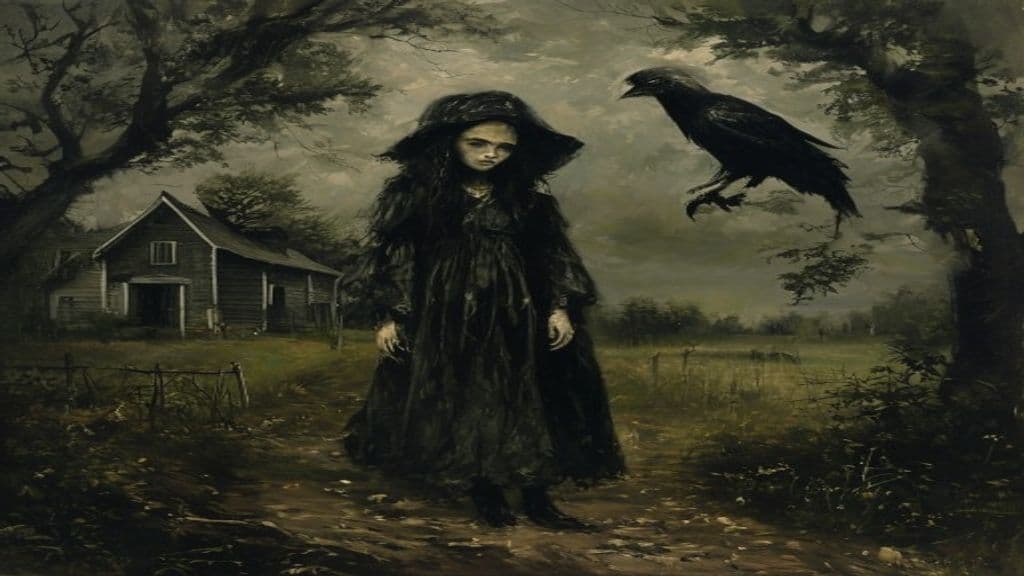
In the principal nineteenth‑century tradition the voice at one point identified itself as 'Old Kate Batts' witch,' and the phenomenon later became known by the toponymic label 'Bell Witch' after the Bell family. Contemporary retellings within the legend offer competing explanations (including references to disturbance of a Native American burial mound and buried treasure) but the primary surviving accounts record the entity identifying with the name 'Kate' and linking itself to Kate Batts.
Most accounts emphasize the presence as largely invisible while reporting occasional visible manifestations and shape‑shifting. Reported visible forms in early narratives included a strange creature resembling a dog, a very large bird, a girl in a green dress, and other animallike apparitions; however, the bulk of activity was unseen and expressed through physical effects such as pulling sheets, chains noises, gnawing sounds, hair‑pulling, pinching, scratching, and sticking Betsy with pins.
Nineteenth‑century accounts attribute spoken speech and extended conversation to the entity, including the capacity to mimic accents and voices, repeat distant sermons verbatim, and engage in biblical argument. It produced poltergeist‑type phenomena (knocks, gnawing, sheets pulled, moving objects), caused physical assaults on people (pinches, scratches, hair‑pulling, pins stuck into a child), and is said in the tradition to have caused paralysis (reported paralysis in John Bell's mouth) and to have been blamed for poisoning the Bell patriarch. Some accounts also claim clairvoyant knowledge and the ability to appear at distant places or to be in more than one place at a time.
Weaknesses
- othernone recorded in primary accounts
Wards
- othernone recorded in primary accounts
Beli
Beli is a jötunn (giant) in Old Norse myth known chiefly as an adversary slain by the god Freyr. Attestations are fragmentary: he appears in Eddic and skaldic references as the named foe of Freyr and as an element in kennings, and scholars treat the fuller myth as largely lost.
Beli Mawr
Beli Mawr is a legendary ancestral king and eponymous progenitor in medieval Welsh genealogies and literature, presented as the father of several named mythic figures and as an origin-figure for royal houses. Modern scholarship sometimes hypothesizes a connection with the continental Celtic deity Belenus/Belenos, but medieval sources principally treat Beli as an ancestral/kingly figure rather than explicitly as a deity.
Beli's bane
A kenning-style epithet from the Old Norse poetic corpus, rendered from Old Norse bani Belia (with an adjectival bjart = 'bright' in some transmissions). It functions as 'the slayer (bane) of Beli' within the prophetic catalogue of Ragnarök in Völuspá rather than as a fully independent named being with its own cult or origin story.
Belial
In Hebrew Bible usage Belial is originally a pejorative term for worthlessness; in Second Temple (Dead Sea Scrolls) literature it is personified as the malign leader of the 'Sons of Darkness', an angelic/oppositional figure who commands hostile spirits and features in Qumran dualist eschatology.
Belinus
Belinus is a legendary king of the Britons as recounted in Geoffrey of Monmouth’s Historia regum Britanniae and later summaries: a warrior-king and lawgiver who fights his brother Brennius, unites Britain, campaigns in Gaul and Italy, founds or restores cities (notably Kaerusc/Caerleon), and is cremated atop a great tower at his death. His name is probably derived from the ancient god Belenus according to some modern summaries, but the sources treat him as a human legendary ruler rather than a deity.
Belisama
Belisama is a Gaulish goddess attested in Roman-period inscriptions and place-names. Epigraphic evidence records formal dedications (including a nemeton and a votive sacrum) and at least one inscription equates her with the Roman Minerva; scholars debate whether her name denotes brightness, strength, or a plant-name, and toponymic evidence also suggests riverine associations.
Belled Buzzard
A figure of American folk tradition, the belled buzzard is a turkey vulture described as bearing a bell and treated in popular reportage and storytelling as a singular, recurring omen that foretells disaster or death by the sound of its bell. The legend originated from actual instances of people fastening bells to buzzards in the mid-19th century and rose to prominence in the late 19th century, especially after association with the 1878 Brownsville, Tennessee yellow fever epidemic.
Bellerophon
Bellerophon is a heroic figure of ancient Greek tradition, famed as a slayer of monsters and the tamer of Pegasus. Various accounts present him as of mixed divine and mortal lineage and as an exemplar of heroic achievement enabled by divine aid and constrained by social-ritual norms.
Bellōna
Bellōna is an ancient Roman goddess personifying war, especially the destructive, bloody, and tumultuous aspects of armed conflict. She had an active civic cult in Rome (including a temple associated with a war column, the columna bellica) and appears frequently in Roman literature and art as an armed, helmeted female figure who accompanies or intensifies battle.
Belobog
Belobog is a name appearing in modern summaries of Slavic religion as a deity associated with light and the sun, typically presented as the opposing pole to Chernobog in a binary contrast of light/dark. Attestations in the provided sources are fragmentary and largely secondary or modern; primary medieval evidence for a named Belobog is not supplied in the excerpts.
Belphegor
Belphegor is a named infernal figure in Christian and later European literary and occult traditions, commonly identified in those traditions with the ancient Near Eastern figure Baal‑Peor. In demonological lists he is associated with particular vices (notably sloth, though some sources assign gluttony), and literary treatments depict him as a tempter who offers wealth, inventions, or incarnate visitation to lead humans into sin.
Belsnickel
Belsnickel is a traditional fur-clad Yuletide visitor from the Palatinate region of southwestern Germany who inspects children's behaviour, disperses sweets to the well-behaved, and threatens or administers punishment (often symbolically) to the naughty. The figure survives in Pennsylvania Dutch and other diaspora communities and appears both as a solitary domestic visitor and as part of boisterous communal processions called 'Belsnickling' or 'Klausentreiben'.
Community Record
- [1]Bell Witch. Wikipedia: 'Bell Witch' article (as cited in research notes)wiki
- [2]Wikidata: Bell Witch. Wikidata entry for Bell Witch (as cited in research notes)other
- [3]Haunted Christmas: Yuletide Ghosts and Other Spooky Holiday Happenings. Collected ghost tales including regional accounts (archive reference in research notes)folk
- [4]Sugar maple and other poems. Archive collection referenced in research notesother