
Recorded tradition locates Belsnickel in the Palatinate and neighboring German regions as a seasonal visitor associated with the feast period of Saint Nicholas and the lead-up to Christmas. Unlike many continental companions of Saint Nicholas, Belsnickel traditionally visits alone rather than serving a saintly benefactor, fusing both punitive and rewarding functions that elsewhere are divided. Historical sources note immigrant transmission to Pennsylvania and other communities in the 19th century; nineteenth-century English-language accounts (e.g., glosses calling him 'Pelsnichol, or Nicholas with the fur') link his name to fur-clad dress and to a familiar form of Nicholas, but do not supply a definitive etymology.
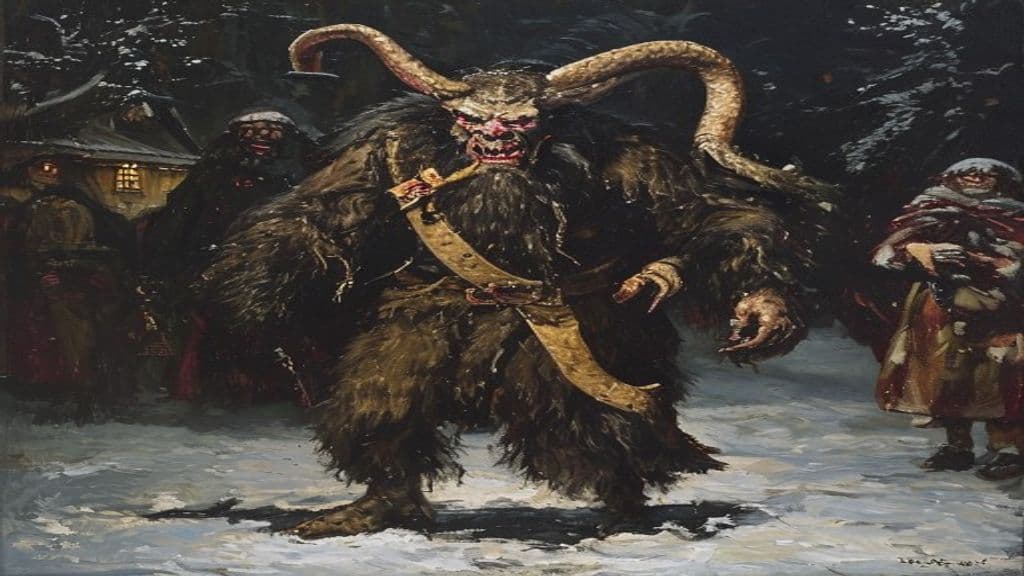
Accounts consistently describe a man dressed in furs and ragged clothing: a long black or brown coat or robe (sometimes torn and dirty), worn with a rope at the waist, and a fur cap or bearskin hat often decorated with bells. The face is commonly disguised—reports mention hideous masks or disguised faces—and some descriptions add a long white beard and a large sack. He carries a switch (birch or hazel rod) and pockets or a sack containing cakes, candies, and nuts. In communal 'Belsnickling' enactments participants add bells, chains, and false faces for a noisy procession.
Sources describe Belsnickel's role and behaviours rather than supernatural powers: he inspects children's conduct, quizzes or requires songs, and dispenses sweets to compliant children while threatening or administering punishment to those deemed naughty. Practitioners rap on doors or windows with a stick, scatter candies on the floor for good children, leave birch rods in stockings, or in some accounts strike youngsters with a switch as part of the performance. The figure also appears in public mumming processions—groups of young men dressed in furs who make loud, boisterous rounds at night—performing a socially sanctioned mixture of intimidation, satire, and gift-giving.
Weaknesses
- conditioncompliance by children (answering questions or singing)
- conditionacceptance of the performance as symbolic (negotiated discipline such as leaving only a birch rod in stockings)
Wards
- conditionchildren answer questions or sing when challenged
- conditionhousehold staging (father or head away so a designated performer may enact the role)
Bell Witch
A largely invisible, communicative haunting centered on the Bell family in early 19th‑century Robertson County, Tennessee. In nineteenth‑century accounts the presence spoke, mimicked voices, produced poltergeist‑style disturbances, caused bodily harm (pinching, hair‑pulling, paralysis), and was blamed in legend for the death of John Bell Sr.
Belled Buzzard
A figure of American folk tradition, the belled buzzard is a turkey vulture described as bearing a bell and treated in popular reportage and storytelling as a singular, recurring omen that foretells disaster or death by the sound of its bell. The legend originated from actual instances of people fastening bells to buzzards in the mid-19th century and rose to prominence in the late 19th century, especially after association with the 1878 Brownsville, Tennessee yellow fever epidemic.
Bellerophon
Bellerophon is a heroic figure of ancient Greek tradition, famed as a slayer of monsters and the tamer of Pegasus. Various accounts present him as of mixed divine and mortal lineage and as an exemplar of heroic achievement enabled by divine aid and constrained by social-ritual norms.
Bellōna
Bellōna is an ancient Roman goddess personifying war, especially the destructive, bloody, and tumultuous aspects of armed conflict. She had an active civic cult in Rome (including a temple associated with a war column, the columna bellica) and appears frequently in Roman literature and art as an armed, helmeted female figure who accompanies or intensifies battle.
Belobog
Belobog is a name appearing in modern summaries of Slavic religion as a deity associated with light and the sun, typically presented as the opposing pole to Chernobog in a binary contrast of light/dark. Attestations in the provided sources are fragmentary and largely secondary or modern; primary medieval evidence for a named Belobog is not supplied in the excerpts.
Belphegor
Belphegor is a named infernal figure in Christian and later European literary and occult traditions, commonly identified in those traditions with the ancient Near Eastern figure Baal‑Peor. In demonological lists he is associated with particular vices (notably sloth, though some sources assign gluttony), and literary treatments depict him as a tempter who offers wealth, inventions, or incarnate visitation to lead humans into sin.
Beltrame
Beltrame is a traditional commedia dell'arte stock character associated with the city of Milan (and nearby Gaggiano), dating to the 16th–17th century or earlier. He functions as a crafty, pretentious villager/husband whose costume (notably the large tunic or gippa, purse, and dagger) and comic antics represent Milanese civic identity onstage.
Belus (Tyre)
Belus is the Greco‑Latin umbrella rendering of Semitic lord‑titles (bēlu/baʿal) that in classical literature appears in multiple guises; in Latin epic and genealogical tradition he functions as a legendary king of Tyre, presented as the father of Dido and Pygmalion and as an ancestral founder figure rather than a defined supernatural being.
Ben Lockwood (Agent Liberty)
Ben Lockwood is a fictional human political antagonist in the Arrowverse (primarily Supergirl, Earth-38) who adopts the persona Agent Liberty to lead the anti-alien movement Children of Liberty. He is a former history professor and media host whose influence is rhetorical and organizational rather than supernatural.
Bendidia
The festival or cult dedicated to the Thracian goddess Bendis, celebrated in ancient Athens on the 19th day of Thargelion in Piraeus. (Note: 1. Power tier should be Primordial (Bendis is described as a Thracian goddess, implying a cosmic-level deity) 2. Appearance and Abilities sections are missing; add them from source material (if availa)
Bendis
Bendis is a Thracian female cult deity associated with hunting, lunar aspects, and Thracian revelry. Her cult was officially introduced into Attica in the mid-5th century BC, where she retained distinct rites and a shrine (the Bendideion) while sometimes being identified with Artemis.
Bene Elohim
Bene Elohim (בני־אֱלֹהִים) is a Hebrew phrase used in the Hebrew Bible and related literature to denote "sons of God" or "sons of the gods." It functions as a collective designation for divine or semi-divine beings associated with a heavenly council or, in some interpretive traditions, as a flexible category that can include angelic ranks or, alternatively, human groups (e.g., descendants of Seth or judges).
Community Record
- [1]Belsnickel. Wikipedia: Belsnickel (overview of nature, appearance, behaviour, geography, and diaspora)wiki
- [2]Wikidata: Belsnickel. Wikidata entry for Belsnickelwiki
- [3]19th-century English gloss: 'Pelsnichol, or Nicholas with the fur'. 1853 British magazine article as cited on Wikipedia (gloss linking Pelz-/Pels- to fur and -nichol to Nicholas)folk
- [4]Jacob Brown (19th-century Maryland account). Historic Maryland recollection describing Kriskinkle/Beltznickle visiting, disguising the face, and using a switch while dispensing treatsfolk
- [5]Der Belsnickel of the Pennsylvania Dutch: 'He looked scary and carried a sack of presents'. Local account summarising Pennsylvania Dutch practice and appearanceother
- [6]Rambles.NET: Pennsylvania Dutch Night Before Christmas (Chet Williamson). Description of Pennsylvania Dutch Belsnickel timing and customsother
- [7]Companions of Saint Nicholas. Comparative context noting that Belsnickel fuses the rewarding and punitive roles common among companions of Saint Nicholaswiki