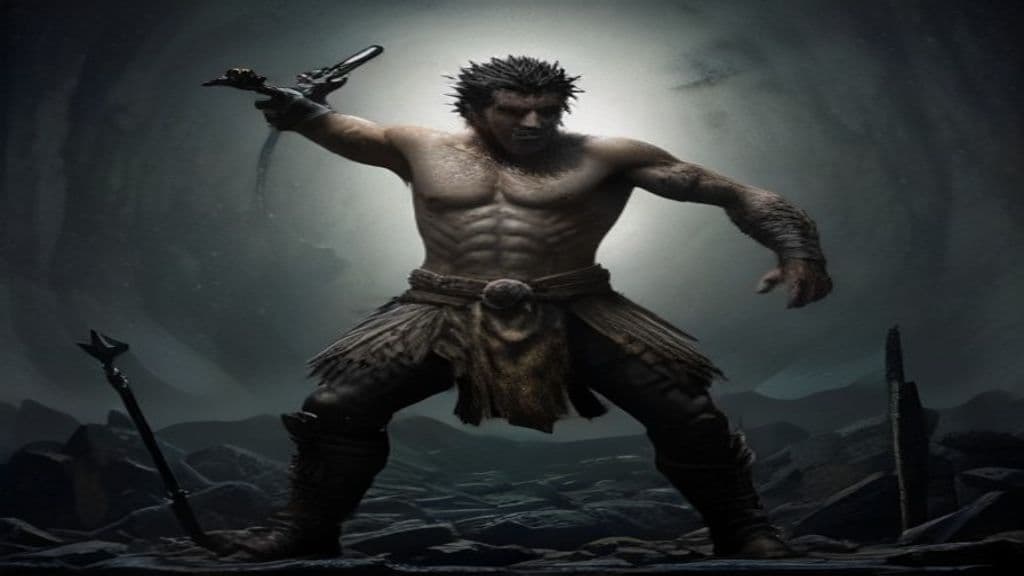
In the poemic and legendary tradition represented by Beowulf, he is the son of Ecgþeow and a member of the Wægmunding kin-group. The narrative context emphasizes reciprocal obligations: Ecgþeow had slain a man and Hroðgar, king of the Danes, paid the weregild and took Ecgþeow in, creating a bond that Beowulf later repays by sailing from Geatland with his retainers to aid Hroðgar. The extant poem locates Beowulf within a pre-Christian heroic age of northern Germanic society and implies he derives from an older cycle of heroic legend rather than being divine; later parts of the poem record his rise to kingship among the Geats and his final death in combat with a dragon.
The surviving sources supply minimal, conventional physical description: Beowulf is known chiefly by his deeds, lineage, and social role as a Geatish warrior and later king. The poem and summaries emphasize his martial status and actions (for example, fighting Grendel unarmed and swimming contests in his youth) rather than precise corporeal details such as height, hair, or heraldic equipment. Accounts record that he fought Grendel with his bare hands and that he at times uses arms and armor appropriate to a heroic warrior when needed (for instance, later in life and in other conflicts).
Beowulf is depicted as possessing extraordinary physical strength and martial skill: in the poem he confronts Grendel who cannot be harmed by manmade weapons, fights unarmed and tears off Grendel's arm, and later pursues Grendel's mother into her lair where he defeats her with the aid of an enchanted giant sword found in her hall. He demonstrates courage and initiative by sailing from Geatland to aid Hroðgar, undertaking dangerous descents into monster lairs, and leading men in warfare; after his warrior career he becomes king of the Geats, leading raids and settling dynastic disputes. His renown is also socially enacted through scop/skald poetry that commemorates and compares his deeds with other legendary heroes.
Weaknesses
- conditionmortality and aging (dies in final battle with a dragon)
Wards
- othernone attested (no magical wards against Beowulf are recorded; cultural protections are social or martial rather than ritual)
Bennu
Bennu is an ancient Egyptian divine bird associated with the sun, creation, and cyclical renewal. Presented as a self-originating creative force and as an emblem of rebirth, Bennu functions as an aspect (ba) of the solar creator gods (Ra and Atum) and appears in funerary iconography linked to Osiris.
Benthesikyme
Benthesikyme (Βενθεσικύμη; Latinized Benthesicyme) is a female sea-nymph in Greek myth, named etymologically from benthos (depth, deep-swells) + kyma (wave). Classical mythographers identify her as a daughter of Poseidon and Amphitrite and as the foster-mother of the hero Eumolpus; some sources place the narrative involving her in Aithiopia (Ethiopia).
Benzaiten
Benzaiten (弁才天/弁財天), often shortened to Benten, is an East Asian Buddhist protective goddess derived from the Indian Sarasvatī. In Japan she was syncretized with Shinto kami and local serpent/dragon spirits, functioning as a patron of speech, music, learning, wealth, and a protective deity whose vows in the Golden Light Sutra promise protection to those who recite or copy it.
Beor
Beor (Hebrew Bor) is a personal name attested in biblical and extrabiblical sources chiefly as the father of the non‑Israelite seer Balaam. He functions as a patronymic identifier that locates Balaam within ancient Near Eastern genealogical and onomastic networks; sources do not present Beor as an independent supernatural agent.
Beorn
A fictional individual in J. R. R. Tolkien's legendarium: a 'skin-changer' who is a man able to assume the form of a great black bear. He is a solitary chieftain who aids the company in The Hobbit and becomes the ancestor of the Beornings, a people retaining diminished bear-shaping power.
Beowa (Germanic Tradition)
A figure associated with barley and agriculture, appearing in Anglo-Saxon royal genealogies. (Note: - Power tier should be Primordial or Ancient, as it's associated with agriculture and fertility on a cosmic or deity-level. - The appearance section is missing, but since there's no description in the)
Berbalang
The Berbalang are legendary creatures from the Philippines described in available sources as corpse-eating ghouls associated with grave-digging; some accounts also report they can fly or send a spirit to do so. Documentation is limited and drawn from summarised folkloric reports.
Berbalang
Berbalangs are a class of corpse‑eating, astral‑projecting beings described in a late‑19th‑century ethnographic account from the island of Cagayan Sulu (Mapun). The report portrays them as a village community whose members are said to dig up graves to eat corpses and, by entering trance, liberate an astral body to possess and feed on the living; protective measures recorded include lime and a coconut pearl talisman.
Berberoka
A water-associated swamp spirit or creature from northern Luzon (Philippines) said to prey on people at ponds, lakes, rivers, and swamps by manipulating water—draining and reflooding sites to drown victims. Described in summaries as a 'swamp creature' or 'water ogre'; some modern adaptations portray it as a scaled ogre.
Berchta (Perchta)
Berchta (also Perchta/Percht) is an Alpine and Upper Germanic female supernatural figure tied to midwinter/Christmastide customs. In surviving folkloric and folkloristic sources she appears as a polyvalent mother-earth/seasonal figure who rewards industrious household behavior and punishes neglect, and who is associated with wintertime movements and textile work (spinning/distaff).
Berchtold
Berchtold is primarily a Germanic personal name; in one brief folkloric attestation from 16th‑century German sources the name Berchtold is recorded as the leader of the Wild Hunt, replacing the female figure Perchta. Beyond this isolated mention there is no sustained folkloric tradition, description, or ritual corpus for a supernatural Berchtold in the provided sources.
Bereet
Bereet is a fictional extraterrestrial character from Marvel Comics, a Krylorian techno-artist/filmmaker who produces techno-art films and who in stories documents or dramatizes adventures (notably of the Hulk). She first appeared in The Rampaging Hulk #1 (Jan. 1977) and made her Earth-616 debut in The Incredible Hulk vol. 2 #269 (March 1982); she also appears briefly in the Marvel Cinematic Universe film Guardians of the Galaxy (2014).
Community Record
- [1]Beowulf (hero) — Wikipedia. Wikipedia contributors, 'Beowulf (hero),' Wikipedia, The Free Encyclopedia.wiki
- [2]From the tower window of my bookhouse (My Bookhouse anthology entry). My Bookhouse: selections including 'How Beowulf delivered Heorot' (children's anthology, Archive.org)literary
- [3]Hero-Myths & Legends of the British Race (archive). Hero-Myths & Legends of the British Race, Archive.org (comparative material and retellings).literary
- [4]Beowulf: Return to the Shieldlands (TV/video summary). Beowulf: Return to the Shieldlands — media summary (Archive.org).other