
Sources give competing etymologies and no single origin narrative. Ethnographic accounts translate the name as German "Gottesklage" ("God's Lament"). One view suggests the compound derives from a contraction Boža žaloć, "God's Pity"; another notes an older lexical element glosc meaning "lament" occurring in manuscripts as early as the 17th century, with the attribute Boža ('God's') possibly added later. The available sources do not provide a mythic creation story for the figure.
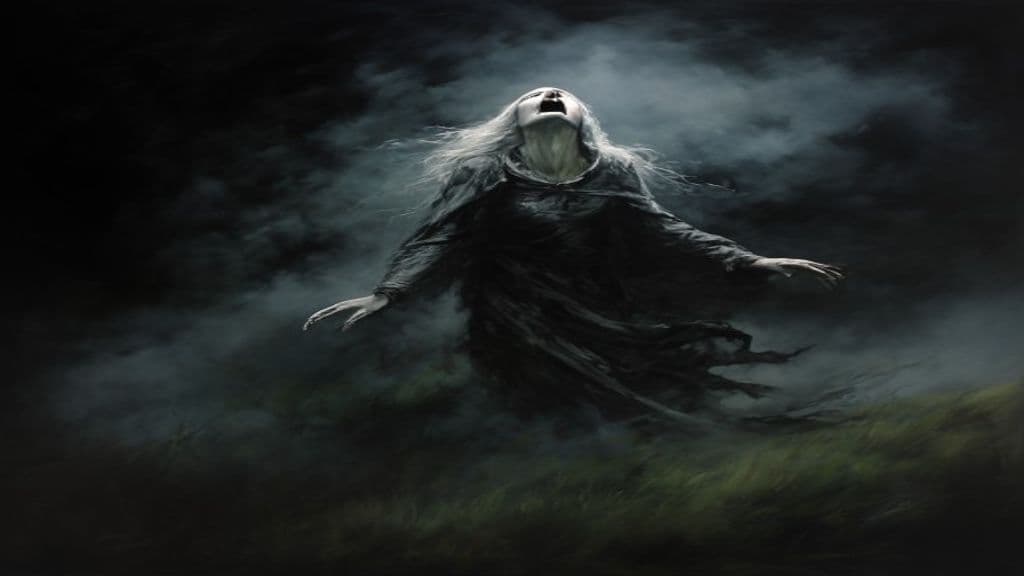
Descriptions vary across sources. An 1886 ethnographic account (W. v. Schulenburg) describes Božalość as "a woman dressed in white with long, unkempt hair and red eyes" who sits in the elder bush (Sambucus nigra). Biren Bonnerjea describes it as "a little woman with long hair, who cries under the window of someone who is about to die." Related accounts discuss a parallel form, bože sedleško, depicted in some tales as a child in white clothes or heard crying like a child and sometimes appearing as a white hen; these variants are reported separately in the sources.
Primary behavior recorded in the sources is emitting cries or lamentations that function as omens. Reported acts include crying under the window of someone about to die and sitting in the elder bush while lamenting. The being's presence is presented as a communicative portent of forthcoming harm—death, misfortune, fire, epidemics, flood—rather than as an agent that directly attacks or aids people.
Botis
Botis is a named spirit from Renaissance and early modern ceremonial grimoires, variously ranked as a President, Earl, or Count. Appearing in sources such as the Ars Goetia (Lesser Key of Solomon), the Pseudomonarchia Daemonum, the Munich Manual of Demonic Magic (as Otius), and mentioned in the Grand Grimoire as subordinate to Agaliarept, he is summoned by ritual operators to answer questions, reveal knowledge, and reconcile allies and enemies.
Botres
Botres (Ancient Greek: Βότρης, Bótrēs) is a Theban youth in Greek myth who, having tasted the sacrificial victim's brain during his father Eumelus's offering to Apollo and then being fatally struck by his father with a brand, is transformed by Apollo into the bird called Aeropus (the bee-eater). The story is attested in Greek mythographic tradition and briefly referenced in Ovid's Metamorphoses and in Antoninus Liberalis' collection of metamorphoses.
Bouncing Boy
Bouncing Boy is a fictional superhero (Charles Foster 'Chuck' Taine) appearing in DC Comics, best known as a member of the Legion of Super-Heroes whose primary Silver Age power is to inflate into an elastic sphere and bounce. Across continuities he functions as comic relief, morale officer, and occasional tactical asset; in some reboots he is non-powered and serves as the Legion's engineer/architect.
Bound monster (motif)
A mythic motif in Norse mythology describing powerful hostile beings who are physically or cosmologically restrained in the present but are prophesied to break free during Ragnarök to wreak destruction. The label is a modern scholarly summary applied to several canonical figures (Loki, Fenrir, Jörmungandr, Hel) rather than an Old Norse technical name.
Bounos (Bunus)
Bounos (Ancient Greek: Βοῦνος) is a legendary early king of Ephyra (an early name for Corinth), described in surviving mythographical summaries as a son of Hermes and the mortal Alcidamea/Alcidamia. He is credited with receiving the throne from Aeëtes when the latter sailed to Colchis and with founding a sanctuary to Hera Bunaea on the road to Acrocorinthus; after his death the kingdom passed into the hands of Epopeus of Sicyon.
Bozorgmehr
Bozorgmehr (Middle Persian Wuzurgmihr ī Bōkhtagān) is attested in Middle Persian, Persian epic, and Arabic/Persian historiography as a Sasanian-era sage, minister (wuzurg framadār), and military commander associated with the House of Karen during the late 5th–6th centuries CE. He is remembered as an exemplary court counselor, author of treatises, and a theme figure in literary traditions rather than a supernatural being.
Božić (Slavic mythology)
A symbolic figure associated with the themes of New Year, spring, and youth in Slavic paganism. (Note: 1. Power tier: Incorrectly classified as Lesser Spirit; based on its association with renewal and spring, it should be at least Ancient. 2. Origin story: The source material does not mention an origin)
Br'er Rabbit
Br'er Rabbit is an African-American folktale trickster — an anthropomorphic rabbit/hare who survives and triumphs by cunning rather than strength. Originating in oral traditions of enslaved Africans in the American South and related Caribbean communities, the character features in story cycles that teach, entertain, and comment on social relations.
Brag
A Northumbrian mischievous shapeshifting being tied to ponds, hedges, lanes, and other liminal localities; it commonly appears as a horse or donkey to entice riders, then bucks them off into water or underbrush and flees, often laughing.
Bragi
Bragi is a figure in Old Norse mytho-poetic tradition associated with skilled eloquence and poetry among the Æsir; Snorri presents him as a god of poetry and husband of Iðunn, while modern scholarship often treats the divine Bragi as a mythologized reflection of the historical 9th-century skald Bragi Boddason.
Brahmadaitya
Bengal's most distinctive ghost: the spirit of a Brahmin who died celibate — before marriage, or having taken a vow of celibacy — whose accumulated learning and unfulfilled life persists. Unlike the North Indian Brahmpret, the Brahmadaitya is often passive or even helpful, but its presence makes any household it inhabits spiritually unsettled.
Brahmahatya (Hindu tradition)
A grave sin and entity in Hindu tradition, representing the act of killing a Brahmin. (Note: 1. Power tier should be Primordial (cosmic) instead of Ancient (deity-level), as Brahmahatya represents a grave sin and not a deity. 2. The article lacks an appearance description, which needs to be a)
Community Record
- [1]Božalość (Wikipedia). Wikipedia: Božalośćwiki
- [2]Wikidata entry for Božalość. Wikidata: Q4953054other
- [3]Das Spreewaldhaus (W. v. Schulenburg, 1886) — cited description in secondary sources. Schulenburg, cited in the Božalość article: description of 'ein Weibchen, weiss gekleidet, mit langem verwilderten Haar und rothen Augen' sitting 'im Fliederstrauch'folk
- [4]Biren Bonnerjea — cited description. Biren Bonnerjea, cited in Božalość summary: 'a little woman with long hair, who cries under the window of someone who is about to die.'folk