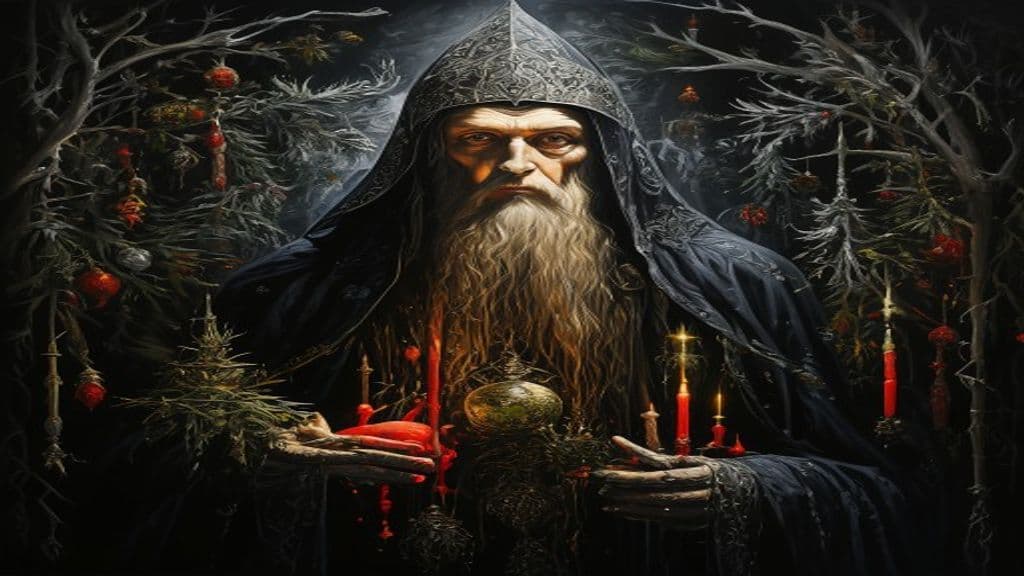
Božić is a creature that embodies the themes of New Year, spring, and youth in Slavic paganism. Its original name 'Božić' is shared among South Slavic languages, including Serbian, Croatian, and Slovenian.
Božić appears to be a symbolic figure associated with the natural cycle of life and death. Its presence is tied to Christmas customs, suggesting that it may have been revered as a harbinger of new life and renewal.
Slavic Water Spirits
Female tutelary beings associated with bodies of water in Slavic paganism, often dual-natured as benevolent or malevolent. (Note: - Power tier is unclear based on the source material; no indication that they are limited to a "Lesser" power tier. - Appearance is not described in the source material, so this section should be remo)
Sledovik
A sacred stone in Slavic and Finnic pagan practices, imbued with spiritual significance. (Note: - Power tier should be Primordial (due to their widespread presence and spiritual significance in Slavic and Finnic cultures). - Abilities description is incomplete and inaccurate (the text only menti)
Unclean Force
A collective term for malevolent entities from Slavic paganism, associated with evil or negative forces. (Note: 1. Power tier should be Ancient (deity-level) instead of Primordial (cosmic), as the Unclean Force is associated with malevolent mythological forces and creatures. 2. Appearance: Add that there is no )
Zbruch Idol (Sviatovid)
A limestone sculpture idol representing a pre-Christian Slavic belief system. (Note: - Power tier: Lowered to Ancient (deity-level), as it's a representation of a deity/concept rather than an actual cosmic being. - Abilities: Removed, as stated in the source material. - Sensory cues: )
Zhrets (Slavic Tradition)
A zhrets is a priest in the Slavic religion, responsible for mediating between humans and gods. (Note: 1. Power tier should be Primordial, as zhrets are described as possessing cosmological knowledge and playing a significant role in resisting Christianity, indicating a level of power that aligns with )
Bound monster (motif)
A mythic motif in Norse mythology describing powerful hostile beings who are physically or cosmologically restrained in the present but are prophesied to break free during Ragnarök to wreak destruction. The label is a modern scholarly summary applied to several canonical figures (Loki, Fenrir, Jörmungandr, Hel) rather than an Old Norse technical name.
Bounos (Bunus)
Bounos (Ancient Greek: Βοῦνος) is a legendary early king of Ephyra (an early name for Corinth), described in surviving mythographical summaries as a son of Hermes and the mortal Alcidamea/Alcidamia. He is credited with receiving the throne from Aeëtes when the latter sailed to Colchis and with founding a sanctuary to Hera Bunaea on the road to Acrocorinthus; after his death the kingdom passed into the hands of Epopeus of Sicyon.
Bozorgmehr
Bozorgmehr (Middle Persian Wuzurgmihr ī Bōkhtagān) is attested in Middle Persian, Persian epic, and Arabic/Persian historiography as a Sasanian-era sage, minister (wuzurg framadār), and military commander associated with the House of Karen during the late 5th–6th centuries CE. He is remembered as an exemplary court counselor, author of treatises, and a theme figure in literary traditions rather than a supernatural being.
Božalość
Božalość is a Wendish (Lusatian Sorb) omen-figure described in ethnographic sources as a messenger or harbinger whose audible lamentation announces imminent death or other calamity for particular people, households, or communities. The name is commonly rendered in German sources as "Gottesklage" ("God's Lament").
Br'er Rabbit
Br'er Rabbit is an African-American folktale trickster — an anthropomorphic rabbit/hare who survives and triumphs by cunning rather than strength. Originating in oral traditions of enslaved Africans in the American South and related Caribbean communities, the character features in story cycles that teach, entertain, and comment on social relations.
Brag
A Northumbrian mischievous shapeshifting being tied to ponds, hedges, lanes, and other liminal localities; it commonly appears as a horse or donkey to entice riders, then bucks them off into water or underbrush and flees, often laughing.
Bragi
Bragi is a figure in Old Norse mytho-poetic tradition associated with skilled eloquence and poetry among the Æsir; Snorri presents him as a god of poetry and husband of Iðunn, while modern scholarship often treats the divine Bragi as a mythologized reflection of the historical 9th-century skald Bragi Boddason.
Community Record
- [1]