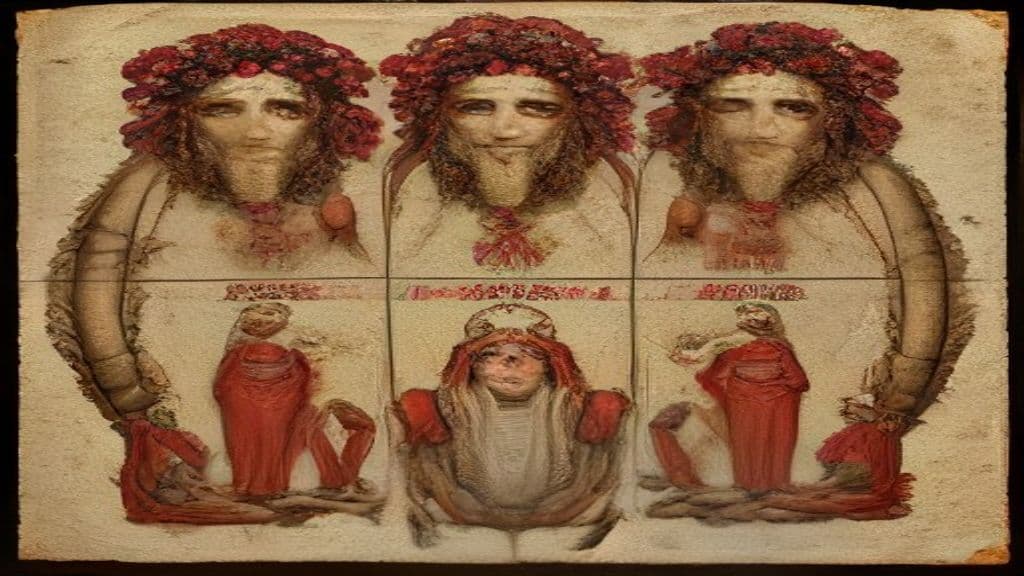
In mainstream Greek mythic tradition as summarized in the sources, Bromius functions as an epithet of Dionysus, the son of Zeus and Semele; Hera's machinations lead to Semele's destruction when she insists Zeus reveal his true form, and the unborn child is rescued by Zeus and later born from his thigh, producing the motif of the 'twice-born' god. Separately, modern scholarship (as reported by Richard Buxton summarizing the Derveni papyrus) reads Bromius/Bromios in fragmentary Orphic material as a name applied to a fundamental divine figure that is placed early in a variant cosmology — a scholarly interpretation of fragmentary evidence rather than a fully preserved narrative in the primary papyrus itself.
The cited materials do not preserve any distinctive iconography or physical description unique to Bromius apart from its identification with Dionysus/Bacchus; no separate anthropomorphic or visual attributes specific to the name Bromius are attested in the provided summaries.
As an epithet of Dionysus, Bromius is associated with the characteristics implied by its etymology (from βρέμειν, 'to roar'): noisiness, boisterousness, and the ecstatic energy tied to Dionysian cult. The sources describe the twice-born identity of Dionysus (Bromius) but do not enumerate discrete supernatural powers unique to the epithet. Secondary scholarship (per Buxton's summary of the Derveni papyrus) suggests the name appears in a fragmentary Orphic cosmogony where Bromius is treated as an early divine figure; the papyrus fragments themselves are incomplete and do not provide a detailed catalogue of cosmogenic functions.

British big cats
A modern folkloric and cryptozoological category in Britain referring to reported sightings of large non-native felines (panthers, pumas, lynx, 'black cats') across the United Kingdom; treated variously as escaped exotic animals, media-driven urban legend, and a continuation of older large-cat motifs in local tradition.
Britomartis
Britomartis is a female divine figure associated in the supplied material with the island of Crete, functioning as a mountain and hunting deity with linked associations to nets and fishermen. She is variously described as a goddess or nymph and was later conflated in Greek tradition with deities such as Artemis, Athena, and Aphaea.
Brittia
In Germanic tradition, Brittia is a mythological concept and physical location associated with the afterlife, where souls of the dead are transported. It exists as both an island and an Isle of the Blessed. (Note: 1. Power tier should be Primordial since Brittia is associated with the afterlife and its description implies a cosmic or transcendent level. 2. Add sensory cues: Brittia's association with death and )
Brizo
Brizo (Greek: Βριζώ) is a minor, local goddess venerated on the island of Delos who functioned as a protector of mariners, sailors, and fishermen and as an oracular deity specialized in oneiromancy (dream-oracle). Her cult was chiefly associated with women of Delos who offered food in small boats and sought prophetic dreams concerning sea-voyages and the fates of seafarers.
Broichan
A 6th century Celtic wizard documented by Adomnán of Iona, with magical abilities and connections to spiritual or supernatural forces. (Note: 1. Power tier should be Ancient, as a wizard serving a king and having connections to a saint is more deity-level than primordial. 2. Add sensory cues based on the fact that Adomnán wrote about Broich)
Brokkr
Brokkr is a dwarf and master smith's assistant in Norse mythic tradition, famed for operating the bellows while his brother (Eitri/Sindri) performed magical forging in the contest that produced Mjölnir, Draupnir, and Gullinbursti. He is best known from the Skáldskaparmál episode in which Loki, as a gadfly, tries to disrupt his bellows work and Brokkr later sews Loki's lips shut when Loki evades a wager.
Bronze Tiger
Bronze Tiger (Benjamin 'Ben' Turner) is a fictional DC Comics character: an African-American, world-class martial artist, operative, and recurring figure who has served as assassin, mercenary, instructor, and member/second-in-command of Amanda Waller's Suicide Squad. Created in the Bronze Age of comics, his history includes training under O-Sensei, capture and brainwashing by the League of Assassins, and later rehabilitation and multimedia adaptations.
Brook horse
No attested folkloric entity called 'Brook horse' appears in the supplied sources. The corpus contains a general note on Germanic water-spirits (nixie family) and several toponymic references to brooks and places named with 'Horse' or 'Brook'; any linking of these materials into a distinct 'Brook horse' folk-entity is not documented in the provided research notes.
Broteas
Broteas (Ancient Greek: Βροτέας, lit. 'mortal' or 'man') is a mythic human figure in Greek tradition, presented as a son of Tantalus and member of that cursed house. He is credited in local tradition with carving the ancient rock relief of the Great Mother (Cybele) on Mount Sipylus near Magnesia ad Sipylum and is also variously narrated as a hunter punished by Artemis or listed among the Lapiths slain in the Lapith–centaur battle.
Brother Blood (Sebastian Blood mantle)
A recurring fictional cult-leader mantle in DC Comics borne by multiple individuals (notably men named Sebastian Blood and later incarnations) who lead the Church/Cult of Blood; the role combines political-theocratic leadership, ritual relics, and supernatural powers tied to lineage and artifacts.
Brother Jonathan
Brother Jonathan is a literary and pictorial personification and stock character representing New Englanders (and at times the United States) in 18th–19th century Anglo‑American print culture. He functions rhetorically in satire, political commentary, and self‑identification rather than as a supernatural being.
Brotherhood of Evil
A recurring supervillain organization in DC Comics, introduced in Doom Patrol #86 (1964). Led by the Brain and frequently allied with Monsieur Mallah and other powered operatives, the Brotherhood functions as an enduring antagonist faction opposing the Doom Patrol, New Teen Titans, and occasionally the Justice League.
Community Record
- [1]Bromius — Wikipedia. Wikipedia, article 'Bromius'.wiki
- [2]Bromius — Wikidata. Wikidata entry Q15278290 'Bromius'.other
- [3]Derveni papyrus and Orphic tradition — summary in Richard Buxton (as cited on Wikipedia). Summary reported on the Wikipedia 'Bromius' page referencing Richard Buxton's commentary on the Derveni papyrus.academic
- [4]Cox-1 Gene-Based Identification and Molecular Phylogenetics of Horseflies (archive) — incidental taxonomic use of 'bromius'. Archive entry referencing biological taxon names using 'bromius' (not related to the deity).other