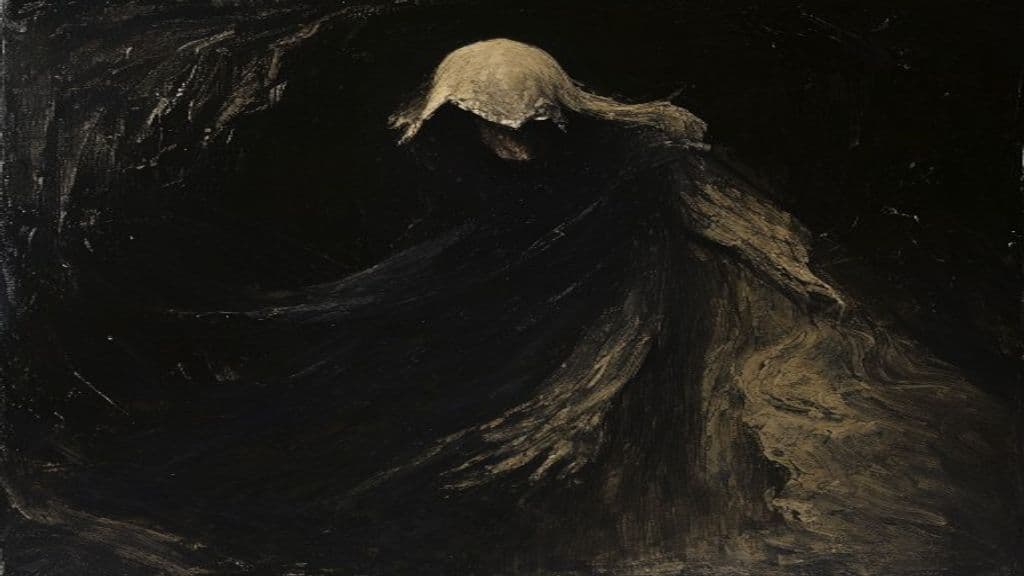
Tan'gun is considered the founder and first king of Gojoseon, with divine ancestry. He is referred to as the 'grandson of heaven'. This indicates a connection to the spiritual or heavenly realm.
No physical description of Tan'gun exists in the provided source material.
As the founder and first king of Gojoseon, Tan'gun's actions are focused on establishing a kingdom. There is no information about his supernatural abilities or interactions with humans beyond his role as a legendary leader.
Weaknesses
- conditionNone specified
Wards
- ritualNone specified
- otherBeing referred to as 'son of a bear' might be relevant for wards or weaknesses.
Bulgae (Korean Fire Dog)
A mythical Korean fire dog said to cause eclipses by biting the Sun and Moon. (Note: * The power tier is incorrect; according to the source, Bulgae cause eclipses by biting both the Sun and Moon, but there's no indication that they're on a primordial level. It should be at least Ancie)
General Sinui
A legendary figure in Korean tradition who attempted to cheat death, but failed. (Note: 1. Power tier: Incorrectly classified as Minor Spirit. Given that General Sinui is a legendary figure who defied death, it's likely he should be categorized as a Greater (powerful regional) or at leas)
Gunungsin (War Gods)
Korean deities associated with war and conflict, possibly connected to the Jakjaegeon myth. (Note: 1. Power tier should be Primordial only if it's supported by source material; based on the provided sources, the power level is unspecified. 2. Abilities are unknown or unspecified in source material,)
Haneunim / Hananim
Haneunim (하느님) or Hananim (하나님) is the sky god in Korean mythology presented as the supreme heavenly deity. The figure functions as the Lord of Sky in older Korean cosmology, appears in the Dangun foundation myth (via the closely related Hwanin/Hwanung genealogy), and is identified in syncretic religious contexts with high deities such as Indra (Śakra), the Jade Emperor (Okhwang Sangje), and is named in modern Korean religions including Cheondoism and Jeungsanism; the terms have also been used as Korean translations for the Christian concept of God.
Onjo and Biryu's Baekje Creation Myth
The creation myth of Baekje revolves around the two brothers, Onjo and Biryu, who founded the dynasty. They possess human capabilities like decision-making and leadership skills. (Note: 1. Power tier: Greater (Onjo and Biryu's actions drove the founding of an entire kingdom) 2. Abilities: Add that their abilities also include diplomatic efforts and negotiations with other kingdoms 3.)
Samsin Halmeoni
A Korean goddess associated with childbirth and fate, revered for her connection to family lineage. (Note: * Power tier: Lesser (based on the description of being a localized spirit) * Abilities: Add that she has no specific abilities or behaviors described * Sensory cues: None listed in source material * )
Seonangshin
Korean patron deity of protection and war, guarding villages from harm. (Note: * Power tier should be Ancient, not Primordial, as the description implies a deity-level power but does not describe cosmic or universal implications. * Appearance is missing, but since it's not provi)
Sosamshin
In Korean mythology, Sosamshin is a household deity and the goddess of the birth of cattle. She occupies an important place in the cosmology of her source culture. (Note: * Power tier: Lesser (not Greater), given that Sosamshin is a household deity and not described as having deity-level powers. * Summary: While it's mentioned she occupies an important place in her sou)
Tamil Mythology
A collection of folklore and traditions from the Dravidian pantheon, syncretized with mainstream Hinduism. (Note: - Power tier: Incorrect; primordial implies cosmic powers beyond mortal comprehension, whereas Tamil Mythology describes a collection of folklore and traditions, not an entity with supernatural abilit)
Tamonten
Tamonten is a label attested in available sources in two different classificatory contexts: one places the name within the cosmology of Buddhist devas (the Cāturmahārājakāyika, the realm associated with the Four Heavenly Kings), and a separate modern dataset entry links the same label to the category "tengu in Japan." The supplied materials are fragmentary and do not provide a unified account of Tamonten as an individual figure.
Tang Sanzang
Tang Sanzang is the fictionalized monk-protagonist of the 16th-century novel Journey to the West, modelled on the historical Xuanzang. In the novel he is a devout, compassionate pilgrim sent from Chang'an to Tianzhu to retrieve the Tripiṭaka; portrayed as a reincarnation of the Golden Cicada, he is protected by supernatural disciples and is ultimately elevated to the Buddha of Sandalwood Merit.
Tangaloa
Tangaloa is a family of sky-associated divine personages in Tongan mythology whose members together occupy roles tied to rulership of the sky and genealogical links between heavenly beings and human chiefly lines. The name is a Polynesian cognate found across island traditions with variable local functions.
Community Record
- [1]Wikipedia: Tan'gun. Research Notes: Tan'gun