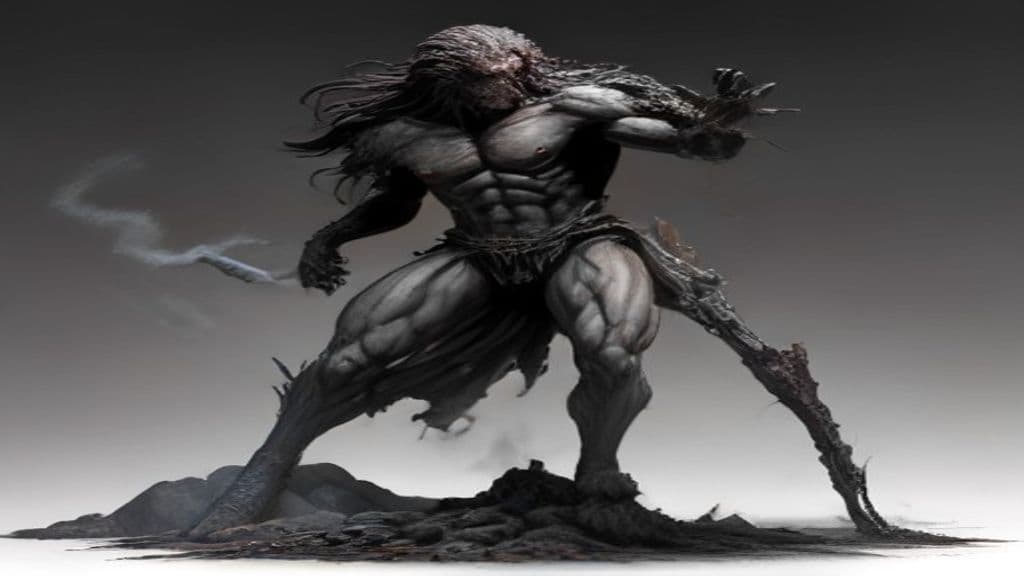
In Roman tradition Cacus is presented as a cave‑dwelling monstrous son of Vulcan (Plutarch calls him son of Hephaestus) who terrorized the area of the Aventine Hill before the founding of Rome. In Virgilic and later retellings he steals cattle belonging to the returning Heracles; when Heracles discovers the theft he pursues Cacus, enters the cave amid smoke and fire, and kills the creature. The episode functions etiologically to explain a local cult to Hercules and the erection of an altar (the Ara Maxima) at the Forum Boarium.
Classical sources and summaries describe Cacus as a large, physically monstrous, fire‑breathing giant associated with a cave; he is said to spew fire and smoke from his lair. Medieval and later literature (for example Dante's Inferno) reimagines him as a hybrid centaur figure with a fire‑breathing dragon on his shoulders and snakes upon his equine back, but that is a later literary transformation rather than a detail of the classical accounts.
Accounts describe Cacus as able to spew fire and smoke and possessing great physical strength/size sufficient to confront Hercules. He is depicted as a cunning thief: in Virgil/Evander variants he stole eight cattle (four bulls and four cows) and concealed the theft by dragging animals by their tails to mislead trackers or, in other variants, by making cattle leave false traces. Behaviorally he is presented as a predator on humans (reports say he 'lived on human flesh' and displayed macabre trophies such as nailing victims' heads to his cave door). He is ultimately overcome when Hercules enters the smoke‑filled cave and kills him.
Weaknesses
- othervulnerability to heroic force/tactic (Hercules' direct assault and killing)
Wards
- ritualAra Maxima (altar to Hercules)
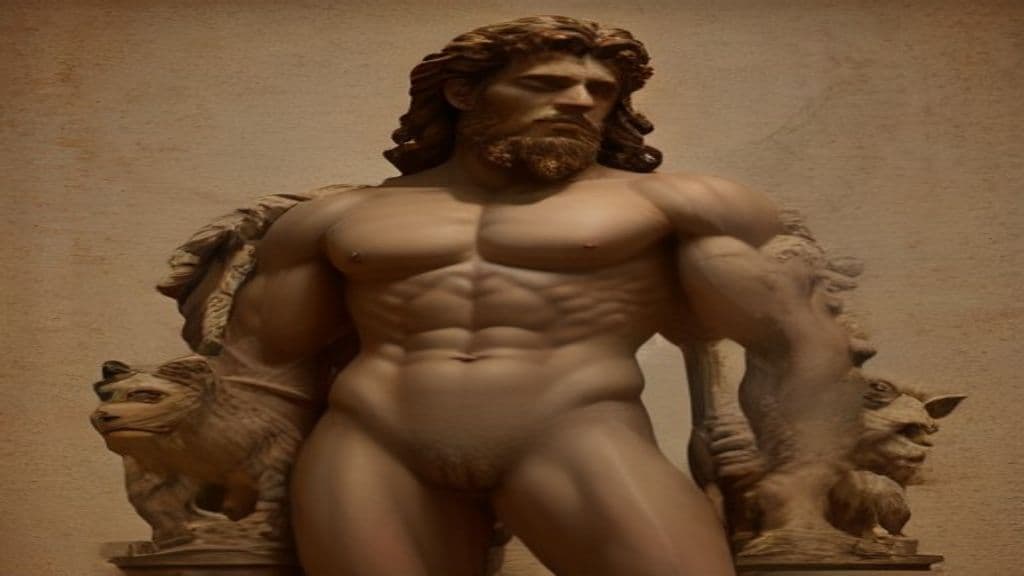
Aergia
Aergia (Ancient Greek: Ἀεργία) is the personification/goddess of sloth, idleness, indolence and laziness in Greco-Roman mythic thought. She appears in literary sources as a named personified quality and as an attendant or guardian in the household of Sleep (Hypnos/Somnus); Roman equivalents include Socordia and Ignavia.
Amechania
Amechania (Ancient Greek: Αμηχανία / Αμηχανίην; also Amekhania, Amakhania; Latin: Amechania) is a personified spirit (daimona) of helplessness, want, or impossibility attested in ancient Greek literary and lexicographic sources. She is cited as a close companion or sister of Penia and Ptocheia and is described in some modern references as virtually identical to Aporia. No cultic practice or iconography is attested in the supplied sources.
Aphrodite
Aphrodite is a major ancient Greek goddess associated with love, lust, beauty, pleasure, passion, procreation, and related social and cosmic forces. She is counted among the principal Olympian deities with major cult-centers (Cythera, Cyprus, Corinth, Athens), celebrated annually at the Aphrodisia, and syncretized with the Roman Venus.
Arcadia (Utopia)
In Greek tradition, Arcadia is an idealized concept representing a harmonious relationship with nature. (Note: 1. The power tier should be "Primordial" is correct, but clarify that this refers specifically to its conceptual or idealized nature, not implying it has traditional magical powers. 2. No explicit des)
Arizelus
Arizelus (also attested Arizelos, Latinized Arizela) is attested in Greek literary and onomastic sources as a personal name borne by mortal figures. In epic genealogy he is known only as the father (patronym) of the warrior Harpalion; in later literature the name appears as the father of an orator Timarchus. No supernatural attributes are recorded.
Autolycus
Autolycus is a mythic Greek trickster-thief, son most commonly of Hermes, famed for cunning, theft, and the ability to alter the appearance of stolen goods; he is a legendary ancestor and occasional tutor within the heroic age rather than an impersonal spirit or cult deity.
Castor and Pollux (the Dioscuri)
A pair of mythic twin brothers of Greek and Roman tradition (the Dioscuri/Gemini) who occupy a liminal heroic/divine status. They function as patrons and protectors of sailors, travellers, horsemen and athletes, and are ultimately placed among the stars as the constellation Gemini.
Chthonius (Χθόνιος / Chthonios)
Chthonius is an Ancient Greek name and epithet meaning "belonging to the earth/the underworld." It is applied to multiple distinct mythic figures — several mortal or semi-divine personages (a Spartos, a son of Aegyptus, a founder-son of Poseidon and Syme, a Centaur, a Giant) — and used as a chthonic epithet for major gods; in modern taxonomy it names a genus of pseudoscorpions.
Clytemnestra
Clytemnestra is a mortal queen of Mycenae in Greek epic and tragic drama, best known for her role in the murder of her husband Agamemnon and for precipitating the cycle of familial vengeance that follows. She appears across Homer and the tragedians (Aeschylus, Sophocles, Euripides) as a politically capable, scheming royal whose actions raise questions of justice, revenge, and social order.
Dryope
Dryope (Ancient Greek: Δρυόπη) is a personal name borne by several distinct female figures in ancient Greek and Roman literature rather than a single consistent supernatural type. Bearers of the name include a mortal daughter of Dryops who bore Amphissus to Apollo, a figure identified with the Roman Fauna mothering Tarquitus by Faunus, a nymph said to have seized Hylas in accordance with Hera's will, a Theban woman who joins the Maenads and gives birth during Bacchic rites, and a Lemnian mother of the Oenotropae by Anius.
Eumolpus
Eumolpus is a legendary Greek culture-hero and priest associated with Demeter and the founding of the Eleusinian Mysteries; he is remembered as a singer, ritual teacher, and sometimes as a Thracian leader in conflict with Athens. Later Roman literature repurposes his name as a poetic persona in satire.
Eurytus
Eurytus is a Greek personal name borne by multiple distinct figures in ancient traditions: at least one Giant (a son of Gaia), a centaur present at the wedding of Pirithous and Hippodamia, several mortal kings (including a king of Oechalia and a king of Caria), and a historical Pythagorean philosopher from Magna Graecia. The name therefore appears across cosmological, heroic, local-political, and intellectual registers rather than referring to a single coherent supernatural being.
Community Record
- [1]Cacus — Wikipedia. Wikipedia: 'In Roman mythology, Cacus ... was a fire‑breathing giant and the son of Vulcan ... He was killed by Hercules after terrorizing the Aventine Hill before the founding of Rome.' (summary and details on theft, fire, and Ara Maxima)wiki
- [2]Wikidata: Cacus. Wikidata entry summarizing classical identifiers and labels for Cacus.other
- [3]The Divine Comedy (Inferno) — recorded receptional depiction. Archive recording of Dante's Inferno; cited in the notes for Dante's later depiction of Cacus as a centaur‑like hybrid guarding thieves.literary
- [4]Africa's Desert Garden (archive). Included in supplied source list (archive collection referenced in materials).other
- [5]Catalogue of Japanese works of art (archive). Included in supplied source list (archive collection referenced in materials).other