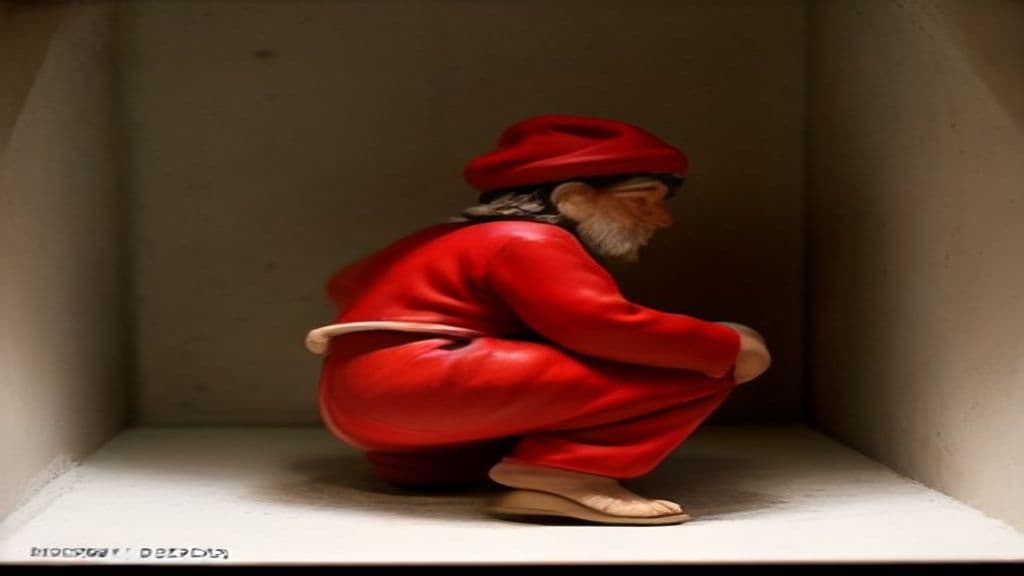
The precise origin of the Caganer is unknown; sources agree the tradition entered nativity displays by the late 17th or early 18th century and is commonly dated to at least the 18th century, with ties to Baroque-era nativity practices. Ethnographic and popular accounts treat the figure as a long-standing element of popular nativity construction rather than as deriving from a single founding myth; commentators note the historic uncertainty while recording its presence in Catalan cultural practice since the early modern period.
Traditionally the Caganer is depicted as a peasant figure wearing a Catalan red cap (barretina), shown squatting with trousers lowered and backside exposed, in the act of defecating. In pessebres it is usually a small figure tucked away in a corner of the model rather than placed near the manger; hiding the figure is itself a family custom. Modern variants commonly portray celebrities, politicians, or authority figures in the same squatting pose, extending the motif as social satire while retaining the essential visual elements.
The Caganer is a static, non-supernatural figurine; sources do not attribute animate or occult powers to it. Any 'effects' are symbolic and folkloric: ethnographers like Joan Amades record a belief that the figurine's act symbolically fertilizes the nativity ground, ensuring fertility, good fortune, or wellbeing for the coming year. Socially, the figure functions as a levelling, humorous device—bringing powerful people 'down' by portraying them in a humiliating bodily act—and as a playful focus for children who are encouraged to find the hidden figure in the pessebre.
Weaknesses
- otherNo weaknesses documented — the Caganer is not treated as a hostile supernatural requiring countermeasures
Wards
- otherNo wards documented — sources record controversy or objection (e.g., criticism when shown outside cultural context) but no protective rituals
Eitri
Eitri (also attested as Sindri) is an Old Norse dwarf smith celebrated in the Skáldskaparmál episode for forging three famous artifacts — Gullinbursti, Draupnir, and Mjöllnir — while working with his brother Brokkr. He is presented as a master craftsman whose work directly affects the gods, not as a deity.
Ekek
A nocturnal birdlike human predator from Philippine folklore, the Ekek (or Ek Ek) is a winged creature said to hunt at night for flesh and blood, particularly targeting sleeping pregnant women and draining fetuses with a long proboscis.
Ekke Nekkepenn
Ekke Nekkepenn is a North Frisian folkloric figure, presented in 19th-century sources as a composite character: Christian Peter Hansen depicted him as a sea-dwelling 'merman' with a wife Rahn, while Theodor Storm later used a similar name for a small fiery, maleficent being. The figure combines a local water-man legend with a Rumpelstiltskin-type name-motif in Hansen's retelling.
El
El (ʼEl, ʾil, ʾilu) is a Northwest Semitic term meaning 'god' that also functions as the proper name and title of a senior, patriarchal deity in Canaanite/Ugaritic and related West Semitic traditions. He is portrayed in surviving texts as the father of the gods, presiding over a divine council, a progenitor of major deities and humankind, and a figure whose attributes were later conflated with those of Yahweh in Israelite religion according to scholarly reconstructions.
El Bilga Khatun
El Bilga Khatun was the wife of Ilterish (Ilterish Qaghan), founder of the Second Turkic Khaganate, and mother of Bilge Qaghan and Kul Tigin. She appears in the Orkhon inscriptions and later historiography as a political partner and honored elite figure of the 8th-century Göktürk polity.
El Borak (Francis Xavier Gordon)
El Borak is a fictional American adventurer created by Robert E. Howard, known by the Arabic epithet meaning "The Swift" for his exceptional speed, martial skill, and guile. Set in early 20th‑century pulp adventure contexts across Afghanistan and adjacent regions, he is portrayed as a legendary human operative whose reputation mediates tribal and political conflict rather than a supernatural being.
El Cucuy
El Cucuy (also rendered Coco or Cucuy) is a Spanish‑language/Latinx folkloric figure functioning as the regional equivalent of the Boogeyman, invoked in lullabies and parental warnings to frighten or discipline children; modern media and paranormal accounts reinterpret it variably as a vigilante creature or an intrusive spirit. Sources show a diffuse folk role rather than a fixed theological identity.
El Naddaha
El Naddaha (Arabic النداهة, "the caller") is an Egyptian popular-legend female water spirit associated with the Nile and its canals. She is portrayed as an alluring, voice-centered figure who calls men—often by name—with a hypnotic voice, drawing them toward the riverbank where they are believed by locals to disappear or drown.
El Shaddai
El Shaddai (Hebrew: אֵל שַׁדַּי, ʾĒl Šadday) is a theonym used in the Hebrew Bible for the God worshipped by the patriarchs and Israel. The compound name is attested across Genesis, Exodus, Job and prophetic texts and has a contested etymology variously read as mountain‑, wilderness‑, destructive, or fertility‑related imagery rather than a single fixed English equivalent.
El Silbón
El Silbón (Spanish: "The Whistler") is a legendary lost-soul figure from the Llanos of Venezuela and the eastern Colombian plains, known in popular accounts for announcing itself by a distinctive whistle and for haunting open plains landscapes in regional storytelling and media.
El Sombrerón
El Sombrerón is a legendary folk character best known from Guatemala and also attested in Mexican and Colombian/Venezuelan collections; portrayed as a nocturnal suitor-like figure who courts or troubles young women, braids animal manes and tails, and travels neighborhoods at dusk with a string of mules carrying coal.
El Tío
El Tío ('The Uncle') is the subterranean lord and local spiritual power of mines in the Bolivian Altiplano (especially Cerro Rico, Potosí). Miners propitiate him with statues and offerings because he is believed to both protect and punish; his identity overlaps with the indigenous Supay and is shaped by colonial and mining contexts.
Community Record
- [1]Caganer. Wikipedia: 'Caganer' article (summary of tradition, appearance, origins, and commentators)wiki
- [2]7th December, El Caganer. Spitalfields Life: popular-press note on El Caganer and its role in Catalan nativity scenesother
- [3]Kitsch xmas. Ship of Fools: article noting controversy when the Caganer was shown outside its native contextother
- [4]The “Caganer” in Catalonian Nativity Scenes | USC Digital Folklore Archives. USC Digital Folklore Archives: student/informant materials summarising customary aspects of the Caganer (hiding, fertility symbolism, popularity)folk
- [5]Remixing El Caganer – vVvAlog. Blog documenting modern variants of the Caganer including celebrity and authority-figure versionsother