
In Hansen's 1858 composite narrative, Ekke Nekkepenn arises from two separate local traditions that the collector combined: an older water-man legend about a being living beneath the North Sea with a wife named Rahn, and a North Frisian variant of the Rumpelstiltskin tale that hinges on learning the supernatural being's name. Later scholarship (notably Willy Krogmann, as summarized in the sources) argues Hansen's linkage and etymological identifications with older Norse sea-deities were mistaken, so the commonly cited figure largely reflects Hansen's 19th-century compositional method rather than a single, continuous ancient archetype.
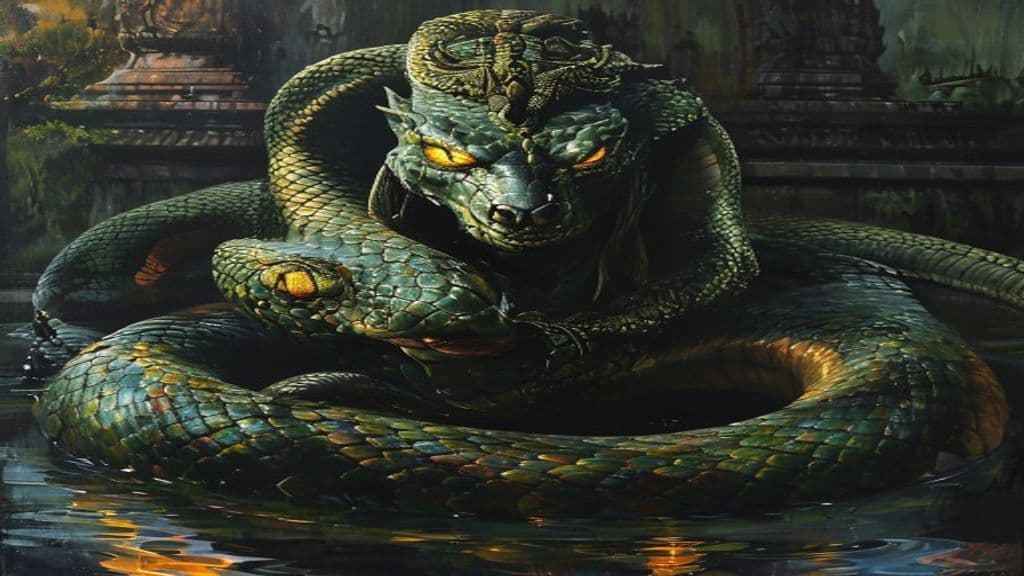
Descriptions vary by nineteenth-century author. In Christian Peter Hansen's 1858 tale, Ekke Nekkepenn is a sea-being who lives on the seabed and can assume the outward form of a handsome sailor when appearing onshore. In Theodor Storm's 1866 use of a similar name (Eckeneckenpen), the figure is cast as a little man of fire who brings blight to fields. These differing portrayals come from distinct literary treatments rather than a single consistent physical type in the recorded tradition.
In Hansen's narrative the being participates in plot events: he and his wife Rahn are said to be able to produce a destructive vortex (the tale describes Rahn 'grinding salt' leading to a powerful vortex that draws a ship and crew under), he can appear ashore as a handsome sailor, can place a ring/chain and claim a human girl as his bride, and can be foiled when his name is learned (the Rumpelstiltskin motif). The same tale also recounts he gives gold and silver and that a woman taken to the sea-bottom later assisted in childbirth and returned safely. In Storm's separate story the name is applied to a small fiery being who casts spells that make fields wither. The sources present these actions as narrative events rather than as catalogued, generalized powers.
Weaknesses
- conditionRevelation of the being's name (public naming)
Wards
- otherThere are no documented ritual wards in the supplied sources; narrative resolution in Hansen is effected by publicly naming the being (exposing his name).
Nis Puk
The Nis Puk is a household spirit from Danish-, Low German- and North Frisian-speaking areas of Schleswig and adjacent regions. Treated as a hybrid of the nisse (house-sprite) and puk/puck (kobold-like manikin), it acts as a domestic helper or a wealth-bringer in some localities and enforces reciprocal obligations through tests, rewards, and punishments.
Einherji (Einherjar)
Einherji (plural Einherjar) is a term from Norse mythic vocabulary attested in the supplied sources mainly as a cultural name and as a statted warrior-type in modern roleplaying/bestiary contexts. The provided materials do not include primary Old Norse myth-text descriptions, so the entries here collate only what those modern and secondary sources assert: a connection to Norse warrior-figures and modern reuse in gaming and Icelandic civic naming.
Eioneus
Eioneus (Ancient Greek Ἠιονεύς, Eioneús) is not a single supernatural being but a personal name borne by several distinct figures in Greek myth. Attestations present Eioneus as mortal or semi-divine personages: genealogical ancestors (fathers or grandfathers), an eponymous founder-figure linked to a coastal city, a suitor slain in a heroic contest, and named warriors killed in the Trojan War cycle.
Eir
Eir is an Old Norse female supernatural figure associated with healing and medical skill in medieval Icelandic sources. She appears in the Poetic Edda and Prose Edda (as an ásynja and as a valkyrie-name) and among the maidens of Menglöð on Lyfjaberg ('hill of healing'); attestations are sparse and scholars debate whether these refer to one coherent deity or multiple figures sharing a name.
Eisheth Zenunim
A feminine personification from Zoharic Kabbalah identified with sexual immorality and named among a quartet of female partners of Samael. Later Western esoteric and popular sources reinterpret her as a Qliphothic princess or succubus-like 'queen' of demons.
Eitri
Eitri (also attested as Sindri) is an Old Norse dwarf smith celebrated in the Skáldskaparmál episode for forging three famous artifacts — Gullinbursti, Draupnir, and Mjöllnir — while working with his brother Brokkr. He is presented as a master craftsman whose work directly affects the gods, not as a deity.
Ekek
A nocturnal birdlike human predator from Philippine folklore, the Ekek (or Ek Ek) is a winged creature said to hunt at night for flesh and blood, particularly targeting sleeping pregnant women and draining fetuses with a long proboscis.
El
El (ʼEl, ʾil, ʾilu) is a Northwest Semitic term meaning 'god' that also functions as the proper name and title of a senior, patriarchal deity in Canaanite/Ugaritic and related West Semitic traditions. He is portrayed in surviving texts as the father of the gods, presiding over a divine council, a progenitor of major deities and humankind, and a figure whose attributes were later conflated with those of Yahweh in Israelite religion according to scholarly reconstructions.
El Bilga Khatun
El Bilga Khatun was the wife of Ilterish (Ilterish Qaghan), founder of the Second Turkic Khaganate, and mother of Bilge Qaghan and Kul Tigin. She appears in the Orkhon inscriptions and later historiography as a political partner and honored elite figure of the 8th-century Göktürk polity.
El Borak (Francis Xavier Gordon)
El Borak is a fictional American adventurer created by Robert E. Howard, known by the Arabic epithet meaning "The Swift" for his exceptional speed, martial skill, and guile. Set in early 20th‑century pulp adventure contexts across Afghanistan and adjacent regions, he is portrayed as a legendary human operative whose reputation mediates tribal and political conflict rather than a supernatural being.
El Caganer
El Caganer is a small, conventional figurine placed within Catalan and neighbouring nativity scenes (pessebres), typically depicted squatting and defecating. It functions as a recurring, recognisable character in the constructed visual landscape of the Christmas nativity, carrying symbolic roles including fertility symbolism, social satire, and a playful family custom of hiding and seeking.
El Cucuy
El Cucuy (also rendered Coco or Cucuy) is a Spanish‑language/Latinx folkloric figure functioning as the regional equivalent of the Boogeyman, invoked in lullabies and parental warnings to frighten or discipline children; modern media and paranormal accounts reinterpret it variably as a vigilante creature or an intrusive spirit. Sources show a diffuse folk role rather than a fixed theological identity.
Community Record
- [1]Ekke Nekkepenn — Wikipedia. Wikipedia article 'Ekke Nekkepenn' (summary of Hansen, Storm, and subsequent scholarship including Krogmann)wiki
- [2]Wikidata item Q1322642 Ekke Nekkepenn. Wikidata entry for Ekke Nekkepenn (identifiers and links to related resources)other