
Charon's obol does not have supernatural powers itself, but rather serves as a payment or bribe for Charon's services.
Chariclo
Chariclo is a name assigned to one or two nymph figures in Ancient Greek myth. In surviving sources she appears either as the wife of the centaur Chiron and member of a Chironian household (nurse of Achilles in some scholia) or as a devotee/attendant of Athena who is the mother of the seer Tiresias; both roles place her among domestic, caregiving, and intercessory minor divine figures rather than as an independent cultic deity.
Charisius
Charisius is an Arcadian prince in Greek myth, counted among the fifty sons of King Lycaon and traditionally credited as the eponymous founder of Charisia (Charisiae) in Arcadia. He is attested only in genealogical and toponymic lists and is not described as a supernatural being or cult figure in the available sources.
Charites
In ancient Greek tradition the Charites (singular Charis) are divine female personifications who embody grace, beauty, festivity and the social arts of banquet, dance and song. Treated primarily as a collective presence and attendants of major Olympian gods (notably Aphrodite and Apollo), they feature in regional cults and poetic traditions as figures who enhance attractiveness, conviviality and ritual joy.
Charlie-27
A comic-book character from Marvel's Earth-691 31st-century setting: a Jupiter-descended human with engineered adaptations for high gravity who serves as a militia captain and founding member of the original Guardians of the Galaxy. Appears in comics beginning 1969 and adapted in the MCU film Guardians of the Galaxy Vol. 2.
Charnabon
Charnabon (also attested as Carnabon) is a figure from Greek mythic fragments described as a mortal king of the Getae/Thrace who treacherously attacked the culture-hero Triptolemus during the latter's mission to disseminate agriculture; Demeter punished him and, in the tradition, placed him among the stars as the constellation Ophiuchus.
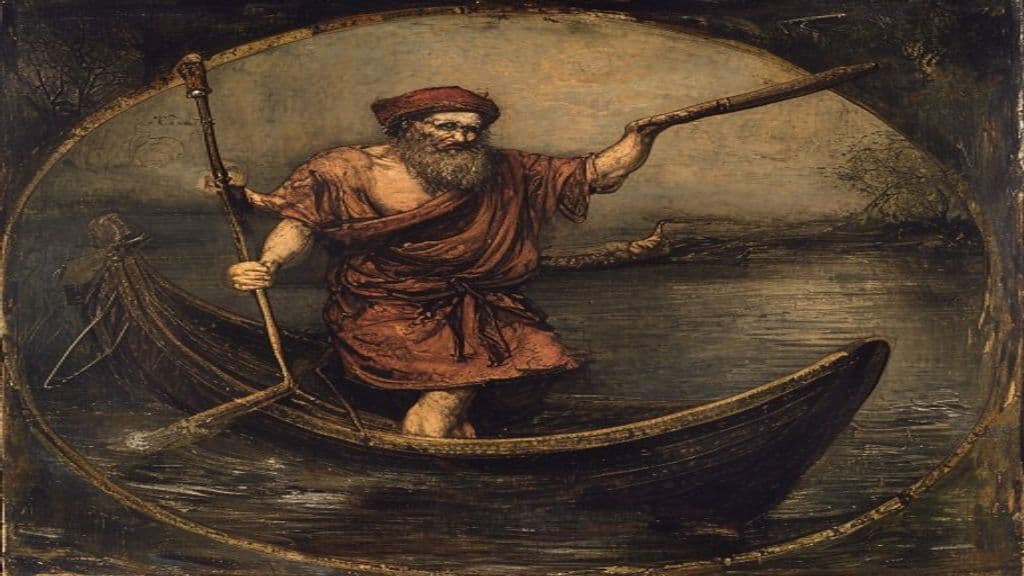
Charon
Charon (Χάρων) is the ferryman of the Greek underworld who conveys the souls of the dead across the boundary river (variously Acheron or Styx). He functions as an underworld attendant and psychopomp whose service typically requires funeral rites and payment (Charon's obol).
Charun
An Etruscan chthonic attendant and psychopomp depicted in funerary art; Charun escorts the dead to the underworld and appears in grotesque, monstrous form often bearing a hammer. He is typically an underworld functionary rather than the sovereign ruler of the dead.
Charybdis
In Greek myth, Charybdis is a sea-associated monstrous force localized to the Strait of Messina, treated in sources either as an anthropomorphized sea-monster or as a violent whirlpool/stream that three times a day swallows and belches the sea. Paired with Scylla, she functions as an unavoidable maritime hazard and proverbial dilemma for voyagers.
Chaturbhuja
Hindu iconographic concept of a deity with four arms, symbolizing power and divinity in Hindu art and literature. (Note: - Power tier should be "Ancient" or even "Primordial", given that it represents a concept associated with deities and symbols of cosmic power. - Abilities claim is partially accurate but could be clea)
Chax (Shax)
Chax (also spelled Shax) is a named spirit attested in modern indices and summaries of Renaissance/early‑modern grimoire material, principally the Ars Goetia/Lemegeton and the Pseudomonarchia Daemonum tradition. The supplied sources record the name in catalogues and reference lists but contain no substantive description, ritual material, or folkloric narratives about the entity.
Chazaqiel
Chazaqiel is named in modern summaries of the Book of Enoch tradition as one of the leaders among the two hundred Watchers who 'fell'; he is repeatedly glossed in the supplied sources as the teacher of knowledge about clouds or meteorology and is etymologically linked to clouds or sky phenomena.
Chebi Khan (Ashina Hubo)
Chebi Khan (Yizhuchebi Khagan; personal name Ashina Hubo) was a historical claimant and later khagan of the Eastern Turkic Khaganate in the mid-7th century CE who rebuilt a measure of Turkic authority after the collapse of the khaganate, before being captured by Tang forces and taken to Chang'an in 650.
Community Record
- [1]Wikipediawiki