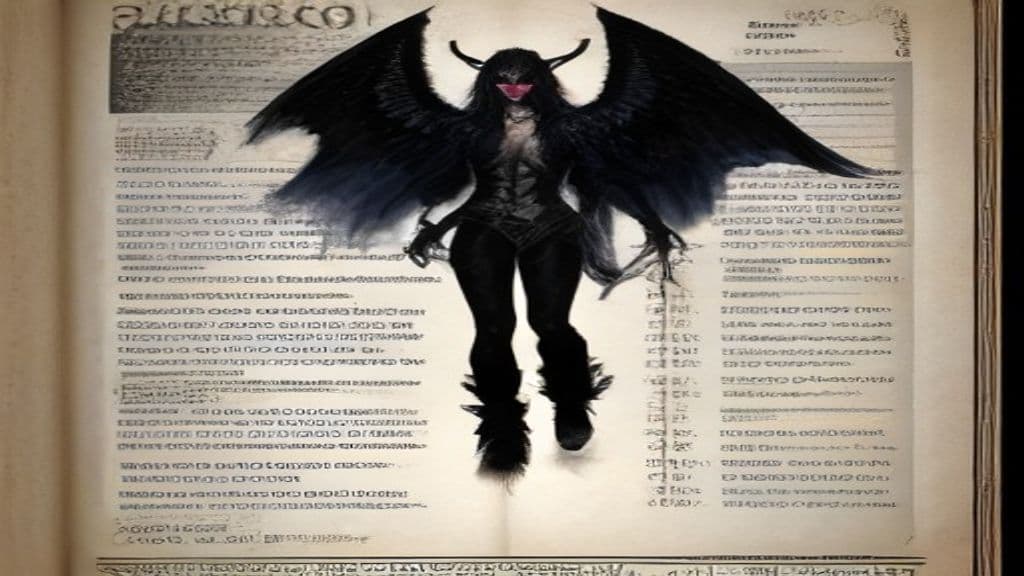
The supplied materials do not provide a narrative origin for Chax/Shax. In the documents available here the name appears as an entry in grimoire catalogues and later reference lists (Ars Goetia / Lemegeton‑style indexes and compilations derived from Johann Weyer), but no indigenous mythic provenance or origin tale is recorded in the excerpts provided.
No description of Chax/Shax's appearance is present in the supplied sources. The references included in the research material only list the name in indexes and catalogues; they do not supply iconography, form, or visual attributes for the entity.
The provided sources do not record any specific powers, offices, or behaviors for Chax/Shax. Although goetic lists elsewhere commonly assign ranks and functions to named entries, the excerpts and indices supplied here do not include those details for this name.
Charnabon
Charnabon (also attested as Carnabon) is a figure from Greek mythic fragments described as a mortal king of the Getae/Thrace who treacherously attacked the culture-hero Triptolemus during the latter's mission to disseminate agriculture; Demeter punished him and, in the tradition, placed him among the stars as the constellation Ophiuchus.
Charon
Charon (Χάρων) is the ferryman of the Greek underworld who conveys the souls of the dead across the boundary river (variously Acheron or Styx). He functions as an underworld attendant and psychopomp whose service typically requires funeral rites and payment (Charon's obol).
Charon's Obol
In Roman tradition, Charon's obol is a payment or bribe given to Charon, the ferryman of the dead, to ensure safe passage across the afterlife. (Note: - Power tier should be Lesser, as it's a payment or bribe, not a cosmic entity. - Remove mention of supernatural powers, as the text states it serves as a payment for Charon's services. - Add that the)
Charun
An Etruscan chthonic attendant and psychopomp depicted in funerary art; Charun escorts the dead to the underworld and appears in grotesque, monstrous form often bearing a hammer. He is typically an underworld functionary rather than the sovereign ruler of the dead.
Charybdis
In Greek myth, Charybdis is a sea-associated monstrous force localized to the Strait of Messina, treated in sources either as an anthropomorphized sea-monster or as a violent whirlpool/stream that three times a day swallows and belches the sea. Paired with Scylla, she functions as an unavoidable maritime hazard and proverbial dilemma for voyagers.
Chaturbhuja
Hindu iconographic concept of a deity with four arms, symbolizing power and divinity in Hindu art and literature. (Note: - Power tier should be "Ancient" or even "Primordial", given that it represents a concept associated with deities and symbols of cosmic power. - Abilities claim is partially accurate but could be clea)
Chazaqiel
Chazaqiel is named in modern summaries of the Book of Enoch tradition as one of the leaders among the two hundred Watchers who 'fell'; he is repeatedly glossed in the supplied sources as the teacher of knowledge about clouds or meteorology and is etymologically linked to clouds or sky phenomena.
Chebi Khan (Ashina Hubo)
Chebi Khan (Yizhuchebi Khagan; personal name Ashina Hubo) was a historical claimant and later khagan of the Eastern Turkic Khaganate in the mid-7th century CE who rebuilt a measure of Turkic authority after the collapse of the khaganate, before being captured by Tang forces and taken to Chang'an in 650.
Chedorlaomer
A foreign king identified in Genesis 14 as 'king of Elam' who leads a coalition of rulers to extract tribute from Levantine city-states and conducts a punitive campaign that results in capture of Lot and subsequent defeat by Abram/Abraham. The name is widely analyzed as an Elamite theophoric compound (Kudur/Kudur- + Lagamar) but lacks uncontested extrabiblical attestation.
Chelone
Chelone is primarily documented as a botanical genus of perennial plants native to eastern North America (commonly called turtlehead or balmony) and secondarily as the name of a nymph attested in classical Aesopic fable tradition. The sources provide horticultural, taxonomic, and herbal-medicinal information for the plants and only a brief literary mention for the mythic name.
Chemical King
Chemical King is a fictional DC Comics character (codename) first appearing in Adventure Comics #371 (1968) as a member of the Legion of Super‑Heroes in the 31st century; his civilian/given name is Condo Arlik, born on the planet Phlon. He is portrayed as a metahuman able to accelerate or decelerate chemical reactions, and his narrative history across DC editorial reboots includes a canonical death (Superboy and the Legion of Super‑Heroes #228, 1977), a post-Zero Hour repurposing, and a restored-deceased status in Final Crisis: Legion of 3 Worlds #1.
Chen Fu Zhen Ren
Chen Fu Zhen Ren (陳府真人; Hokkien: Tan Hu Cin Jin) is a deified ancestral/tutelary figure venerated in East Java, Bali, and Lombok. Centered on a historical/legendary migrant craftsman who became a local immortal, his cult is maintained in Chinese temples and by indigenous Kejawen practitioners and functions as a protective, communal ancestor patron.
Community Record
- [1]Chax (Wikipedia). Wikipedia contributors, 'Chax', Wikipedia, The Free Encyclopediawiki
- [2]Shax (Wikidata). Wikidata entry for Shaxwiki
- [3]Names of the Goetia demons (list derived from Wier and Lemegeton). Online list: 'Names of 72 demons from Joannes Wierus Pseudo-Monarchia Demonorum (1577) and from Lemegeton (British Library, MS Sloane 3648, ed. by Kevin Wilby, published by Adam McLean 1985).' (as given in research notes)other
- [4]List of demons in the Ars Goetia (Wikipedia). Wikipedia contributors, 'List of demons in the Ars Goetia', Wikipedia, The Free Encyclopediawiki