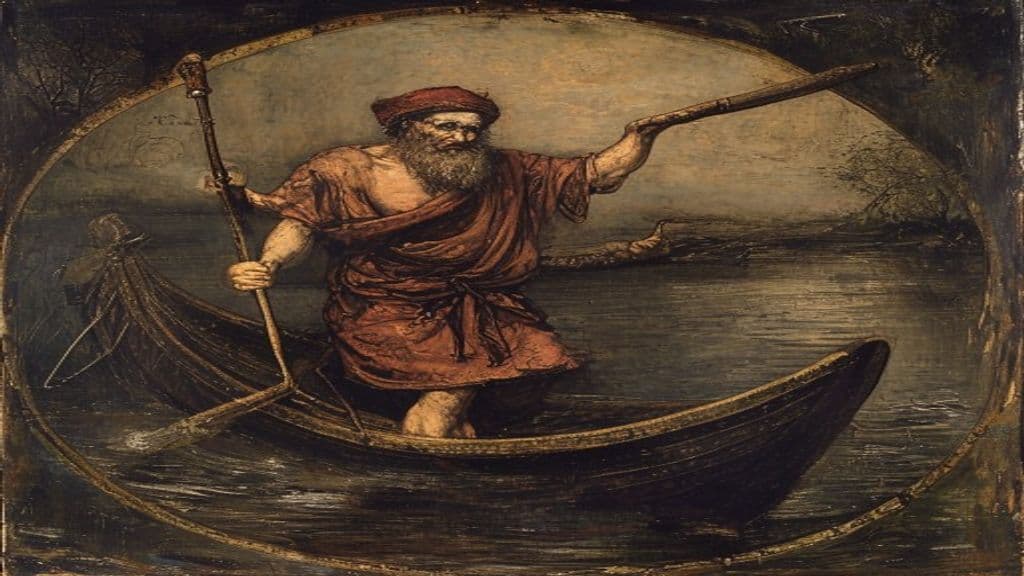
Surviving ancient literary sources treat Charon as a functional figure of the underworld apparatus rather than as a deity with a consistent genealogy; no standard parentage is given in the principal ancient corpus cited here. Later writers (Renaissance and post-classical) sometimes proposed genealogies or identifications, but in the classical texts Charon appears as the named ferryman who mans the boat across the rivers that border Hades (attested in Greek and later Roman literature and in funerary iconography).
In classical Greek vase-painting (5th–4th century BCE) Charon is depicted as a rough, unkempt seaman, often shown with a ferryman's pole and dressed in reddish-brown garments. Roman literary descriptions (notably Virgil) elaborate the image into a sordid, foul-clothed old man with an uncombed beard and eyes likened to "hollow furnaces on fire." Later medieval and Renaissance art amplify these traits (mean-spirited gaunt old man, sometimes winged or demonic in medieval imagining); modern popular iconography often conflates him with skeletal or Grim Reaper imagery, anachronistic relative to ancient descriptions. The distinct Etruscan figure Charun should not be conflated with Greek Charon: Charun bears different visual attributes (wings, pointed ears, vulture-like beak, and a hammer) in the Etruscan tradition.
Charon's primary function is transport: he ferries the souls of those who have received proper funeral rites across the underworld rivers (Acheron in many Greek accounts; Styx in many Roman poets). He enforces the requirement of a fare — coins known as Charon's obol are archaeological evidence of that expectation. Literary tradition (Virgil) reports that souls unable to pay or lacking rites must wander the near shores for a period (Virgil gives one hundred years). In mythic narratives living heroes may cross with authorization (e.g., Aeneas's golden bough in Virgil) or by force (episodes in which Heracles overpowers Charon), showing narrative limits to his dominance rather than catalogued supernatural vulnerabilities.
Weaknesses
- conditioncan be physically overpowered
- conditionauthority/authorization (literary devices like the golden bough permit passage)
Wards
- substanceCharon's obol (funerary coin placed with the dead)
- ritualproper funeral rites
Cecrops I
Cecrops I is a legendary autochthonous founder‑king of Attica and the first king of Athens, portrayed as a culture‑hero who instituted marriage, burial rites, civic divisions, and cult practices. He appears in Greek tradition as human above and serpentine or fish‑tailed below, and as the mortal witness/arbitrator in the mythic contest between Athena and Poseidon over patronage of the city.
Eumolpus
Eumolpus is a legendary Greek culture-hero and priest associated with Demeter and the founding of the Eleusinian Mysteries; he is remembered as a singer, ritual teacher, and sometimes as a Thracian leader in conflict with Athens. Later Roman literature repurposes his name as a poetic persona in satire.
Nereids
Nereids are the class of female sea-nymphs in Greek myth, traditionally the fifty daughters of Nereus and the Oceanid Doris, associated especially with the Aegean Sea. They appear as beautiful young women who dwell in the sea and form the retinue of major sea-deities, acting as benevolent helpers of sailors and participants in mythic narratives.
Chariclo
Chariclo is a name assigned to one or two nymph figures in Ancient Greek myth. In surviving sources she appears either as the wife of the centaur Chiron and member of a Chironian household (nurse of Achilles in some scholia) or as a devotee/attendant of Athena who is the mother of the seer Tiresias; both roles place her among domestic, caregiving, and intercessory minor divine figures rather than as an independent cultic deity.
Charisius
Charisius is an Arcadian prince in Greek myth, counted among the fifty sons of King Lycaon and traditionally credited as the eponymous founder of Charisia (Charisiae) in Arcadia. He is attested only in genealogical and toponymic lists and is not described as a supernatural being or cult figure in the available sources.
Charites
In ancient Greek tradition the Charites (singular Charis) are divine female personifications who embody grace, beauty, festivity and the social arts of banquet, dance and song. Treated primarily as a collective presence and attendants of major Olympian gods (notably Aphrodite and Apollo), they feature in regional cults and poetic traditions as figures who enhance attractiveness, conviviality and ritual joy.
Charlie-27
A comic-book character from Marvel's Earth-691 31st-century setting: a Jupiter-descended human with engineered adaptations for high gravity who serves as a militia captain and founding member of the original Guardians of the Galaxy. Appears in comics beginning 1969 and adapted in the MCU film Guardians of the Galaxy Vol. 2.
Charnabon
Charnabon (also attested as Carnabon) is a figure from Greek mythic fragments described as a mortal king of the Getae/Thrace who treacherously attacked the culture-hero Triptolemus during the latter's mission to disseminate agriculture; Demeter punished him and, in the tradition, placed him among the stars as the constellation Ophiuchus.
Charon's Obol
In Roman tradition, Charon's obol is a payment or bribe given to Charon, the ferryman of the dead, to ensure safe passage across the afterlife. (Note: - Power tier should be Lesser, as it's a payment or bribe, not a cosmic entity. - Remove mention of supernatural powers, as the text states it serves as a payment for Charon's services. - Add that the)
Charun
An Etruscan chthonic attendant and psychopomp depicted in funerary art; Charun escorts the dead to the underworld and appears in grotesque, monstrous form often bearing a hammer. He is typically an underworld functionary rather than the sovereign ruler of the dead.
Charybdis
In Greek myth, Charybdis is a sea-associated monstrous force localized to the Strait of Messina, treated in sources either as an anthropomorphized sea-monster or as a violent whirlpool/stream that three times a day swallows and belches the sea. Paired with Scylla, she functions as an unavoidable maritime hazard and proverbial dilemma for voyagers.
Chaturbhuja
Hindu iconographic concept of a deity with four arms, symbolizing power and divinity in Hindu art and literature. (Note: - Power tier should be "Ancient" or even "Primordial", given that it represents a concept associated with deities and symbols of cosmic power. - Abilities claim is partially accurate but could be clea)
Community Record
- [1]Charon (Greek mythology) — Wikipedia. Wikipedia contributors, "Charon (Greek mythology)," Wikipedia, The Free Encyclopediawiki
- [2]Charon (moon) — Wikipedia. Wikipedia contributors, "Charon (moon)," Wikipedia, The Free Encyclopediawiki
- [3]The Zork Library: Charon. The Zork Library entry on Charon (iconography and literary references)other
- [4]WorldWideWords: 'Charon'. WorldWideWords topical entry on Charon and language/historyother
- [5]Biblical Cyclopedia: Charon. Biblical Cyclopedia article summarizing classical referencesother