
Sources present Chen Fu Zhen Ren as a figure from a Chaozhou/Fujian migrant family who, noted for filial piety and skill as a craftsman, served local polities. According to a temple stele and a Malayan-script life history, he became captain of a single-poled ship, survived a wreck in the Bali Strait and was cast ashore at Blambangan. He is said to have built a palace at Macanputih (Banyuwangi), been summoned to build for the Mengwi king in Bali, suffered betrayal when officers were sent to kill him, and ultimately departed the world by climbing Sembulungan Mountain where he attained immortality. Scholarly readings infer these events after 1729 CE (interpretive dating by Salmon and Sidharta) but the primary inscriptions do not give exact years.
The stele biography and the Malayan-script life history preserved in cited sources do not provide a standardized iconographic or physical description; the available documents record actions and episodes (shipwreck, palace-building, walking on water, ascent to immortality) but do not record clothing, facial features, or a fixed statue-form in the quoted material.
Legendary acts in the sources include survival of a shipwreck, exceptional skill as a craftsman who built palaces in Bali and Blambangan, supernatural travel (the account says Tan Cin Jin walked over the water across the Bali Strait while two officers used his sandals as a boat), and attainment of immortality after ascending Sembulungan Mountain. The narrative also places him within a supernatural kin network in which his brothers become local powers (one a beach deity at Watu Dodol, another a tiger), producing protective taboos reported by worshipers.
Weaknesses
None recorded.
Wards
- ritualtemple worship and commemorative inscription
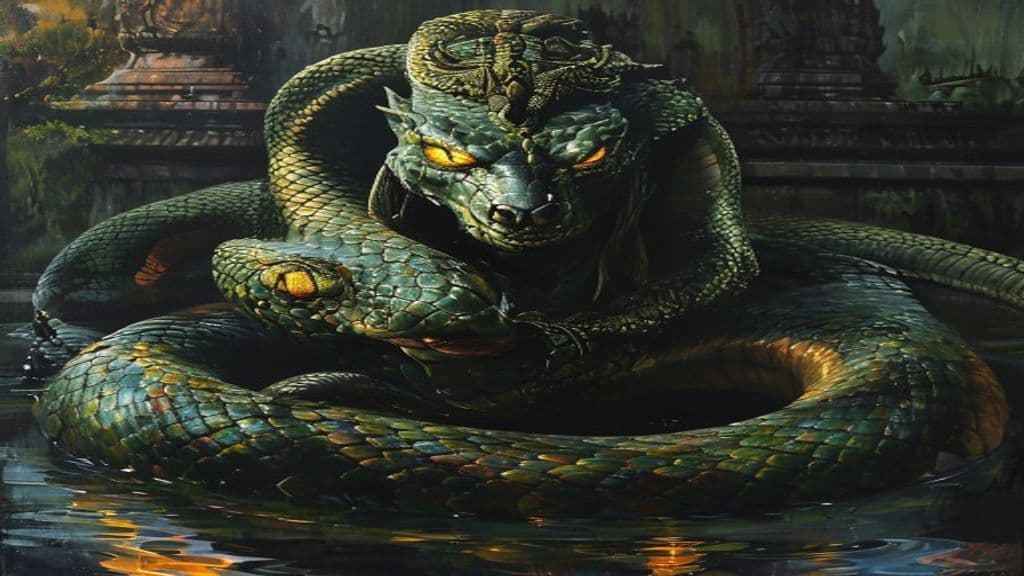
Naga
Divine serpent beings of Hindu, Buddhist, and Jain cosmology — powerful guardians of water, earth, and underground treasures. Revered as deities in South and Southeast Asia.
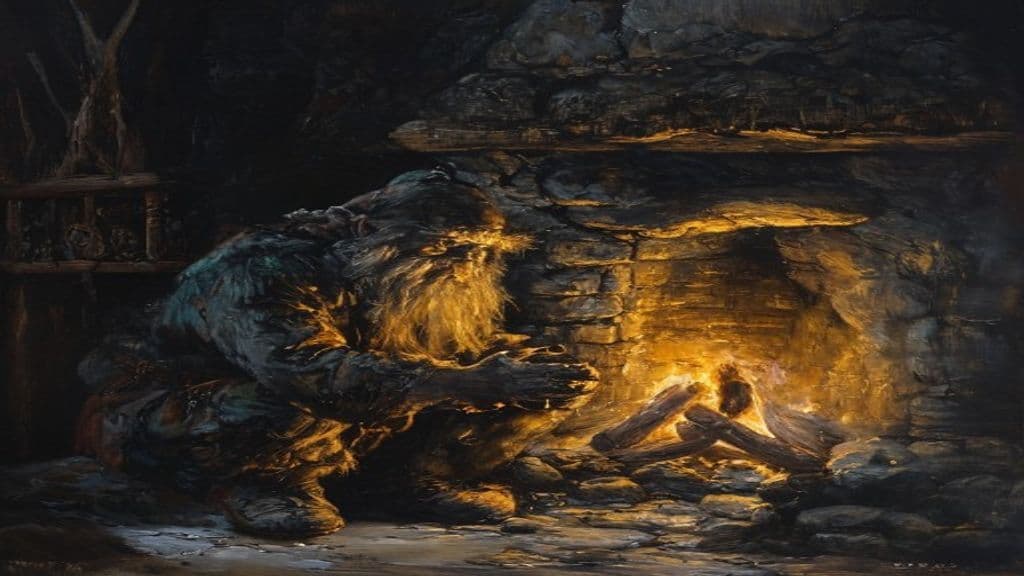
Domovoi
The house spirit of Slavic tradition — a small, invisible guardian of the home bound to a specific dwelling and its family. Protective when respected; dangerous when insulted or forgotten.
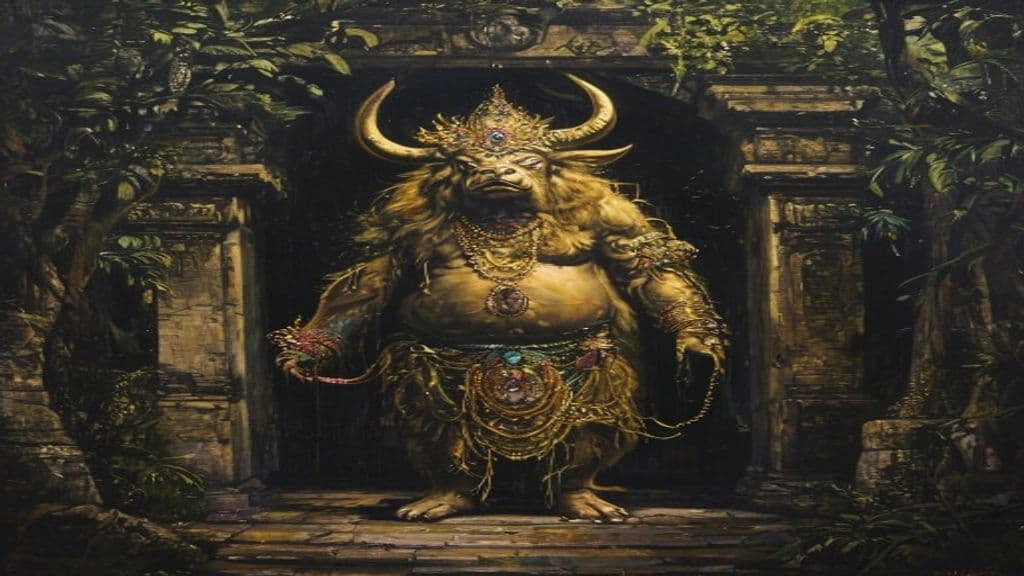
Yaksha
Nature spirits of Hindu, Buddhist, and Jain cosmology — guardians of forests, treasures, and wilderness. Ambivalent beings, capable of great benevolence to the respectful and terrible harm to the greedy.

Apsara
Celestial dancers and water nymphs of Hindu cosmology — beautiful semi-divine beings who dance at the court of Indra and, by his command, descend to earth to distract sages from excessive asceticism.
Chax (Shax)
Chax (also spelled Shax) is a named spirit attested in modern indices and summaries of Renaissance/early‑modern grimoire material, principally the Ars Goetia/Lemegeton and the Pseudomonarchia Daemonum tradition. The supplied sources record the name in catalogues and reference lists but contain no substantive description, ritual material, or folkloric narratives about the entity.
Chazaqiel
Chazaqiel is named in modern summaries of the Book of Enoch tradition as one of the leaders among the two hundred Watchers who 'fell'; he is repeatedly glossed in the supplied sources as the teacher of knowledge about clouds or meteorology and is etymologically linked to clouds or sky phenomena.
Chebi Khan (Ashina Hubo)
Chebi Khan (Yizhuchebi Khagan; personal name Ashina Hubo) was a historical claimant and later khagan of the Eastern Turkic Khaganate in the mid-7th century CE who rebuilt a measure of Turkic authority after the collapse of the khaganate, before being captured by Tang forces and taken to Chang'an in 650.
Chedorlaomer
A foreign king identified in Genesis 14 as 'king of Elam' who leads a coalition of rulers to extract tribute from Levantine city-states and conducts a punitive campaign that results in capture of Lot and subsequent defeat by Abram/Abraham. The name is widely analyzed as an Elamite theophoric compound (Kudur/Kudur- + Lagamar) but lacks uncontested extrabiblical attestation.
Chelone
Chelone is primarily documented as a botanical genus of perennial plants native to eastern North America (commonly called turtlehead or balmony) and secondarily as the name of a nymph attested in classical Aesopic fable tradition. The sources provide horticultural, taxonomic, and herbal-medicinal information for the plants and only a brief literary mention for the mythic name.
Chemical King
Chemical King is a fictional DC Comics character (codename) first appearing in Adventure Comics #371 (1968) as a member of the Legion of Super‑Heroes in the 31st century; his civilian/given name is Condo Arlik, born on the planet Phlon. He is portrayed as a metahuman able to accelerate or decelerate chemical reactions, and his narrative history across DC editorial reboots includes a canonical death (Superboy and the Legion of Super‑Heroes #228, 1977), a post-Zero Hour repurposing, and a restored-deceased status in Final Crisis: Legion of 3 Worlds #1.
Chen Jinggu (陳靖姑)
Chen Jinggu is a historical‑legendary Taoist woman venerated as a protective goddess of women, pregnancy, childbirth, children, and coastal communities in Fujian and Taiwan. Remembered as a Lushan‑school priestess who used ritual power to end a drought and vanquish a white snake, she was later honored in temples and mediumship and is incorporated into modern maritime devotional calendars.
Chenghuangshen (City God)
Chenghuangshen (城隍神), commonly called the City God, is a tutelary deity in Chinese folk religion tied to a specific settlement. Historically associated with a city's walls and moat, the deity functions as protector of local affairs and as a local official in the postmortem ordering of souls for that place.
Cheonyeo Gwishin (Virgin Ghost)
Cheonyeo gwishin is a subtype within the Korean category of gwisin: spirits/ghosts of humans who have died. The available sources identify gwisin as human-derived spirits distinct from non-human folkloric beings (e.g., dokkaebi) and note that contemporary media often depicts such ghosts as liminal, socially isolated figures.
Cherchen (Chercheny)
No folkloric entity named 'Cherchen' or 'chercheny' is described in the supplied sources. The term appears only as the toponym for the oasis town Qiemo (Cherchen) in Xinjiang and as a travel-route waypoint in 19th–20th century European travel literature and Cold War-era documents.
Cherin
Cherin is attested in medieval pseudo-history as a legendary king of the Britons in Geoffrey of Monmouth's Historia Regum Britanniae; later the string appears as a modern given name and surname in various secular contexts. The available sources record genealogical placement and modern name usages but do not present Cherin as a supernatural being.
Chernava
Chernava is a water spirit in East Slavic (Russian) folklore portrayed as a mermaid and the personification of the river Chernava; in the Sadko bylina she is presented as one of the Sea Tsar's daughters (in some versions, his niece) who aids the hero by transforming into the river Chernava and returning him to the human world.
Community Record
- [1]Chen Fu Zhen Ren (Wikipedia article). Wikipedia contributors, 'Chen Fu Zhen Ren', Wikipedia, The Free Encyclopedia.wiki
- [2]Wikidata: Chen Fu Zhen Ren. Wikidata entry Q9009023 for Chen Fu Zhen Ren.other