
There is no indigenous origin myth preserved for Chernoglav in the surviving material. The deity is known only from a short passage transmitted via Old Icelandic sources (the Knýtlinga saga) that lists him among gods worshipped on the island of Rügen/Jasmund. Modern scholars have proposed alternative identifications or etymologies (e.g., readings as Triglav; links to Chernobog; possible identification with Yarovit or Perun), but these are interpretive reconstructions rather than attestations in the saga text itself.
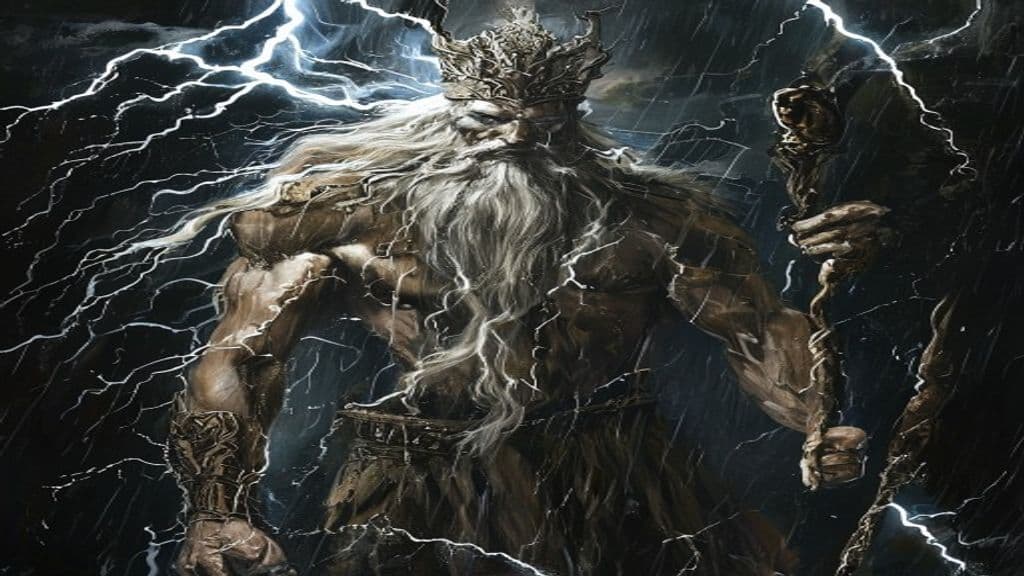
The saga passage provides a single physical detail: 'He had a moustache of silver.' No consistent iconography or additional descriptive attributes for Chernoglav survive in the cited material; the deity is otherwise attested only in the brief regional listing of gods associated with Rügen/Jasmund.
The only attested function is martial: the Knýtlinga saga calls him 'their god of victory who went with them on military campaigns,' indicating cultic association with warfare and success in battle. The sources do not describe specific supernatural powers, feats, spells, or miraculous deeds beyond this role. The saga also relates that the statue or cult 'resisted longer than the others but they managed to get him there years later,' a narrative of resistance to Christianization rather than an account of divine actions.
Weaknesses
- conditionsuppression by Christianization / removal or destruction of cult images
Wards
None recorded.
Chenghuangshen (City God)
Chenghuangshen (城隍神), commonly called the City God, is a tutelary deity in Chinese folk religion tied to a specific settlement. Historically associated with a city's walls and moat, the deity functions as protector of local affairs and as a local official in the postmortem ordering of souls for that place.
Cheonyeo Gwishin (Virgin Ghost)
Cheonyeo gwishin is a subtype within the Korean category of gwisin: spirits/ghosts of humans who have died. The available sources identify gwisin as human-derived spirits distinct from non-human folkloric beings (e.g., dokkaebi) and note that contemporary media often depicts such ghosts as liminal, socially isolated figures.
Cherchen (Chercheny)
No folkloric entity named 'Cherchen' or 'chercheny' is described in the supplied sources. The term appears only as the toponym for the oasis town Qiemo (Cherchen) in Xinjiang and as a travel-route waypoint in 19th–20th century European travel literature and Cold War-era documents.
Cherin
Cherin is attested in medieval pseudo-history as a legendary king of the Britons in Geoffrey of Monmouth's Historia Regum Britanniae; later the string appears as a modern given name and surname in various secular contexts. The available sources record genealogical placement and modern name usages but do not present Cherin as a supernatural being.
Chernava
Chernava is a water spirit in East Slavic (Russian) folklore portrayed as a mermaid and the personification of the river Chernava; in the Sadko bylina she is presented as one of the Sea Tsar's daughters (in some versions, his niece) who aids the hero by transforming into the river Chernava and returning him to the human world.
Chernobog and Belobog
A pair of opposing divine names recorded by medieval and early modern Christian chroniclers for West Slavic contexts: Chernobog ('Black God') associated with adverse fortune and harm, and Belobog ('White God') presented as a beneficent counterpart. Their historicity and status in pre-Christian Slavic religion are disputed; Chernobog is attested earliest (12th c.), while Belobog appears in much later sources and may be a later contraposition.
Cherub
In Abrahamic religious literatures a cherub (Hebrew kərūḇ, pl. kərūḇīm; English cherub/cherubim) is a class of exalted celestial being associated with the divine presence, guardianship of sacred space, and service near God. Descriptions range from the composite, winged hybrid creatures of prophetic visions and Near Eastern art to later Western artistic renderings as chubby winged putti; their rank and appearance vary across Jewish, Christian, and Islamic traditions.
Cherubim
Cherubim are a class of non-human, winged supernatural beings in the Abrahamic religious corpus and related traditions. They function primarily as guardians and attendants of a divine presence—appearing around thrones, the Ark, sacred trees, and in liturgical representation—and the term has been adopted in various devotional and modern cultural contexts.
Chervona Ruta
Chervona Ruta (Ukrainian: Червона рута, lit. 'Red Rue') is a Ukrainian cultural motif that refers both to a plant of ambiguous identification (variously associated with the rue genus Ruta or with rhododendron) and to a hugely popular song written by Volodymyr Ivasiuk in 1968 which spawned recordings, covers, and a namesake music festival.
Chesias
Chesias (Ancient Greek: Χησιὰς, Khēsiàs) is a named nymph in Greek mythology, described in the sources as "the fairest of the nymphs," wife of the Samian river-god Imbrasus, and mother of the Naiad Ocyrhoë. She is attested as a local nature-nymph associated with the island of Samos.
Cheval Bayard
Cheval Bayard is a named legendary horse that appears in medieval French romance (notably the chansons de geste such as The Four Sons of Aymon) and in later popular retellings. In the supplied materials the figure is presented alternately as a marvelous steed within medieval narrative tradition and, in a small number of modern commentaries, as a mischievous trouble‑making horse used as a storytelling antagonist.
Chevalier Onulphe d’Aa / Ridder Onulfe van Aa
A processional giant effigy associated with the municipality of Anderlecht; recorded in a Wikidata entry as a civic festival figure rather than a personal supernatural being. The source gives only name variants and classification as a processional giant, with no further descriptive or narrative detail.
Community Record
- [1]Chernoglav (Wikipedia). Wikipedia contributors, 'Chernoglav,' Wikipedia, The Free Encyclopedia.wiki
- [2]Knýtlinga saga (Old Icelandic account, summary recounted in secondary sources). Wikidata entry Q9198099 summarising Old Icelandic sources (Knýtlinga saga) attesting Tjarnaglófi as a god of victory on Rügen.literary