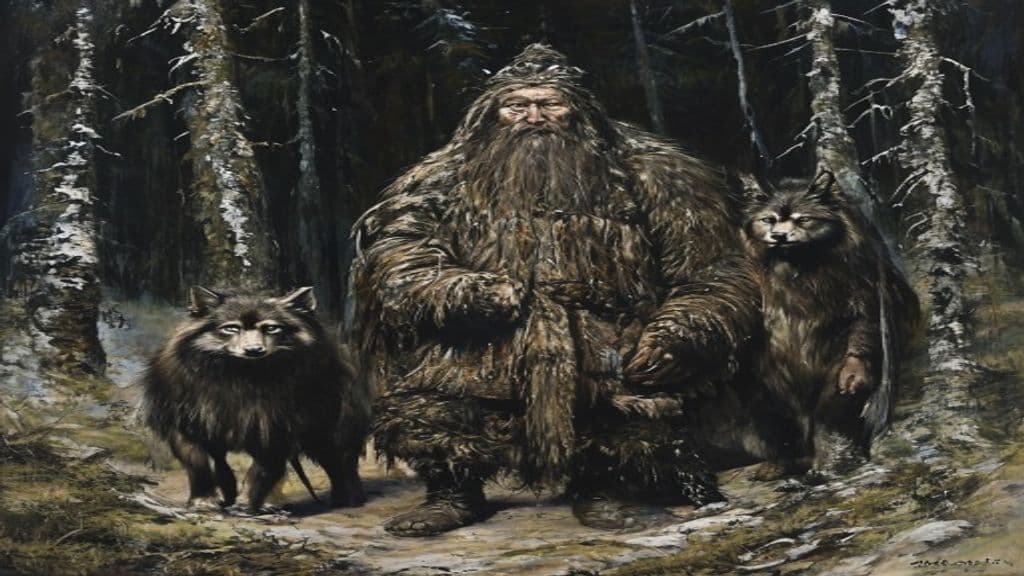
In the collected legends the Chud are narrated as a people of an earlier age who either were displaced by Slavic expansion and Christianization, fled into forests, went underground by digging earthen vaulted chambers and then buried themselves, or were transformed in later memory into other kinds of beings. Komi cosmogonic accounts present the Chud-era as a different order of things—an age in which crops grew by themselves, children spoke at birth, and death was absent—while Russian regional tales preserve motifs of fortification, resistance, flight, and subterranean disappearance that explain their absence from the present landscape.
Descriptions vary by tradition. Russian and northern Russian accounts often describe the Chud as short‑statured, 'white‑eyed' (chud beloglazaya) and exceptionally wealthy. Komi variants depict them living 'like animals' in forests—wearing skins and eating game—and other Komi descriptions characterize them as dark or 'black' anthropomorphic beings with shaggy hair and pig‑like legs. Some Komi cosmologies frame the Chud within a compressed, diminutive world where distances and sizes were smaller; the precise physical traits therefore differ according to local storytelling.
Attributes ascribed to the Chud are primarily collective and cosmological rather than individualized magical powers. Many tales emphasize their great wealth and the presence of hidden riches (sometimes taken underground). Komi cosmogonic motifs portray the Chud age as a world with spontaneously growing crops, early‑capable children, and absence of death—features of a different cosmic order rather than powers of persons. Other narratives record maladaptive or foolish communal behaviors (e.g., improper agricultural or woodworking practices) that provoke cosmic change. Defensive behaviors preserved in legends include building earthen fortresses and, in the face of defeat or contact, flight into forests or deliberate subterranean burial.
Weaknesses
- conditionvulnerability to external invasion and Christianization (narrative vulnerability recorded as defeat, flight, or subterranean withdrawal)
- conditionsocial/technological maladaptation (folktales attribute world‑altering consequences to their foolish communal actions in Komi accounts)
Wards
- otherearthen fortifications and flight into woods (narrative defensive measures attested in regional legends)
- othersubterranean burial by the Chud themselves (story‑motif of digging earthen roofs on pillars and cutting them to go underground)
Ak Ana
Ak Ana (also Ağ Ana, Ak Ene) is the primordial water-mother of Turkic and some Siberian (Khanty, Mansi) traditions: a holy maternal creator principle associated with the pre-earth expanse of water, fertility of the land, and the threshold to the spirit world.
Bai Baianai
Bai Baianai is a Turkic‑Altaic protective spirit and sometimes goddess associated with forests, animals, hunters, fishing, fertility and material wealth. In the Yakut/Altai tradition she functions as a patron of hunters and a provider of abundance, yet in some accounts she can punish humans with drought, crop‑burning or livestock disease if offended.
Beaivi
Beaivi is the Sámi Sun and sun-being: the same term names both the celestial body and the personified solar deity. Central to seasonal rites in Sápmi, Beaivi is petitioned for the return of spring, warmth, fertility (especially of reindeer), and for recovery from mental illness and sun-related ailments.
Izhma (forest spirit)
Izhma is a putative name sometimes discussed in secondary sources in relation to the Izhma River and the Izhma Komi people, but the provided materials contain no primary folkloric attestations describing an entity named Izhma as a forest spirit. References to spirits and landscape beings exist in the regional cultural context, but an Izhma spirit is not documented in the supplied sources.
Radien-attje
Radien-attje is a sky-centered, fertility-linked ruling figure in Southern and Western Sámi belief, portrayed as the cosmic ruler and giver of life who upholds the world via a world-pillar and receives the souls of the righteous. He functions as the senior member of a heavenly family and is propitiated with seasonal sacrifices to ensure fertility and the continued stability of the cosmos.
Radien-pardne
Radien-pardne (also Radien-bardne, Southern Sámi Raedienbaernie; also Raediengiedte/Radienkiedde) is a deity in Sámi religion described as the active son who carries out the orders of his passive father, Radien-attje. He forms part of a divine triad with Radien-attje and Raedieahkka; scholars have compared this trio to the Christian configuration of God the Father, Jesus, and the Virgin Mary (comparative framing from the sources).
Raedieahkka
Raedieahkka (also attested as Radien-akka) is a goddess in Sámi mythology who, together with her consort Radien-attje, is described in the cited sources as one of the two principal divinities responsible for creating the world and the human soul. She is named as the mother of Rana Niejta and Raediengiedte.
Ravgga
Ravgga is attested in one source as a fish-associated fortune-telling being in Sámi mythology. Beyond a single-line definition identifying it as a 'fortune-telling fish god,' there is no supporting ethnographic or narrative detail in the supplied materials.
Yelbeghen
A multi‑headed monstrous being from Turkic (notably Altai) traditions, originally depicted as a serpentine or draconic creature that in later tellings appears as an ogre‑like behemoth; associated with cosmic predation (eclipses), guarded treasures, great strength, magic, and occasionally sexual relations with humans.
Chthonius (Χθόνιος / Chthonios)
Chthonius is an Ancient Greek name and epithet meaning "belonging to the earth/the underworld." It is applied to multiple distinct mythic figures — several mortal or semi-divine personages (a Spartos, a son of Aegyptus, a founder-son of Poseidon and Syme, a Centaur, a Giant) — and used as a chthonic epithet for major gods; in modern taxonomy it names a genus of pseudoscorpions.
Chuchunya (Yeti / Abominable Snowman)
A large, hairy, humanoid creature reported in modern legend and cryptozoology as inhabiting the Himalayan mountains; presented in contemporary sources as a mythical humanoid or cryptid rather than a well‑documented indigenous cosmological being. Much alleged evidence consists of anecdotal sightings, disputed recordings, photographs, and footprint casts, some of which have been judged hoaxes.
Chudail (Churel)
A female revenant figure in North Indian and broader South Asian popular imagination: a vengeful female spirit said to return after traumatic or unjust death to haunt, possess, or exact revenge on the living. The figure functions in folklore and cinema as a locus for anxieties about gendered violence and transgressive femininity.
Community Record
- [1]Chud (folklore) — Wikipedia. Wikipedia entry 'Chud (folklore)'wiki
- [2]Chud (Wikidata). Wikidata item Q4517715other
- [3]Aether Hour Ep. 12 Preview — Archive.org (mentions 'Land of Chud'). Archive.org preview for Aether Hour episode referencing 'Land of Chud' and related legendsother
- [4]WWN Ep. 36 Preview — Archive.org (mentions 'Land of Chud'). Archive.org preview for WWN episode referencing 'Land of Chud' in promotional materialother