
Sources describe Yelbeghen as a mythic monster within Turkic oral and epic material. Etymological notes recorded in the cited summaries link yel ('wind, magic, demonic') with a second element traced to begen / böke ('giant serpent, dragon'), which commentators use to explain its original draconic/serpentine character. Some epic cycles place multiple Yelbegens as offspring of a figure named Altan Sibaldai (the 'golden witch'), and mention a Yelbegen king (Yelmogus) in certain accounts; these genealogical details appear in secondary summaries of the epic material rather than in a single fixed cosmogonic origin narrative.
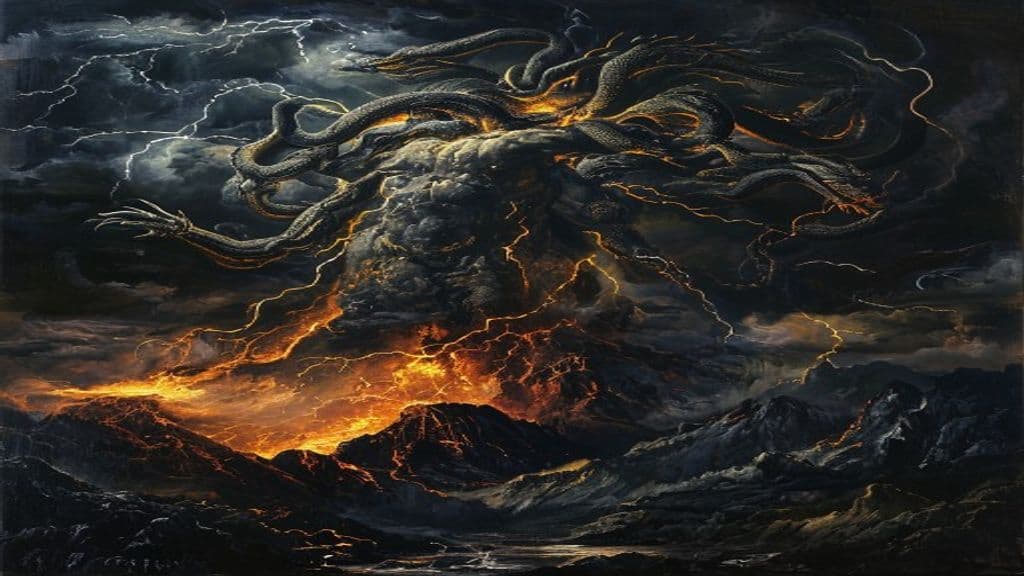
Early attestations and summaries describe Yelbeghen as multi‑headed (commonly 3, 7, or 9 heads) and originally serpent‑ or dragon‑like; later variants present it as a multi‑headed ogre or behemoth. It is described in summaries as extremely large, fire‑breathing, of supernatural strength, and often depicted as wealthy (possessing castles and hidden riches). Some accounts emphasize a bestial, chaotic aspect while others depict the creature as intelligent and magically proficient.
Reported powers include fire‑breathing, prodigious strength, long life, magical knowledge and sorcery, and the capacity to guard or hide great riches in remote places. In Altai legend Yelbeghen is explicitly said to 'eat' the Sun, Moon, and to 'chew the stars,' a motif used to explain lunar eclipses and other celestial irregularities. Some summaries also record tales where Yelbeghen is lustful toward women and capable of producing offspring with humans. Secondary summaries note that Yelbeghen can function as a coherent, knowledgeable adversary in epic narratives as well as a chaotic cosmic predator.
Typhon
The last great monster of Greek mythology — a vast, fire-breathing giant whose shoulders sprouted a hundred serpent heads, nearly toppling Zeus from Olympus.

Dragon (Long)
Long (龍, "dragon") is a pervasive cultural and artistic motif that appears in Taoist sacred-geographical contexts, Chinese literature, and modern exhibitions; the provided sources treat it as part of the broader mythic imagery present around Taoist sites and ritual scenes rather than as a single, consistently described doctrinal entity.
Ak Ana
Ak Ana (also Ağ Ana, Ak Ene) is the primordial water-mother of Turkic and some Siberian (Khanty, Mansi) traditions: a holy maternal creator principle associated with the pre-earth expanse of water, fertility of the land, and the threshold to the spirit world.
Alp Er Tunga
Alp Er Tunga is a legendary heroic ruler of Turan in early Turkic tradition, remembered as an ideal warrior-king and ancestral figure invoked in medieval dynastic genealogies. He also appears in Iranian epic tradition under the cognate name Afrosiyab/Afrasiab, where the figure is framed differently.
Bai Baianai
Bai Baianai is a Turkic‑Altaic protective spirit and sometimes goddess associated with forests, animals, hunters, fishing, fertility and material wealth. In the Yakut/Altai tradition she functions as a patron of hunters and a provider of abundance, yet in some accounts she can punish humans with drought, crop‑burning or livestock disease if offended.
Bai-Ülgen
Bai-Ülgen (often shortened to Ülgen) is a high creator-deity in Turkic religious cosmology, presented in available sources as a magnificent and wealthy divine figure who occupies a top position in the pantheon and is sometimes identified with the overarching sky god Tengri. Some modern references also list him within Mongolian contexts.
Chud
The Chud (Russian: Чудь) are an ancient, mythic people in Russian and several Finno‑Ugric oral traditions. Presented as a pre‑modern population, they appear in legends as a displaced, assimilated, or subterranean society whose disappearance and former condition help explain features of landscape and cosmology in regional folklore.
Gün Ana
Gün Ana (literally 'Sun Mother') is the Turkic personification of the Sun attested in Kazakh, Kyrgyz, and related Turkic traditions as a maternal, life-giving sky-being associated with fertility, warmth, health, and protection of the vulnerable; she is placed cosmologically in the upper heavens and figures in creation accounts involving solar light.
Koyash
Koyash is the personified Sun and a solar deity in Turkic and related Turco‑Mongolian cosmologies. Regarded as one of the visible Tenger (heavenly beings), Koyash functions as a life‑giving intermediary whose rays connect Tengri to living spirits and who participates in cosmic creation.
Szelanya
Szelanya is presented in the supplied sources as a named wind or air deity (often called a goddess) found in brief Turkish and Hungarian mythic listings and modern popular summaries. Traditional descriptions are fragmentary; later fantasy and fandom materials expand her image beyond the concise encyclopedic entries.
Yer iyesi
Yer iyesi is the familiar spirit or guardian of the earth and specific territory in Turkic/Tatar and related Tengrism traditions. Conceived as a land-attached iye, it appears in male and female forms (Yer Ata and Yer Ana) and is associated with protection of land and, in the female aspect, fertility and primordial presence at cosmogony.
Yeii (Navajo Spirit Deity)
Minor deities associated with natural forces and localities in the Navajo pantheon. (Note: - Power tier: The draft article states that yeii are Minor deities, but according to the source material, they are "deities of minor importance", implying a Lesser or Greater power tier is more accura)
Yel İyesi
Yel İyesi is the Turkic iye (guardian spirit) of wind and air, a culturally ambivalent spirit or deity-form—often called Yel Ana (Wind Mother) or Yel Ata (Wind Father)—responsible for winds, weather phenomena, and related misfortune or aid in Turkic folk cosmology.
Yellow Emperor (Huangdi / Xuanyuan)
The Yellow Emperor (Huangdi, 黃帝), also known by the clan/name Xuanyuan, is a legendary culture-hero and thearchic sovereign in Chinese tradition who is venerated as an ancestral ruler and cosmic deity associated with the central/earth (yellow) phase, the Yellow Dragon, and certain astral identities. He is traditionally credited with foundational cultural, calendrical, medical, and political knowledge and is incorporated into the Five Regions Highest Deities scheme.
Community Record
- [1]Yelbeghen. Wikipedia contributors, 'Yelbeghen,' Wikipedia, The Free Encyclopedia.wiki
- [2]Yelbeghen / Codex / Orna RPG Series. Orna Codex entry (game reference) summarizing the name in popular culture contexts.other
- [3]Yelbeghen Tower Key / Codex / Orna RPG Series. Orna Codex item page referencing Yelbeghen in game material.other
- [4]Forbidden Books: 'Giants On Record' (excerpt mentioning Yelbeghen in a thematic list). Forbidden Books excerpt (secondary popular source referencing mythic giants and monsters).other
- [5]A Book of Creatures (blog summary mentioning Yelbeghen). Blog post summarizing mythic creature entries including Yelbeghen.other