
In the cosmogony reported in the available sources, an endless expanse of Water preceded the formation of Earth; Ak Ana is the sacred female presence of that primordial Water. The summary account states that Water had been created earlier than Earth and that Ak Ana was therefore regarded as the elder sister of Earth. In one cited narrative, the sky-creator Kayra (Kaira) Khan — sometimes represented as a pure white goose — flies over the endless Water until Ak Ana appears to urge him to create; from the bottom of the Water a 'sacred duck' named Lura lifts sand, clay and silt from which the Earth is formed. The same source also reports that Ak Ana is described as both consort and daughter of Kayra Han in those traditions.
The provided sources do not give a detailed anthropomorphic description. Rather, Ak Ana is presented by epithet and role: called Ak Ana / Ağ Ana / Ak Ene and translated as the 'Holy Mother' and the goddess of the water. Emphasis in the material is on her status as the primordial mother associated with Water and as elder sister of Earth rather than on clothing, color, or other physical attributes.
Source texts attribute to Ak Ana foundational creative agency and proprietorship over life and fertility: she is said to have urged Kayra/Kaira Khan toward creation and to determine 'the life, fertility and productivity of land.' Water — Ak Ana's domain — is described as the initial state of existence, 'the possessor of spirits and the entrance into the other realm,' and as giving rise 'evenly [to] both foreign and hostile elements.' These phrases in the source portray her as a primordial, liminal power connecting material creation and the spirit realm and as responsible for fertility of the earth.
Weaknesses
- otherNo specific weaknesses recorded in the provided sources
Wards
- otherNo protective wards or counter-rituals recorded in the provided sources
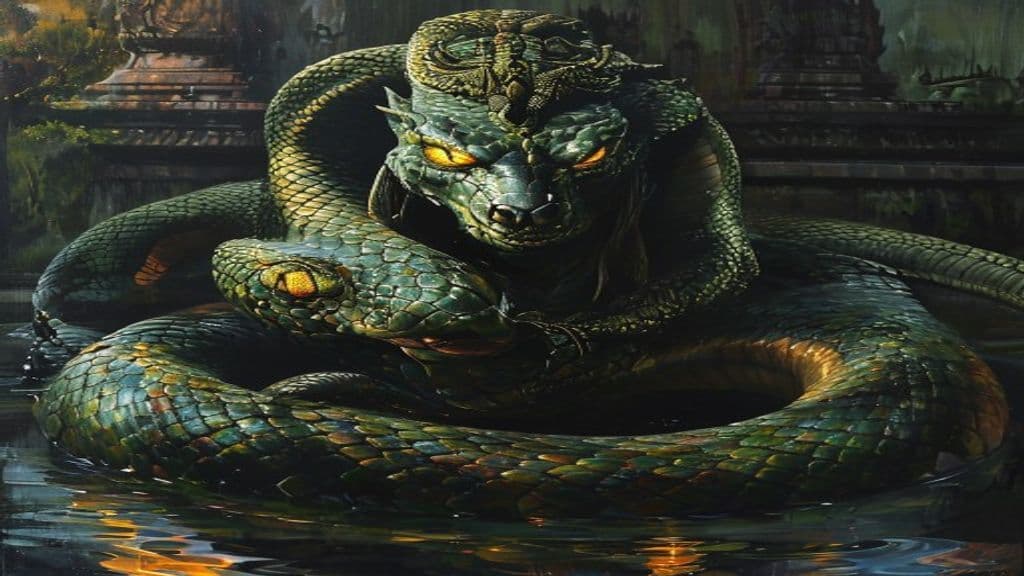
Naga
Divine serpent beings of Hindu, Buddhist, and Jain cosmology — powerful guardians of water, earth, and underground treasures. Revered as deities in South and Southeast Asia.
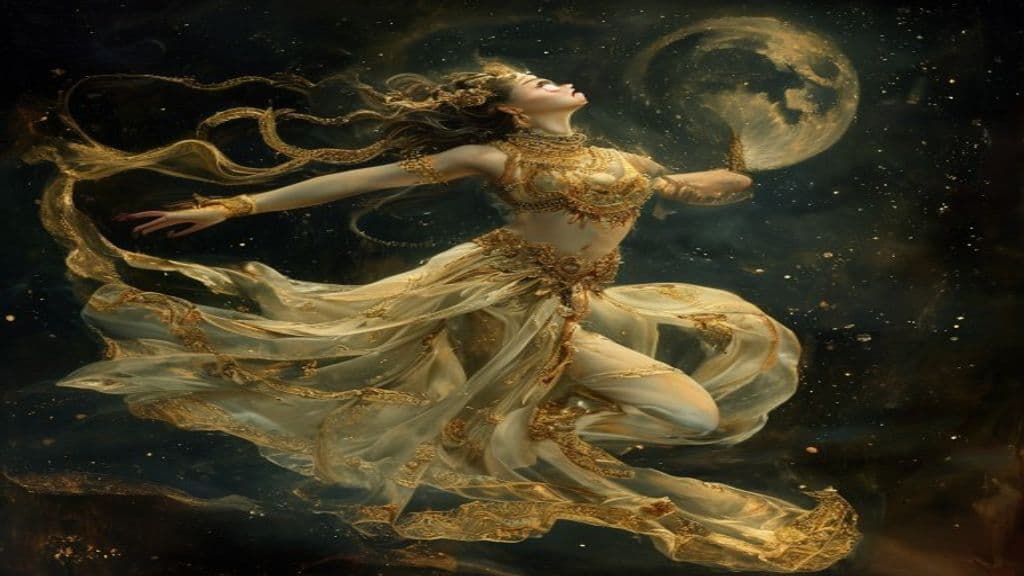
Apsara
Celestial dancers and water nymphs of Hindu cosmology — beautiful semi-divine beings who dance at the court of Indra and, by his command, descend to earth to distract sages from excessive asceticism.
Alp Er Tunga
Alp Er Tunga is a legendary heroic ruler of Turan in early Turkic tradition, remembered as an ideal warrior-king and ancestral figure invoked in medieval dynastic genealogies. He also appears in Iranian epic tradition under the cognate name Afrosiyab/Afrasiab, where the figure is framed differently.
Bai-Ülgen
Bai-Ülgen (often shortened to Ülgen) is a high creator-deity in Turkic religious cosmology, presented in available sources as a magnificent and wealthy divine figure who occupies a top position in the pantheon and is sometimes identified with the overarching sky god Tengri. Some modern references also list him within Mongolian contexts.
Chud
The Chud (Russian: Чудь) are an ancient, mythic people in Russian and several Finno‑Ugric oral traditions. Presented as a pre‑modern population, they appear in legends as a displaced, assimilated, or subterranean society whose disappearance and former condition help explain features of landscape and cosmology in regional folklore.
Gün Ana
Gün Ana (literally 'Sun Mother') is the Turkic personification of the Sun attested in Kazakh, Kyrgyz, and related Turkic traditions as a maternal, life-giving sky-being associated with fertility, warmth, health, and protection of the vulnerable; she is placed cosmologically in the upper heavens and figures in creation accounts involving solar light.
Koyash
Koyash is the personified Sun and a solar deity in Turkic and related Turco‑Mongolian cosmologies. Regarded as one of the visible Tenger (heavenly beings), Koyash functions as a life‑giving intermediary whose rays connect Tengri to living spirits and who participates in cosmic creation.
Szelanya
Szelanya is presented in the supplied sources as a named wind or air deity (often called a goddess) found in brief Turkish and Hungarian mythic listings and modern popular summaries. Traditional descriptions are fragmentary; later fantasy and fandom materials expand her image beyond the concise encyclopedic entries.
Yelbeghen
A multi‑headed monstrous being from Turkic (notably Altai) traditions, originally depicted as a serpentine or draconic creature that in later tellings appears as an ogre‑like behemoth; associated with cosmic predation (eclipses), guarded treasures, great strength, magic, and occasionally sexual relations with humans.
Yer iyesi
Yer iyesi is the familiar spirit or guardian of the earth and specific territory in Turkic/Tatar and related Tengrism traditions. Conceived as a land-attached iye, it appears in male and female forms (Yer Ata and Yer Ana) and is associated with protection of land and, in the female aspect, fertility and primordial presence at cosmogony.
Ajitanātha
Ajitanātha is the second tirthankara of the current cosmic age in Jainism: an enlightened spiritual teacher who renounced worldly life, attained omniscience (kevalajñāna), and achieved liberation (moksha), and who is credited with establishing a large four-part monastic order in the tradition's hagiography.
Ajogun
Ajogun are a class of malevolent spiritual forces in the Yoruba religious worldview that regularly interfere with human lives, responsible for death, disease, curses, loss, conflict and related misfortunes. They are described as the polar opposite of the benevolent Oriṣa, led by Iku (Death), and can be warded off or appeased through intercession by Eṣu and by observing Ifá divinatory counsel.
Aka Manah
Aka Manah (Akem manah; Middle Persian Akoman, New Persian Akvan) is the personification of 'evil mind' in Zoroastrian literature. Originating as a Gathic term for corrupt thought, the figure is later reified in the Younger Avesta and Pahlavi texts as a high-ranking demonic opponent of Vohu Manah and ally of Angra Mainyu, whose activity is to pervert human thought and moral discrimination.
Aka Manto
Aka Manto (赤マント, "Red Cloak") is a Japanese urban legend and schoolyard ghost-story about a masked, cloaked figure who appears in public or school toilet stalls and forces occupants to choose between colored toilet paper; each choice in the tale produces a violent supernatural consequence. The legend is part of modern popular folklore recorded in school contexts from the 1930s onward rather than a formal religious myth.
Community Record
- [1]Ak Ana. Wikipedia, 'Ak Ana' (accessed source summary provided)wiki
- [2]Wikidata entry: Ak Ana (Q4700040). Wikidata item Q4700040 (label and structured data)wiki