
In medieval Irish narrative sources she appears as a daughter of the tuatha dé Danann (named in the Book of Lismore as 'Cleena Fairhead, daughter of Genann mac Treon of the tuatha dé Danann') and as an otherworld woman encountered by legendary figures. She is recorded in Acallam na Senórach (the Colloquy of the Ancients) in a story often called 'Clíodna's Wave' and in the Book of Lismore where she interacts with Teigue and companions; later folk tradition in Munster attaches her to particular families and place‑names (Carrig‑Cleena, Tonn Chlíodhna) in County Cork (sources: Book of Lismore summary; Acallam na Senórach summary; Wikipedia).
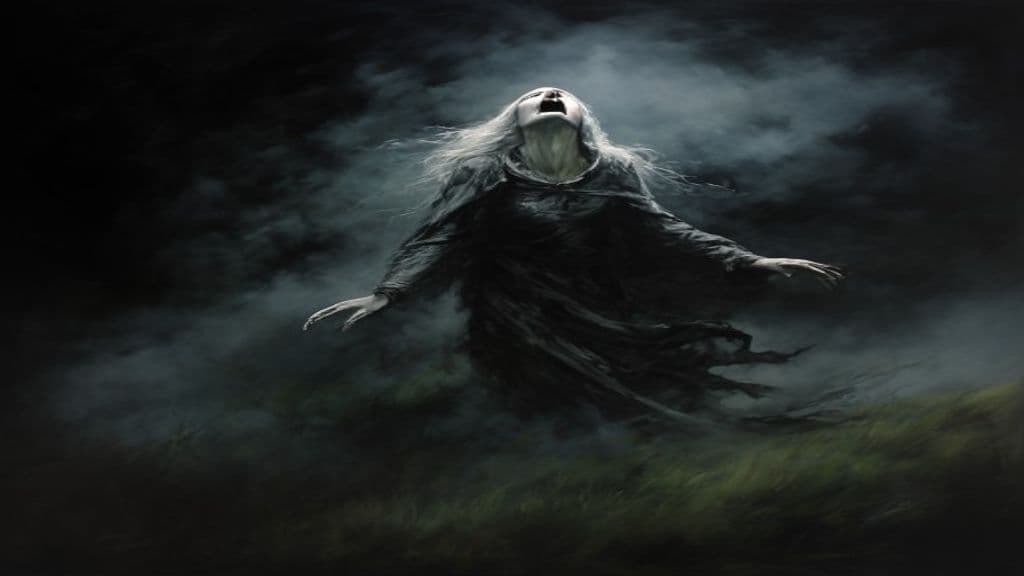
Textual descriptions in the extant summaries are limited. Medieval material gives her an epithet rendered as 'Cleena Fairhead' or 'Cleena of the Fair Hair' (Book of Lismore summary) but supplies no sustained physiognomic inventory. Repeatedly associated visual motifs include her three brightly coloured birds that eat apples from an otherworld tree and whose song heals sickness, and a palace 'in the heart of a pile of rocks' near Mallow called Carrig‑Cleena; beyond these motifs the provided sources do not give detailed clothing, stature, or monstrous features (source: Wikipedia summary of Book of Lismore and local tradition).
Across the recorded narratives she functions as a powerful otherworld leader and benefactor: she is called queen of the sióga and of the banshees of South Munster (Desmond). Specific abilities in the cited tales include provision of enchanted aids (the Book of Lismore reports she gives three birds to guide and provide music and an emerald cup that transforms water to wine and carries the warning that parting the cup from Teigue will cause his death), a healing function (the birds' song is said to heal sickness), transformation magic (an O'Keeffe legend summary describes a Cleena who could 'transform creatures to any form she pleased' and who used sleep mixtures and curses), and agency in sea/otherworld events (the 'Clíodna's Wave' episode in Acallam na Senórach in which music and the sea conspire to sweep her away in some versions). She thus acts as benefactor, lover, and dangerous otherworld power depending on the narrative (sources: Book of Lismore; Acallam na Senórach; O'Keeffe legend summary; Wikipedia).
Brian (Uar/Uair)
One of the three Sons of Tuireann in the Irish tale Oidheadh Chlainne Tuireann. Brian (also recorded as Uar or Uair) participates with his brothers in the killing of Cian, is sent by Lugh on a quest to fetch magical weapons as recompense, and returns mortally wounded when Lugh refuses to heal them.
Elatha
Elatha is a figure in Irish medieval myth portrayed as a king of the Fomorians who also fathers several leading members of the Tuatha Dé Danann. He is depicted as a noble, luminous maritime prince associated with gold and light imagery and appears in narratives such as the Second Battle of Mag Tuired and genealogical accounts explaining the ancestry of figures like Bres, the Dagda, Ogma, and Lir.
Ethniu
Ethniu (also Ethne, Ethliu, Eithne, Ethnea, etc.) is a figure of Irish myth, presented as the daughter of the Fomorian leader Balor and the mother of the hero Lugh. Her story centers on imprisonment to avert a prophecy and the clandestine conception and rescue of her child, motifs that link her to dynastic and prophetic conflicts in the mythic cycles.
Áillen (Aillen)
Áillen is an otherworldly incendiary figure in Irish tradition who annually harasses the royal site of Tara at Samhain by lulling inhabitants to sleep with harp or timpán music and burning the place with fiery breath; his cycle is broken in the story-cycle when the hero Fionn mac Cumhaill resists the soporific music and kills him.
Clytia
Clytia (also Clytie) is primarily an Oceanid of Greek myth famed for unrequited love for the sun-god Helios and a narrative metamorphosis; the name also appears for several other mortal or semi‑divine women in classical genealogies. Separately, Clytia is a modern scientific genus of cnidarians (e.g., Clytia hemisphaerica) used in developmental biology.
Clytie (Oceanid)
Clytie (Ancient Greek: Κλυτίη / Κλυτία) is an Oceanid — a daughter of the Titans Oceanus and Tethys — best known in Greek myth for her unrequited love for the sun-god Helios, her role in revealing his affair with Leucothoe, and her metamorphosis into a sun-turning plant (traditionally described as a heliotropic flower in later summaries).
Clytius
Clytius is a personal name (Ancient Greek Κλυτίος, Klytios) borne by numerous distinct figures in Greek myth — including several mortal warriors, princes, attendants, and at least one Giant counted among the earth-born opponents of the Olympian gods. As a Giant Clytius appears in Gigantomachy narratives and vase-painting iconography; as a mortal the name recurs in epic genealogies and lists. The lexical form also survives in modern taxonomic usage for insects and butterflies but this reception is separate from the ancient mythic tradition.
Clytoneus
Clytoneus is a personal name in ancient Greek mythic genealogies and epic narrative borne by at least two mortal figures: an Argive genealogical ancestor (also attested as Clytius) linked to seafaring descendants, and a Phaeacian prince, son of Alcinous and Arete, who competes in the athletic games for Odysseus in the Odyssey.
Cnossia
Cnossia is a minor female figure in Greek mythic genealogies, identified in surviving secondary references as either a nymph or a slave associated with King Menelaus of Sparta and named as the mother of his son Xenodamus. Her name links her to the city of Cnossus (Knossos) on Crete, but no independent narratives or cultic roles are attested in the available sources.
Coatlicue
Coatlicue (Cōātlīcue) is an Aztec (Mexica) earth-and-mother deity identified in modern sources as the mother who gave birth to the moon, the stars, and Huītzilōpōchtli; she is also associated with maternal and mortuary aspects through identification with titles such as Toci and Cihuacōātl.
Coblyn (coblynau / coblynod)
A small, mine-associated Welsh spirit (plural coblynau or coblynod) that inhabits mines and quarries. Coblynau make peculiar knocking sounds used by miners to locate rich veins, imitate miners' work ineffectually while dressed in miner-like clothes, are generally considered helpful and lucky, but withdraw assistance if miners act greedily or are disrespectful.
Coblynau
Coblynau (singular coblyn) are small gnome-like mine and quarry spirits from Welsh folklore. They are reported in folkloric summaries as haunting underground workings, making knocking sounds, and—according to some miners' tales—occasionally indicating locations of ore or riches.
Community Record
- [1]Clíodhna — Wikipedia. Wikipedia: 'Clíodhna' article (summaries of Book of Lismore, Acallam na Senórach, and regional tradition).wiki
- [2]Clíodhna — Wikidata. Wikidata entry for Clíodhna (identifier and linked data).other