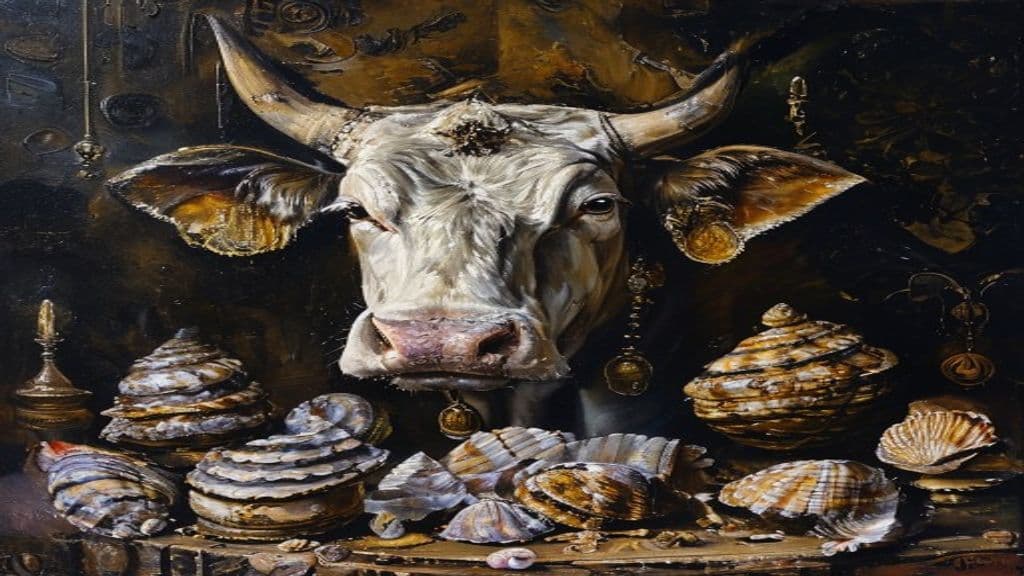
Cowrie shells are used as a tool for divination, but no specific entity is associated with them.
Used to seek guidance, understanding and insight into various aspects of life. Shells used as a means of gaining knowledge or predicting future events.
Weaknesses
None recorded.
Wards
- symbolicProtective charms and talismans
Elegua
Elegua (Ẹlẹ́gbára / Eleguá / Exu / Legba variants) is an Orisha and liminal mediator in Yoruba and Yoruba-derived religions. He is guardian of roads, doorways, and crossroads, the messenger who must be acknowledged before other rituals, and a trickster-enforcer who manages balance between opposites.
Esu (Eshu, Elegbara)
Esu (also attested as Eshu, Elegbara, Elegua/Elegguá, Exu) is a named Orisha — a deity — in the Yoruba traditional religious system and its diasporic continuations. The provided source identifies Esu principally as an Orisha associated with roads and notes the figure's presence across Ifa/Orisha practice and several Afro-diasporic religions.
Orisha
Orisha (Òrìṣà) are named divine or supernatural figures in Yoruba religious thought and its Afro‑diasporic continuations (for example, Candomblé and Cuban Yoruba associations). They function as central agents of worship, ritual engagement, and divinatory communication in Yoruba communal and individual religious life.
Oriṣa (Orisha / Orixá)
Oriṣa (Yoruba: òrìṣà; Portuguese: orixá; Spanish variants: orisha, oricha, orichá) are the class of divine spirits or deities central to the Yoruba religion of West Africa and to Yoruba-derived religious systems in the Atlantic diaspora (notably Lucumí/Santería in Cuba and Candomblé in Brazil). They function as active sacred presences and intermediaries in communal and individual religious life; in diaspora settings they were often syncretized with Catholic saints as a strategy of continuity under colonial Christian rule.
Oshun
Oshun (Ọṣun, Ochún, Oxúm) is a major orisha and Irunmole in the Yoruba religious corpus and its diasporic traditions, associated with freshwater (rivers), love, fertility, femininity, divination, prosperity and beauty. She is honored at the Osun-Osogbo Sacred Grove and in festivals and ritual forms across Yorubaland and Afro‑Atlantic religions such as Candomblé and Regla de Ocha/Santería.
Pomba Gira
Pomba Gira is an Afro-Brazilian female spirit invoked in Umbanda and Quimbanda who personifies feminine sexuality, desire, and liminality; she functions as a consort to Exu, is petitioned for matters of the heart, and is treated with respect because of her reputed wrath and power in ritual possession.
Ṣàngó (Shango / Chango / Xangô)
Ṣàngó is a major orisha in the Yorùbá pantheon identified as a deified royal ancestor (the third Alaafin of Oyo) and as the spirit who governs thunder, lightning, fire, virility, drumming, dance, strength and justice. He is venerated across Yorubaland and in African-derived New World religions (e.g., Candomblé, Santería, Vodou) where his attributes, symbols and rituals have been adapted and occasionally syncretized with Catholic saints.
Court of Owls
A fictional secret society and criminal cabal in DC Comics' Gotham City, the Court of Owls is an intergenerational network of elite families who exercise covert political and financial control and employ indoctrinated assassins known as Talons. First introduced in the New 52 Batman run, the Court functions as a hidden power structure whose existence is treated as an urban legend until revealed in-story.
Courtney Whitmore
Courtney Elizabeth Whitmore is a fictional American comic-book heroine who functions as a legacy-costumed successor (second Star-Spangled Kid, later Stargirl) within DC Comics continuity. She is an equipment-reliant, youthful exemplar who catalyzes a new generation of heroes and serves within the Justice Society of America and allied teams.
Cowardly Lion
A fictional anthropomorphic African lion created by L. Frank Baum for the Land of Oz stories, the Cowardly Lion is a speaking, sapient animal who paradoxically doubts his courage despite repeatedly acting bravely. He appears first in The Wonderful Wizard of Oz (1900) and recurs in sequels and later reinterpretations.
Cowroid
A cowroid (also spelled cauroid) is a prehistoric and ancient Egyptian seal‑amulet that imitates the cowrie shell. Treated as a protective amulet, cowroids were incorporated into women's dress (notably girdles) and funerary assemblages from Pre‑dynastic contexts through multiple Dynastic periods, and sometimes bear divine imagery (for example Taweret).
Coyote
Coyote is both a North American canid species and a recurring mythic trickster figure in various Native American traditions (notably Aridoamerican/Chemehuevi). As a cultural figure Coyote alternately appears as an animal or a man and functions as a morally ambivalent transformer and trickster in origin and social tales.
Community Record
- [1]