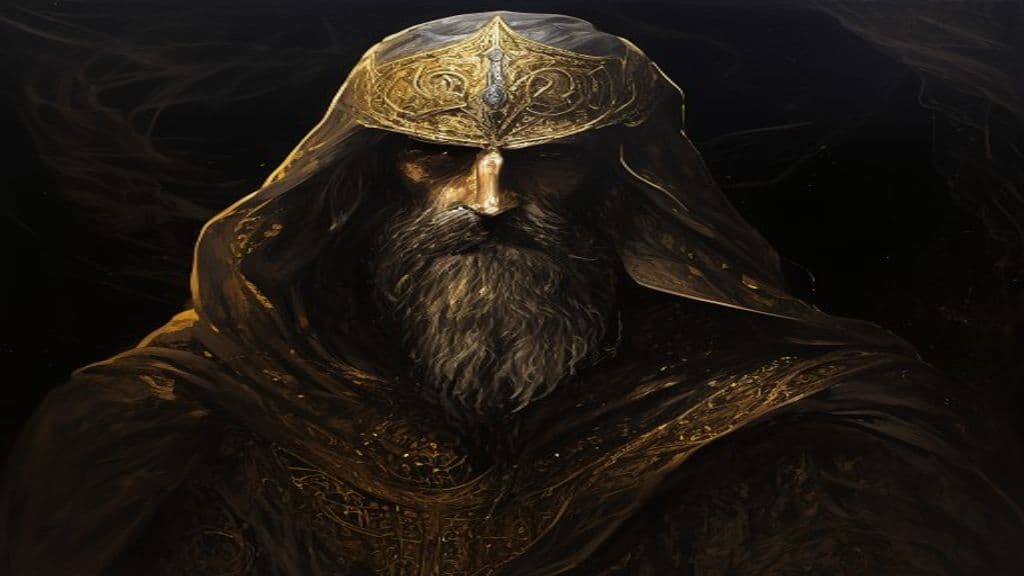
Shaddād is a legendary king in Arabian folklore, described as tyrannical. His legend reflects the worldview of early Arab cultures, where moral accountability was emphasized.
No information on powers or abilities is available.
Weaknesses
Wards
Darda'il
In the cited Islamic tradition, Darda'il (Arabic: دردائيل, glossed 'Journeyers of God') are angels who travel the earth searching out assemblies where people remember God's name. The name is also attested as that of an angel invoked in exorcism; the figure appears in modern cultural references alongside other named angels.
Jinn
A class of supernatural beings from pre-Islamic Arabian religion later integrated into Islamic theology; jinn are created, morally accountable entities distinct from humans and angels, often unseen but capable of taking visible forms and interacting with people in varied ways.
Mahd al-Aadiyya
A chronicle character in Arabian tradition, serving as a vessel for conveying divine warning through poetry. (Note: 1. The power tier should be Primordial (as she serves as a vessel for conveying divine warnings from Allah, which would imply a connection to cosmic forces rather than regional or local). 2. Appearanc)
Rakhsh (Persian Tradition)
A mythological stallion and companion to the legendary hero Rostam in the Persian national epic Shahnameh. (Note: 1. Power tier: Based on Rakhsh's association with a legendary hero, it seems more likely to be Greater (deity-level) rather than Lesser. 2. Abilities: While we can infer that Rakhsh has strength and s)
Tahmina
In Persian epic tradition, Tahmina is a human character in the Shahnameh, a 10th-century epic poem. She is Rostam's wife and Samanganshah's daughter, appearing in the story 'Rostam and Sohrab'. Tahmina serves as a figure illustrating themes relevant to 10th-century Persian society. (Note: 1. Power tier should be "Lesser" since Tahmina is a human character with no supernatural powers. 2. Origin story section is missing. 3. Appearance section needs to state that there is no physical desc)
Seven Hathors
A grouped manifestation of the Egyptian goddess Hathor appearing as seven attendant female deities associated with birth, fate, and the transition of souls. They are attested in temple iconography and literary tales as visitors who foretell a newborn's destiny and appear in liminal contexts between life and death.
Seventh son of a seventh son
A folkloric birth-status applied to a male who is the seventh consecutive male child in an unbroken male line whose father was also a seventh son; across several European-derived and Latin American traditions this status is associated variously with exceptional healing or with dangerous supernatural transformations. The figure functions as a social/biological category that explains extraordinary capacities or misfortunes rather than a single mythic individual or species.
Sexual vampire (Daoist sexual vampirism)
A conceptual category and set of practices in Chinese Daoist sexual-alchemical literature describing the absorption of another person's qi and jing through sexual techniques; also a literary motif comparing seductress spirits to practitioners who 'feed' on vital substances. It functions as both an esoteric technique aimed at longevity and a mythic trope of sexual predation in stories of fox spirits and reanimated corpses.
Shachihoko
A Japanese mythic sea-creature and roof-ornament (shibi) combining a predator head (dragon or tiger) with a carp body. In Japanese architectural and folkloric contexts it functions as an apotropaic roof guardian believed to store water and control rain, used primarily to protect wooden buildings from fire and as a status emblem.
Shade
A shade is the shadowy spirit or ghost of a dead person in classical and ancient Near Eastern literary and religious cosmologies, understood as the diminished, insubstantial residuum of a person who dwells in the underworld (Hades, Sheol/tsalmavet) rather than among the living.
Shadow (concept)
A polyvalent term used across optics, psychology, computing/administration, and popular paranormal conversation. In the supplied sources it is primarily an optical phenomenon and a psychological archetype; other uses are metaphorical or technical rather than descriptions of a single, traditional supernatural being.
Shadow People
Shadow people are a contemporary paranormal concept describing animate, human-shaped shadow-like presences. Presented primarily in modern paranormal media and practitioner discourse, they are often interpreted as spirits or unseen presences rather than as elements of a specific historic folk cosmology.
Community Record
- [1]Wikipedia. 1. WHAT THE ENTITY IS: Shaddād is a legendary king in Arabian folklore, described as tyrannical (Source 1).wiki