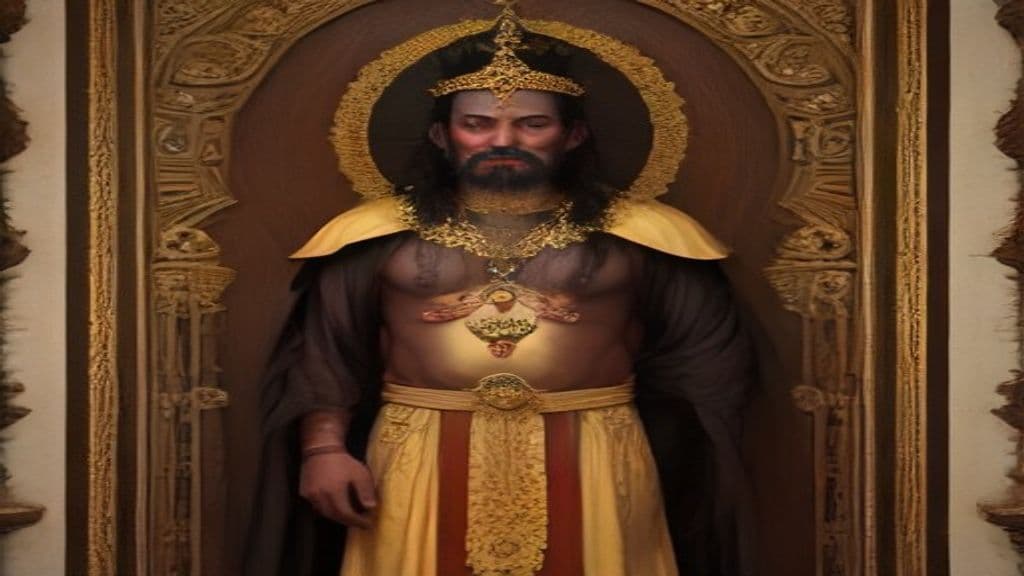
Sources record multiple, distinct origin accounts preserved in local tradition and Buddhist-inflected lore. In one local folkloric genealogy Dedimunda is said to have been born on Talagiri mountain to a Yakṣa chief named Pūrṇaka and a Nāga queen Erandathi, situating him within Yakṣa–Nāga lineages. A Buddhist-style tradition describes him as a grandson or agent of Vesamuni (Vaiśravaṇa) who was sent to confront Mara’s forces at the Bodhi tree; in this narrative the Buddha blessed him and granted him authority to protect the Buddha Śāsana in Sri Lanka for 5,500 years. A separate local variant treats him as a deified human — a high-caste commander or noble (Devaka/Devatha Bandara) elevated after death. The sources present these as alternative or complementary traditions rather than a single unified biography (all summaries from the provided Wikipedia entry).
Dedimunda’s iconography is distinctively local, adopting the historical court regalia of a Kandyan noble (Nilame) rather than classical heavenly deva dress. He is represented as a mature, bearded man standing in a rigid frontal (samabhanga) pose, wearing a four-cornered hat, a high-collared short jacket with puffed sleeves, a draped waistcloth secured by an ornamental belt, and holding a ceremonial cane or sceptre (soluwa) in his right hand. A rooster is frequently depicted at his feet, and folklore names a blue or white horse as his divine vehicle. This Kandyan-era court appearance marks him as an adjudicative, guardian figure in local temple imagery (Wikipedia).
Devotees attribute to Dedimunda the power to heal mortal illnesses, eradicate epidemics, cast away evil spirits, and aid infertile married couples with hopes of childbirth. In Buddhist-style narratives he is credited with confronting demonic forces after the Buddha’s enlightenment and, in one local legend, restoring life to a pregnant queen and her child after a shipwreck; these are presented in the sources as legendary actions rather than verifiable historical events. His iconography (sceptre, noble dress) and name meaning (firmness, severity) also mark him as an enforcer of order and a punitive guardian who protects the Buddha Śāsana and punishes wrongdoers (Wikipedia).
Weaknesses
- otherNo weaknesses recorded in sources
Wards
- ritualPūjā and vow-making at shrine (Aluthnuwara Sri Dadimunda Devale)
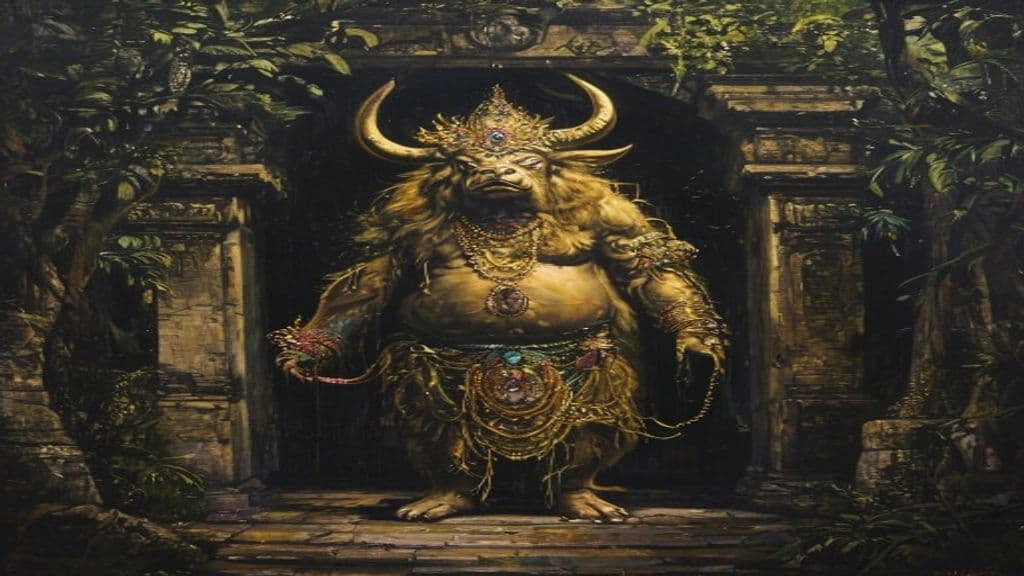
Yaksha
Nature spirits of Hindu, Buddhist, and Jain cosmology — guardians of forests, treasures, and wilderness. Ambivalent beings, capable of great benevolence to the respectful and terrible harm to the greedy.
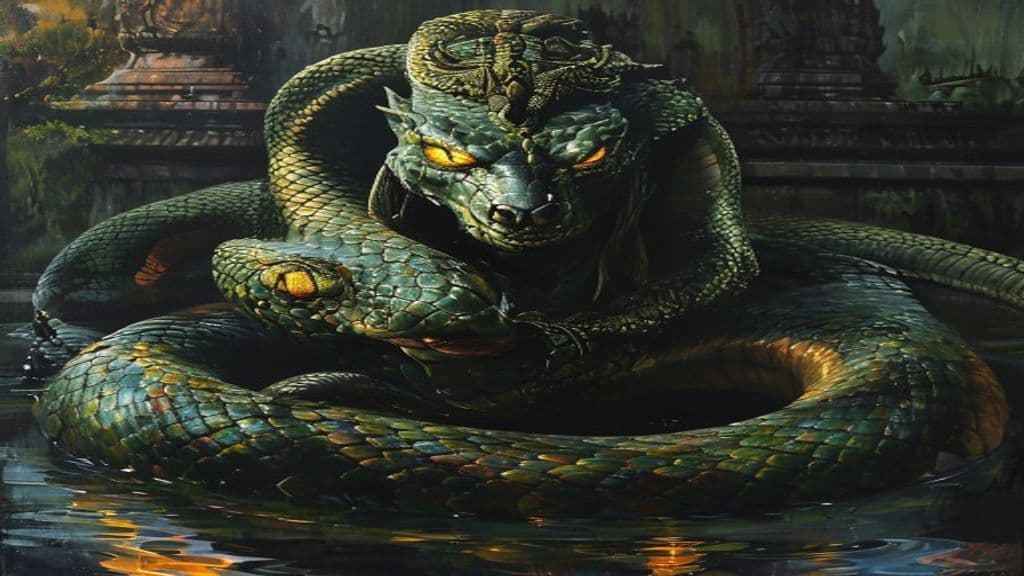
Naga
Divine serpent beings of Hindu, Buddhist, and Jain cosmology — powerful guardians of water, earth, and underground treasures. Revered as deities in South and Southeast Asia.
Dís (dísir)
In Norse/North Germanic tradition, a dís (pl. dísir) is a collective term for female supernatural beings whose roles range from protective ancestral spirits and fertility figures to fate‑linked women comparable to valkyries or norns; they are invoked in both private and public cult (notably the dísablót) and can be benevolent or hostile toward humans.
Dísir
In Norse tradition, the dísir are a class of female supernatural beings associated with fate, fertility, and the welfare of kin; they may be protective guardians of clans or ambivalent/hostile toward mortals and are venerated in rites called dísablót.
Dôn
Dôn is an ancestral matriarch in medieval Welsh legend, presented as the mother and progenitor of a named kin-group commonly called the 'Children of Dôn'. She functions as a genealogical and cosmological origin-figure whose household is mapped onto Welsh place-names and constellations.
Dökkálfar and Ljósálfar
In the Prose Edda framework these are two contrasted classes of álfar (elves): Ljósálfar ('light-elves') associated with luminous, upper heavens and described as “fairer than the sun,” and Dökkálfar ('dark-elves') associated with subterranean dwelling and described as “blacker than pitch.” Scholarly sources debate whether Snorri’s binary reflects older Norse ideas or a later, possibly Christian-influenced ordering and whether dökkálfar overlap with svartálfar or dwarfs.
Dúnedain
The Dúnedain are a lineage of Men in J. R. R. Tolkien's legendarium descended from the Edain and the Númenóreans. They are renowned for their long lifespans (in earlier generations), martial skill, keen senses, and historical role as rulers of Númenor and later as the kingdoms and rangers of Arnor and Gondor; the name in Sindarin literally means 'Men of the West.'
Dúrnir (Durnir)
Dúrnir (also spelled Durnir) is an Old Norse mythic proper name attested in skaldic verse and in later medieval name-lists. He is presented in the skaldic corpus and Dverga heiti as a dwarf-name but also appears in Snorri Sturluson’s Nafnaþulur among giant (jötunn) names, indicating fluid classification in the transmitted sources.
Dīpankara Buddha
A Buddha of the past in Buddhist sacred history who, according to traditional narratives, recognized and predicted the future Buddhahood of the bodhisattva Sumedha (a previous life of Gautama/Śākyamuni). He is venerated in ritual contexts, represented in Asian Buddhist art, and commemorated in contemporary temple and festival practices.
Dīpaṅkara
Dīpaṅkara is a Buddha of the past in Buddhist tradition, known chiefly for predicting that the bodhisattva Sumedha would in a future age become the Buddha Gautama. Placed in vast cosmological time, he functions as an exemplar and a source of prophetic recognition in Buddhist hagiography and later devotional practice.
Dōsojin
Dōsojin (道祖神) are local Shinto kami venerated as tutelary guardians of liminal places such as village boundaries, crossroads, mountain passes, bridges, and roads. Represented by stones, carved couples, phallic markers, poles, or syncretic Buddhist images, they are locally maintained to ward off wandering spirits, epidemics, and to promote fertility and safe passage.
E-Man
E-Man is a fictional comic-book superhero created by writer Nicola Cuti and artist Joe Staton for Charlton Comics in 1973. Within his fictional universe he is presented as a sentient packet of energy — a 'cosmic being' — who acts as a wisecracking, light-toned crimefighter.
Ea (Enki)
Enki (Akkadian Ea) is a major Mesopotamian deity associated with wisdom, crafts, fresh subterranean waters (the Abzû/Apsu), magic, and incantations. He functions as a benefactor of humankind and rulers, a source of ritual and healing authority, and the divine ruler of the subterranean freshwater domain called the Abzû.
Each-Uisge
The most dangerous water horse in Scottish Highland folklore — haunting sea-lochs and mountain lakes, more violent than the river kelpie, known for consuming its victims whole.
Community Record
- [1]Dedimunda deviyo. Wikipedia: Dedimunda deviyowiki
- [2]Śrī Deḍimuṇḍa Deviyo (Wikidata). Wikidata: Q19711881wiki