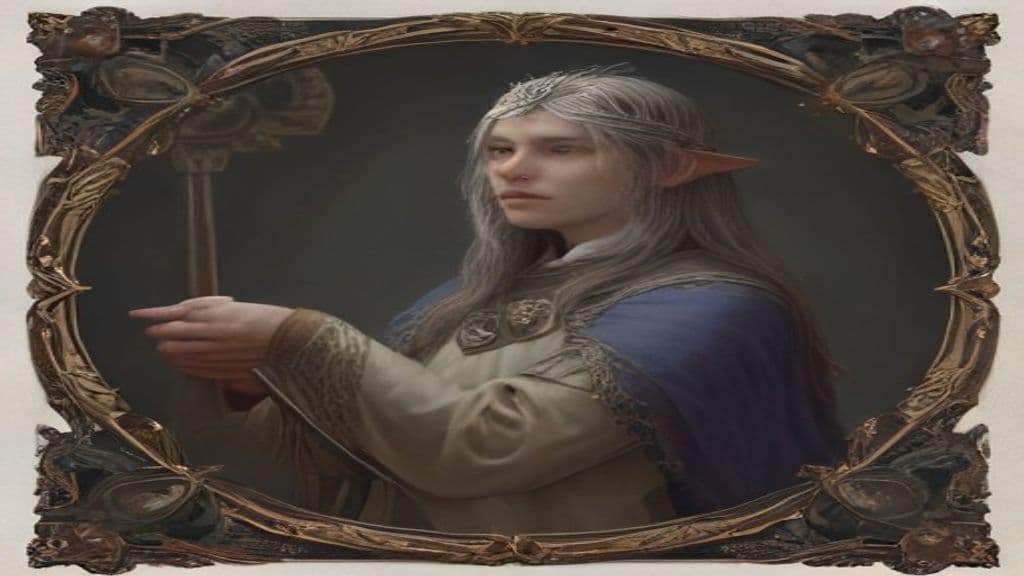
The Dúnedain trace their descent to the Edain, the tribes of Men who sided with the Elves in the First Age. For their aid the Valar granted these Men the island of Númenor at the beginning of the Second Age; from this 'Men of the West' the Númenórean civilization developed. After the Downfall of Númenor, survivors founded the kingdoms of Arnor and Gondor in Middle-earth. Over centuries the Dúnedain split politically between those faithful to the Valar and Elves and those who turned to the King's Men or became Black Númenóreans; remnants endured as rangers and ruling houses, culminating in the reunification of Arnor and Gondor in the Fourth Age under Aragorn.
As a people the Dúnedain are presented principally through their cultural stations rather than a single racial appearance; earlier Númenóreans are associated with a nobility and longevity of bearing. Surviving Northern Dúnedain who became Rangers are described specifically as grim in life, appearance, and dress, favoring rustic green and brown clothing; members of the Grey Company are noted wearing dark grey cloaks and occasionally a silver pointed‑star brooch. Ranger equipment in sources includes sturdy, rough‑haired horses, helms, shields, spears and bows, indicating a practical, martial presentation for those groups.
Tolkienic sources attribute to Númenóreans and their Dúnedain descendants qualities likened to those of the Elves: keener senses and the reported ability to understand the language of birds and beasts. They are noted as hardy, skilled trackers and warriors who defended their lands against hostile forces. Early generations retained extended lifespans granted to Númenórean bloodlines; over time in Gondor this longevity diminished through intermarriage with other Men, while the Faithful preserved certain traditions and heirlooms.
Weaknesses
- conditionshortening of lifespan through intermarriage with other Men
- otherpolitical division: split into Faithful and King's Men with some becoming Black Númenóreans (historical susceptibility to corruption)
Wards
None recorded.
Déjanire
Déjanire is the mortal wife of Heracles (Hercule) in classical myth as retold in modern French theatrical and operatic adaptations. In the cited materials she functions as a dramatic character whose act of giving a tunic soaked in Nessus's blood—presented to her as magically restorative but actually poisonous—precipitates Hercule's agonized death and apotheosis.
Dían Cécht
Dían Cécht is the professional healer of the Tuatha Dé Danann in medieval Irish myth. Presented as a master of remedies, salves, sacred wells, and prosthetic craft (notably the silver arm of Nuada), he functions as the gods' physician and head of a hereditary healing household.
Dís (dísir)
In Norse/North Germanic tradition, a dís (pl. dísir) is a collective term for female supernatural beings whose roles range from protective ancestral spirits and fertility figures to fate‑linked women comparable to valkyries or norns; they are invoked in both private and public cult (notably the dísablót) and can be benevolent or hostile toward humans.
Dísir
In Norse tradition, the dísir are a class of female supernatural beings associated with fate, fertility, and the welfare of kin; they may be protective guardians of clans or ambivalent/hostile toward mortals and are venerated in rites called dísablót.
Dôn
Dôn is an ancestral matriarch in medieval Welsh legend, presented as the mother and progenitor of a named kin-group commonly called the 'Children of Dôn'. She functions as a genealogical and cosmological origin-figure whose household is mapped onto Welsh place-names and constellations.
Dökkálfar and Ljósálfar
In the Prose Edda framework these are two contrasted classes of álfar (elves): Ljósálfar ('light-elves') associated with luminous, upper heavens and described as “fairer than the sun,” and Dökkálfar ('dark-elves') associated with subterranean dwelling and described as “blacker than pitch.” Scholarly sources debate whether Snorri’s binary reflects older Norse ideas or a later, possibly Christian-influenced ordering and whether dökkálfar overlap with svartálfar or dwarfs.
Dúrnir (Durnir)
Dúrnir (also spelled Durnir) is an Old Norse mythic proper name attested in skaldic verse and in later medieval name-lists. He is presented in the skaldic corpus and Dverga heiti as a dwarf-name but also appears in Snorri Sturluson’s Nafnaþulur among giant (jötunn) names, indicating fluid classification in the transmitted sources.
Dēdimunda Dēyiyō
A locally venerated Sinhalese Buddhist guardian deity of Sri Lanka, regarded as a principal protector of the Buddha Śāsana and a tutelary figure invoked for healing, protection from spirits and epidemics, and assistance with fertility. His cult is institutionally centered at the Aluthnuwara Sri Dadimunda Devale and other regional devalayas.
Dīpankara Buddha
A Buddha of the past in Buddhist sacred history who, according to traditional narratives, recognized and predicted the future Buddhahood of the bodhisattva Sumedha (a previous life of Gautama/Śākyamuni). He is venerated in ritual contexts, represented in Asian Buddhist art, and commemorated in contemporary temple and festival practices.
Dīpaṅkara
Dīpaṅkara is a Buddha of the past in Buddhist tradition, known chiefly for predicting that the bodhisattva Sumedha would in a future age become the Buddha Gautama. Placed in vast cosmological time, he functions as an exemplar and a source of prophetic recognition in Buddhist hagiography and later devotional practice.
Dōsojin
Dōsojin (道祖神) are local Shinto kami venerated as tutelary guardians of liminal places such as village boundaries, crossroads, mountain passes, bridges, and roads. Represented by stones, carved couples, phallic markers, poles, or syncretic Buddhist images, they are locally maintained to ward off wandering spirits, epidemics, and to promote fertility and safe passage.
E-Man
E-Man is a fictional comic-book superhero created by writer Nicola Cuti and artist Joe Staton for Charlton Comics in 1973. Within his fictional universe he is presented as a sentient packet of energy — a 'cosmic being' — who acts as a wisecracking, light-toned crimefighter.
Community Record
- [1]Dúnedain - Wikipedia. Wikipedia: 'Dúnedain' article (summary of Tolkien's legendarium, name, origins, abilities, Rangers, Faithful vs King's Men, Black Númenóreans)wiki
- [2]Dúnedain - Wikidata. Wikidata entry for Dúnedainwiki
- [3]Narsil (shards passed among the heirs of Isildur). Archive item referencing the shards of Narsil and their passage to Aragorn as heir of Isildurother
- [4]Khraniteli (Archive audiovisual material). Archived film/audio material referencing Tolkien's works (contextual archive)other
- [5]Discussion and reference compendium: 'The Dunedain' (Trevor Stone). Essay and reference material on Dúnedain (secondary commentary drawing on canonical sources)other