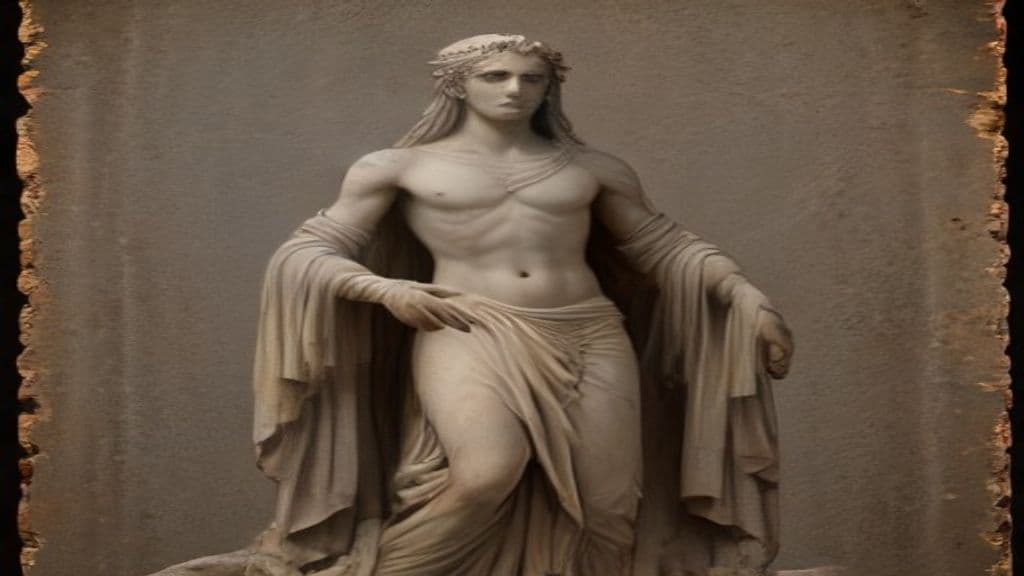
Deiphontes is presented in the sources as a son of Antimachus and a member of the Heraclid genealogical network (tracing descent through Ctesippus, son of Heracles by Deianira in some accounts). He becomes the husband of Hyrnetho, daughter of Temenus, and through that marriage is drawn into the succession politics that follow Temenus's rule. In Apollodorus-derived summaries the army, abhorring the parricides, declares Deiphontes and Hyrnetho rightful successors to Temenus at Argos; in Pausanias's contrasting local tradition Deiphontes does not take Argos but instead establishes himself at Epidaurus, where he expels an Ionian king (Pityreus) and ultimately erects a sanctuary to his dead wife. These accounts place him within the mytho-historical generation of the Heraclidae and the Dorian settlement narratives that explain early dynastic arrangements in the Peloponnese.
Primary sources do not provide a physical or iconographic description of Deiphontes: no height, dress, or distinguishing marks are recorded. He is identified in narrative and genealogical terms — son of Antimachus, husband of Hyrnetho, father of children in some lists — and by social roles (general, adviser, leader). Pausanias and the compendia cite him by these relational and civic markers rather than by bodily depiction, and modern summaries note the absence of a physical description in the surviving texts.
The sources attribute to Deiphontes human capacities of military command, leadership, and single combat rather than supernatural powers. He is said to have been openly employed by Temenus as a general and adviser in war and on other occasions. In the narrative preserved by Pausanias he pursues Hyrnetho's abductors, kills one brother (Cerynes), wrestles another (Phalces) who holds Hyrnetho, and in the struggle Hyrnetho is accidentally killed; Deiphontes recovers her body and transports it to Epidaurus, where he erects a sanctuary. He is also credited with expelling an Ionian ruler, Pityreus, from Epidaurus in that local tradition. These are presented as mortal deeds consistent with a heroic leader's political and martial agency.
Weaknesses
- conditionnone attested in sources
- othernarrative vulnerability: inability to prevent Hyrnetho's accidental death during the rescue struggle
Wards
- othernone attested in sources
Defender Strange
A named alternate-universe variant of Doctor Stephen Vincent Strange depicted in contemporary Marvel Cinematic Universe media and merchandise; presented as a magical practitioner who functions as a protector of his Earth/universe against interdimensional and supernatural threats.
Deianira
Deianira is a Calydonian princess in Greek myth, wife of the hero Heracles, whose acceptance of a deceitful 'love‑potion' from the dying centaur Nessus leads inadvertently to Heracles' agonizing death; she is portrayed as a tragic mortal figure in epic and dramatic traditions.
Deildegast
A Norwegian folkloric ghost bound to boundary stones as postmortem punishment for those who moved or tampered with property markers; compelled to attempt to restore displaced stones but never succeeding, it serves as a social deterrent against moving borders.
Deioneus
Deioneus is an ancient Greek personal name borne by several mortal men in mythic genealogies and narratives (kings, princes, fathers, husbands). The name recurs in independent regional traditions (Phocis, Perrhaebia/Thessaly, Oechalia, Megara) and does not denote a single supernatural being.
Deiphobos
Deiphobos is a Trojan prince in Greek epic tradition, a son of Priam and Hecuba who fought in the Trojan War. Later epic and post-epic poets (Virgil, Chaucer in allusion) treat his household and fate among the episodes of Troy's sack; classical summaries also record him as a notable warrior who killed several named opponents.
Deiphobus
Deiphobus (Ancient Greek Δηΐφοβος) is a Trojan prince, son of King Priam and Hecuba, attested across Homeric epic and later Greek and Roman narratives as a warrior of the Trojan War. He appears in the Iliad among Trojan leaders, is given expanded roles in post‑Homeric sources (notably Euripides, Dares, Dictys, Malalas) and in Vergil’s Aeneid is depicted posthumously as a horribly mutilated corpse who recounts his death.
Deipyle
Deipyle (Ancient Greek Δηιπύλη) is a mortal woman of the Argive royal house in Greek myth, daughter of Adrastus and Amphithea, who in many accounts marries Tydeus and is cited as mother of the hero Diomedes. She functions primarily as a genealogical link in heroic narratives rather than as a supernatural being.
Deipylus
Deipylus is a personal name borne by three distinct mortal figures in Greek myth: a son of Jason and Hypsipyle associated with Lemnos, a Thracian prince of Polymestor and Iliona who is killed in a case of mistaken identity, and a minor Achaean warrior active in the Trojan War. The name functions in genealogical and epic narratives rather than as a supernatural or cultic being.
Deity (category)
A deity is a supernatural, non-human being or principle credited with authority or power over aspects of the universe, life, or human experience and often the object of reverence or worship. The term covers a wide range of beings from an ultimate transcendent creator to localized gods within pantheons and can also denote impersonal divine principles in some traditions.
Delbáeth
Delbáeth (Delbáed; Modern Irish Dealbhaoth/Dealbhaodh) is a recurring personal name in medieval Irish mythological genealogies applied to multiple princely figures of the Tuatha Dé Danann/Fomorian world. Rather than a single consistently depicted being, Delbáeth appears as one or more ancestral/regnal figures—successors of the Dagda, fathers or ancestors of notable personages, and eponymous progenitors for historical septs such as the Delbhna.
Dellingr
Dellingr is an Old Norse divine figure personifying the coming of day (dawn) and is attested as the father of Dagr (Day) in medieval Eddaic and saga texts. His name appears in kennings and poetic formulas (notably "Delling's doors") that mark the threshold of sunrise; surviving sources treat him as an etiological/personified deity rather than a hostile spirit.
Delphus
Delphus (Ancient Greek: Δέλφος, Latinized Delphus) is an eponymous mythic ancestor credited in Greek mythographic traditions as the person from whom the town and sanctuary of Delphi were believed to have derived their name. He appears in variant genealogies as a son of Poseidon or of Apollo and as ancestor to regional rulers and oracle-associated figures such as Pythis and Phemonoe.
Community Record
- [1]Pausanias, Description of Greece (2.26–28). Pausanias, Description of Greece, 2.26–28 (summary of Deiphontes' deeds at Epidaurus and the abduction/killing of Hyrnetho)literary
- [2]Apollodorus (summaries and compendia referencing succession of Temenus). Apollodorus-based summaries as cited in modern compendia: account that the army declared Deiphontes and Hyrnetho rightful successors after Temenus' death (see derived summaries and Pantheon entry)literary
- [3]Deiphontes | Pantheon. Pantheon summary entry on Deiphontes (genealogical and narrative summary derived from ancient sources)other
- [4]HERACLIDES - Greek Mythology Link (Maicar). Maicar Greek Mythology link summarizing Heraclid genealogies and mentioning Deiphontes as son of Antimachus and husband of Hyrnethoother
- [5]Two Tombs for Hyrnetho: A Case Study in Localism and Mythographic Topography (Harvard Research Bulletin). Research Bulletin discussing the scant treatment of Hyrnetho and local variants (notes on Pausanias and other traditions regarding Hyrnetho and Deiphontes)academic
- [6]ToposText: Deiphontes. ToposText entry summarizing Pausanias and related localizing traditions about Deiphontes at Epidaurusother
- [7]Myths.UVic.ca: Deiphontes. Genealogical and narrative notes on Deiphontes derived from ancient sourcesother