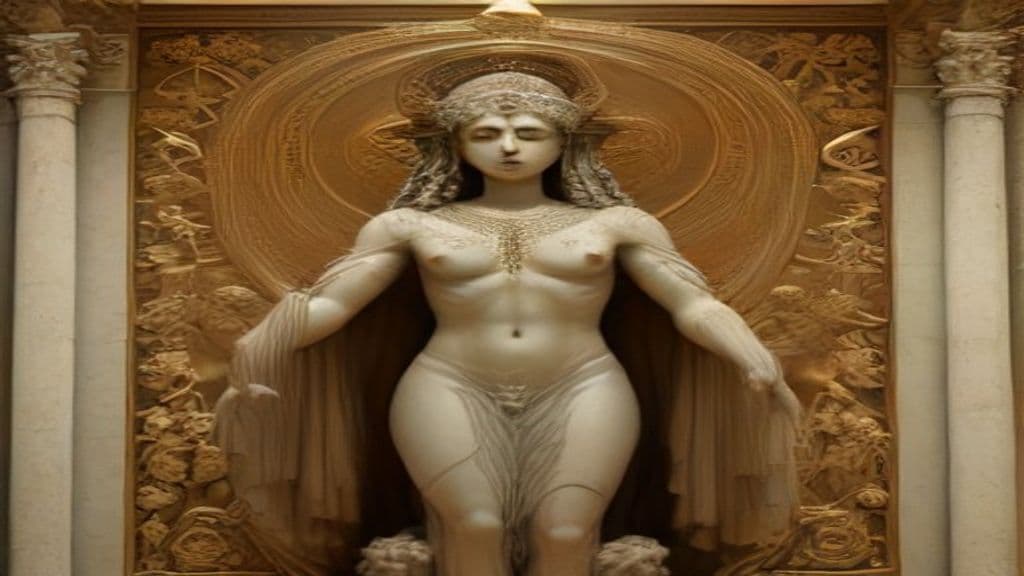
Linguistically, the English term derives from Old French deité and Latin deitatem/deitas, coined by Augustine from deus (Latin). The Latin deus is connected to Proto-Indo-European *deiwos, which also yields Sanskrit deva and Greek dios; these roots emphasize notions of brightness or 'shining' as conceptual space for divinity. Culturally, notions of deity vary widely: some systems posit a single supreme creator (theism/monotheism), others a pantheon of specialized divine personages (polytheism), while still other frameworks treat divinity as an impersonal principle or locate divine reality within the self (e.g., Upanishadic identifications of Atman with deva). (Source: etymology and comparative summary drawn from linguistic and encyclopedic treatments.)
There is no single authoritative physical description; deities are variously personified across traditions and may be male, female, hermaphroditic, genderless, or take non-human forms. Classical and comparative treatments show variation from anthropomorphic gods of Greek and Roman imagery to Indian temple icons and abstract divine principles. In ritual contexts, deity presence is frequently mediated by temple images, cult icons, or ritual embodiment (for example, classical Indian temple ritual and associated performing arts present the deity through iconography and the devotional presence of performers).
Deities are described as possessing powers greater than those of ordinary humans and as having authority over domains such as natural phenomena, ethical principles, human fortunes, and ritual efficacy. They may be petitioned, worshipped, invoked, or embodied in ritual and can function as cosmic agents, moral exemplars, or immanent spiritual realities. Depending on the tradition, deities range from benevolent to ambivalent or hostile; some traditions conceive of divine beings as subject to cosmological limits or ethical/ritual constraints rather than absolutely unlimited power.
Weaknesses
- otherNo universal weakness — traditions differ; some divine beings are limited by cosmological, ritual, or ethical constraints
Wards
None recorded.
Deioneus
Deioneus is an ancient Greek personal name borne by several mortal men in mythic genealogies and narratives (kings, princes, fathers, husbands). The name recurs in independent regional traditions (Phocis, Perrhaebia/Thessaly, Oechalia, Megara) and does not denote a single supernatural being.
Deiphobos
Deiphobos is a Trojan prince in Greek epic tradition, a son of Priam and Hecuba who fought in the Trojan War. Later epic and post-epic poets (Virgil, Chaucer in allusion) treat his household and fate among the episodes of Troy's sack; classical summaries also record him as a notable warrior who killed several named opponents.
Deiphobus
Deiphobus (Ancient Greek Δηΐφοβος) is a Trojan prince, son of King Priam and Hecuba, attested across Homeric epic and later Greek and Roman narratives as a warrior of the Trojan War. He appears in the Iliad among Trojan leaders, is given expanded roles in post‑Homeric sources (notably Euripides, Dares, Dictys, Malalas) and in Vergil’s Aeneid is depicted posthumously as a horribly mutilated corpse who recounts his death.
Deiphontes
Deiphontes (Ancient Greek: Δηϊφόντης) is a named mortal figure in Greek mytho-historical genealogies, presented as a Heraclid leader, husband of Hyrnetho, and founder/benefactor associated with a sanctuary at Epidaurus. Sources preserve competing traditions: some make him succeed Temenus at Argos with army support, while others report he settled at Epidaurus after Temenus' death and erected a sanctuary for his wife.
Deipyle
Deipyle (Ancient Greek Δηιπύλη) is a mortal woman of the Argive royal house in Greek myth, daughter of Adrastus and Amphithea, who in many accounts marries Tydeus and is cited as mother of the hero Diomedes. She functions primarily as a genealogical link in heroic narratives rather than as a supernatural being.
Deipylus
Deipylus is a personal name borne by three distinct mortal figures in Greek myth: a son of Jason and Hypsipyle associated with Lemnos, a Thracian prince of Polymestor and Iliona who is killed in a case of mistaken identity, and a minor Achaean warrior active in the Trojan War. The name functions in genealogical and epic narratives rather than as a supernatural or cultic being.
Delbáeth
Delbáeth (Delbáed; Modern Irish Dealbhaoth/Dealbhaodh) is a recurring personal name in medieval Irish mythological genealogies applied to multiple princely figures of the Tuatha Dé Danann/Fomorian world. Rather than a single consistently depicted being, Delbáeth appears as one or more ancestral/regnal figures—successors of the Dagda, fathers or ancestors of notable personages, and eponymous progenitors for historical septs such as the Delbhna.
Dellingr
Dellingr is an Old Norse divine figure personifying the coming of day (dawn) and is attested as the father of Dagr (Day) in medieval Eddaic and saga texts. His name appears in kennings and poetic formulas (notably "Delling's doors") that mark the threshold of sunrise; surviving sources treat him as an etiological/personified deity rather than a hostile spirit.
Delphus
Delphus (Ancient Greek: Δέλφος, Latinized Delphus) is an eponymous mythic ancestor credited in Greek mythographic traditions as the person from whom the town and sanctuary of Delphi were believed to have derived their name. He appears in variant genealogies as a son of Poseidon or of Apollo and as ancestor to regional rulers and oracle-associated figures such as Pythis and Phemonoe.
Delphyne
Delphyne (Ancient Greek Δελφύνη) is a female serpent (drakaina) of Greek myth tied to the sanctuary of Apollo at Delphi and to Typhonic myth. Early literary sources portray her as a large, pestilential she‑serpent slain by Apollo in the foundation-myth of the Delphic oracle; other traditions link her to Typhon as nurse or guardian of his spoils.
Delphyne Gorgon
Delphyne Gorgon is a fictional character from modern American comic books (Marvel Comics). Portrayed as an Amazon warrior, general and later queen with a Gorgon-derived physiology, she appears in The Incredible Hercules storylines and related Marvel continuity.
Demeter
Demeter is an Olympian goddess of ancient Greek religion who presides over agriculture, grain, and the fertility of the earth. She functions as a divine mother-figure and guardian of social customs, sacred law, and the cycle of life and death, and is central to the Eleusinian Mysteries alongside her daughter Persephone.
Community Record
- [1]Deity - Wikipedia. Wikipedia, 'Deity' article (overview of definitions, etymology, and cultural varieties)wiki
- [2]Mohiniyattam (archive text). Archive: Mohiniyattam (description of dance as temple ritual and devotional offering)other
- [3]Fishes, Flowers, & Fire as Elements and Deities in the Phallic Faiths & Worship… | Project Gutenberg. Project Gutenberg text (comparative scholarly treatment of deity imagery and cultic forms)literary
- [4]Studies Of Christianity, by James Martineau -- Project Gutenberg. Project Gutenberg (theological reflection on concept of deity in Christian thought)literary