
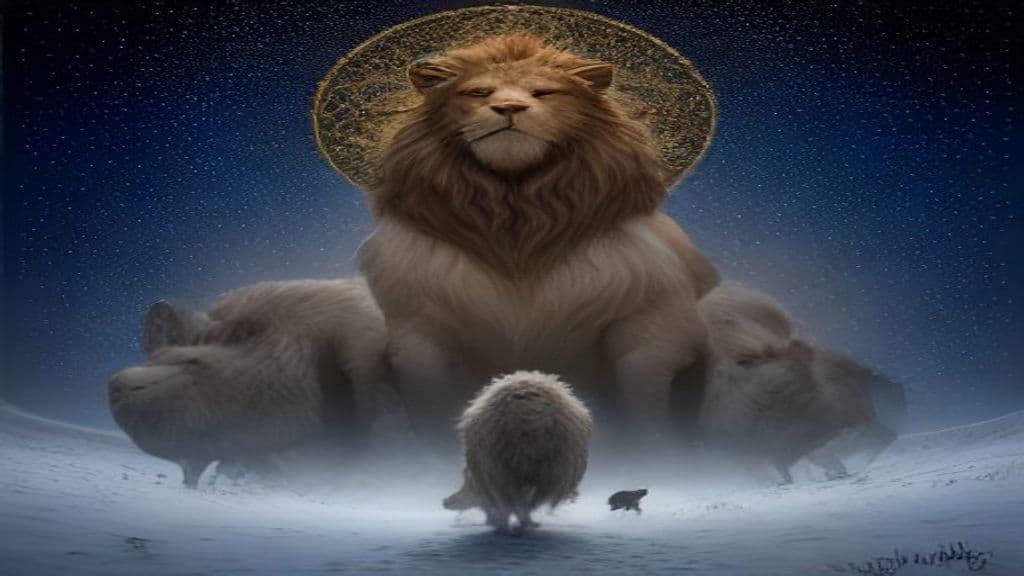
As presented in Lewis's narrative chronology, Digory Kirke is an Englishman born in 1888 whose childhood adventures (notably in 1900) bring him into other worlds via magic rings manufactured by his Uncle Andrew and the Wood between the Worlds. In The Magician's Nephew he is directly involved in awakening Jadis in Charn and, under Aslan's direction, retrieves an apple from a locked garden that secures Narnia and later yields wood for the wardrobe portal. Lewis's notes place a fatal railway crash in 1949 that kills Digory and others prior to their entrance into the renewed Narnia/Aslan's Country, an event reported as part of the fictional narrative.
Lewis's texts do not supply detailed physical measurements or exhaustive physical description. The character appears in two principal life stages in the sources: as a boy who undertakes the transworld adventures in The Magician's Nephew, and as an elderly country-house resident referred to as 'the Professor' in The Lion, the Witch and the Wardrobe. Film adaptations depict him at various ages, but those portrayals are adaptations rather than textual descriptions from Lewis's original works.
Digory is an ordinary human without inherent supernatural powers; his transworld travel is enabled by Uncle Andrew's magic rings and by travel through the Wood between the Worlds. He is granted permission by Aslan to retrieve an apple with curative/immortality properties and exercises moral agency in resisting temptation and obeying Aslan's instructions. His significance is narrative and moral rather than supernatural: his choices causally affect the history of Narnia (bringing Jadis into London; planting the apple core that later provides the wardrobe's wood).
Weaknesses
- conditionordinary human limitations (mortality, susceptibility to temptation)
- otherdependence on external magical devices and authorities (Uncle Andrew's rings, the Wood between the Worlds, and Aslan's permission)
Wards
- otheravoidance of Uncle Andrew's rings and the pools of the Wood between the Worlds (the sources note these are the means of translocation and sources of danger, but provide no canonical warding ritual)
Dido (Elissa)
Dido (also Elissa or Elishat/Elisha) is the legendary founder and first queen of the Phoenician settlement that became Carthage in Greek and Roman literary tradition. Her tale—flight from Tyre, clever acquisition of land by an oxhide trick, foundation of Byrsa, and death on a funeral pyre—appears in Hellenistic historiography and Roman epic and is used etiologically to explain Carthage's origins.
Dies
Dies is the Roman personification of Day, treated in literary and encyclopedic sources as the counterpart of the Greek Hemera and as a divine figure in genealogical accounts of cosmic forces.
Dietrich (tradition)
Dietrich is not presented in the supplied sources as a supernatural being but as an ancient Germanic dithematic personal name meaning 'ruler of the people', used historically as both a given name and a surname and appearing in literary tradition as the name of legendary heroes such as Dietrich von Bern.
Dietrich von Bern
A legendary Germanic heroic figure formed by the folkloric transformation of the historical Ostrogothic king Theoderic the Great; he appears across medieval heroic poems and sagas as an exiled king of 'Bern' (medieval Verona), a great warrior, and opponent of both human and monstrous foes.
Dievas
Dievas (Lithuanian; Dievs in Latvian; Diews in Old Prussian) is the primordial supreme sky deity in Baltic religion, understood as the luminous sky-dome, a creator and ruler of gods, and a god of light, prosperity and time. The lexeme is a Baltic reflex of Proto-Indo-European *Dyēus and, following Christianization, the same word came to denote the Christian God.
Dievs (Dievas)
Dievs (Latvian Dievs; Lithuanian Dievas) is the primordial sky‑father of the Baltic traditional pantheon, presented in sources as a supreme luminous sky power, creator and ruler of the gods, and associated with light, prosperity, and cosmic order. The theonym survives in modern Latvian language and civic/religious usage but the supplied corpus gives little on specific myths, iconography, or ritual praxis tied to the pre‑Christian figure.
Dii Consentes
A canonical Roman grouping of twelve principal deities (six male, six female) honored collectively as a harmonized council of major gods. Attested in Roman literary and antiquarian sources and represented in public statuary and a dedicated portico, the Dii Consentes function as an ordered roster of the chief divine personages rather than a singular mythic agent.
Dilong (地龍)
Dilong (地龍; dìlóng, "earth dragon") is a category-name in Chinese dragon taxonomy denoting dragons associated with the earth/ground. The term is polyvalent in sources: it designates an earth-associated dragon-type in cosmological and omen literature, and by analogy names earthly animals (notably the earthworm) used in materia medica.
Dimoetes
Dimoetes (Ancient Greek: Διμοίτης, sometimes spelled Thymoetes in manuscripts) is a mortal figure in Greek mythic narrative, known from a Hellenistic-era love-tragedy compilation. His story, preserved in Parthenius' Sorrows of Love (attributed to earlier author Phylarchus), presents him as a tragic lover whose obsessive attachment to a corpse ends in his suicide.
Dinadan
Dinadan is a fictional human knight of Arthurian romance, a member of King Arthur's Round Table best known as a pragmatic, comic, and cynical foil—especially to Tristan—appearing in the Old French Prose Tristan, later continuations, and Thomas Malory's Le Morte d'Arthur. He is portrayed as a competent but reluctant warrior, a teller of satirical commentary on chivalry and courtly love, and is killed in Malory during the internal collapse of Arthur's court.
Dinah Soar
Dinah Soar is a fictional superpowered humanoid pterosaur appearing in American Marvel Comics, a founding member of the Great Lakes Avengers who possesses high-speed flight, a hypersonic/inaudible voice, and an empathic calming rapport. She was introduced in 1989 and is portrayed as born in the Savage Land with her precise lineage unrevealed.
Dingir
Dingir (Sumerian DIĜIR, 𒀭) is a Sumerian cuneiform sign and word that functions as an ideogram for sky/heaven and as a logogram/determinative for divinity (god/goddess). It is a written/symbolic category in Sumerian and later Mesopotamian orthographies rather than an agentive supernatural being.
Community Record
- [1]Digory Kirke - Wikipedia. Wikipedia: Digory Kirkewiki
- [2]Digory Kirke - Wikidata. Wikidata: Q2386582wiki