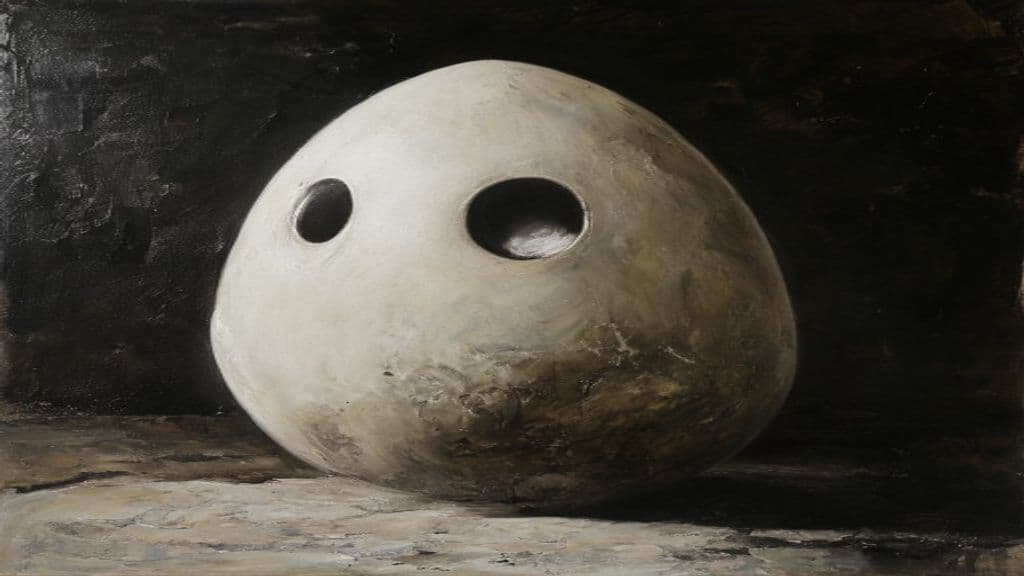
The Egg ghost has no arms, legs, nor a head, and lacks eyes, nose, or mouth. Its appearance is solely that of an egg-like form.
According to legend, when a person sees an Egg ghost, they will die. This suggests that the entity has a malevolent presence or power over human life.
Weaknesses
- unknownincorruptible personalities
Wards
None recorded.
Edward Mordake
A late-19th-century apocryphal case popularized in sensational journalism and medical miscellany describing a supposedly well-born Englishman born with a second, allegedly malign face on the back of his head. Modern researchers treat the account as a likely hoax or urban legend rather than a documented historical or folkloric supernatural being.
Edward Tregear
Historical figure, not considered a supernatural entity in Māori tradition. (Note: * The Power tier should be "Primordial" as Edward Tregear is a historical figure, implying no supernatural abilities or powers. * The Appearance section should indicate that there is no physical descr)
Eeyeekalduk
Eeyeekalduk is identified in multiple compiled references as an Inuit supernatural figure associated with medicine, healing, and good health. The available sources list the name among Inuit deities or pantheons but provide no primary ethnographic detail about myths, rituals, or iconography.
Efnisien
Efnisien (also spelled Efnysien or Efnissien) is a human royal figure in the medieval Welsh Second Branch of the Mabinogi (Branwen ferch Llŷr). Presented as an explosively violent and disruptive kin whose cruelty precipitates international war, he ends the tale by sacrificing himself to destroy a magical cauldron used by the Irish to revive the dead.
Egbere
Malevolent humanoid supernatural beings in Yoruba mythology, residing in woods and active only at night. (Note: 1. Power tier should be Greater (powerful regional) based on the description as malevolent beings residing in woods. 2. Abilities need more specific information, such as their connection to darkness o)
Egeria
Egeria is a Roman nymph of springs and sacred groves, cast in legend as the divine consort and counselor of Numa Pompilius who imparted laws and ritual forms to Rome's foundational king. She functions as a local tutelary female deity associated with the origin of Roman rites rather than as a cosmic power or a hostile spirit.
Eggþér
A jötunn figure in the Old Norse poem Völuspá who sits upon a mound striking a harp and is portrayed as joyful at the onset of Ragnarök; presented as the herder associated with a female jötunn of Járnviðr who raises wolves descended from Fenrir.
Eglė the Queen of Serpents (Žilvinas)
A central figure of a Lithuanian folktale in which a speaking serpentine ruler—called the grass-snake/serpent prince Žilvinas—marries the human maiden Eglė, keeps an underwater palace and household, can be summoned by a secret chant, and whose story culminates in human→tree metamorphoses after betrayal.
Ego the Living Planet
Ego the Living Planet is a fictional sentient planet created for American comic-book mythology (Marvel Comics) by Stan Lee and Jack Kirby. Presented as an individual, planetary-scale organism, Ego appears across Marvel cosmic stories as a thinking, willful celestial body that can interact with gods, heroes, and galactic civilizations.
Egregore
A polyvalent Western‑esoteric concept naming an emergent, non‑physical collective form produced by sustained coordinated thought, will, ritual, or activity of a group. Usage ranges from a descriptive term for a 'collective mind' to a belief in a semi‑autonomous spiritual entity nourished by group devotion, and in contemporary discourse is often used metaphorically for organized online or political phenomena.
Egremus
Egremus is a named mortal figure in Greek myth attested only as a combatant who fell in the war between Eumolpus and Eleusis. He is identified by the patronymic 'son of Eurynomus' and appears only in genealogical/war-list context in the cited source.
Egungun (ancestral masquerade spirits)
Egungun refers both to Yoruba masked, costumed masquerades and to the collective force of departed ancestors who manifest through those masquerades. In performance the layered costumes are treated as a dwelling for ancestor presence; egungun appear periodically—especially at annual festivals—to remember the dead, bless the community, and mediate between the living and the otherworld.
Community Record
- [1]Egg ghost. Wikipedia Article: Egg Ghostwiki